
Lieferung heute & morgen

Qualitätsgarantie

Willkommens-Angebote freischalten: KOSTENLOSE Lieferung | Bis zu 80 % RABATT | Kostenlose 30-Tage-JoyPlus-Testphase
App herunterladen
Purchasing a 4K dash cam might seem straightforward at first. The reality, however, is that many drivers are left disappointed by exaggerated marketing claims and hidden flaws. A high-resolution video is useless if the critical detail is blurry at the wrong moment or the recording fails entirely. As your Joybuy Product Recommendation Officer, I'm here to help you identify the common pitfalls and make an informed decision.
Before we dive into the important features, let's shed light on the problems that often only become apparent after the purchase.
To avoid these pitfalls, focus on the following verifiable technical specifications.
A native 4K resolution (3840 x 2160 pixels) offers four times the detail of Full HD. This isn't a luxury, but a necessity for clearly identifying license plates, even from a distance or while in motion. Pay close attention to the specific image sensor used. Sensors like the Sony STARVIS 2 are renowned for their high light sensitivity and excellent image quality, especially in low-light conditions. High resolution without a high-quality sensor is ineffective.
Accidents don't always happen from the front. A single, forward-facing car camera will leave you in the dark during rear-end collisions, side impacts, or acts of vandalism.
Modern dash cams offer more than just video recording. Features like GPS and Wi-Fi are extremely practical.
Instead of a one-size-fits-all recommendation, we've selected models tailored to specific needs and user profiles.
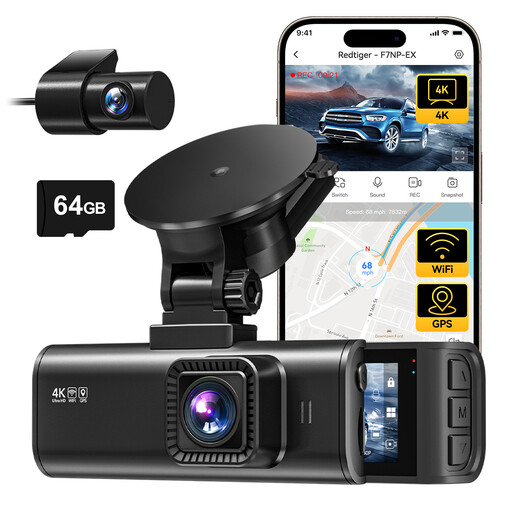
Why it's a match: Ideal for daily commuters and families who need reliable front and rear documentation. The combination of a 4K front camera and an HD rear camera covers the most common accident scenarios without overwhelming users with superfluous features.
This model offers true 4K resolution at the front, not just an upscaled image. The dual-channel system also provides more comprehensive evidence than a simple front-facing camera, offering effective protection in rear-end collisions.
Integrated GPS and 5.8 GHz Wi-Fi for fast data transfer and seamless recording of route data without extra modules.
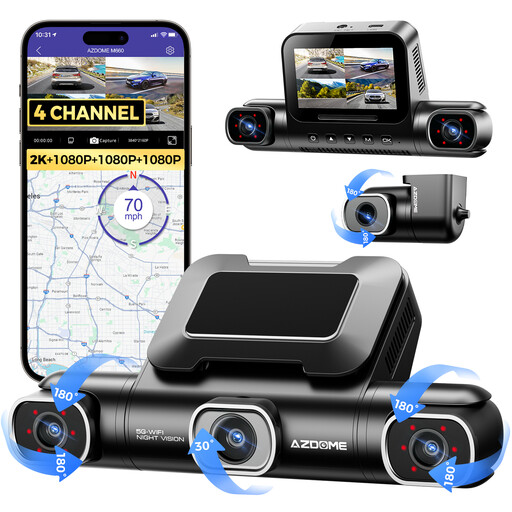
Why it's a match: Perfect for tech-savvy vehicle owners who want gapless surveillance of their vehicle. The four-camera system leaves no blind spots and is ideal for tight urban parking conditions and for protection against vandalism from all angles.
This model goes far beyond standard parking surveillance, offering true 360-degree dash cam coverage. The integrated eMMC storage is also more reliable and faster than conventional SD cards, minimising the risk of data loss.
True 4-channel recording for complete 360° vehicle coverage and integrated 128 GB eMMC storage for enhanced data security and speed.
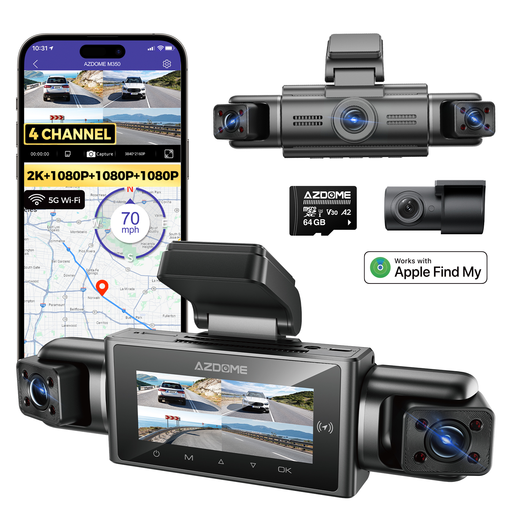
Why it's a match: Specifically designed for users deeply integrated into the Apple ecosystem. The native "Find My" integration allows for global vehicle tracking without additional subscriptions or apps—a unique feature for security-conscious individuals who want to keep an eye on their vehicle at all times.
While many dash cams only embed GPS data in the video, this model integrates directly into Apple's "Find My" network. This provides a robust and familiar tracking solution that goes far beyond mere GPS logging.
World's first dashcam with native Apple "Find My" network integration for global vehicle tracking directly through the familiar Apple app.
We have compiled a complete, up-to-date list of products that fully meet these strict selection criteria and rigorous safety standards.
Yes, using a dash cam to document accidents is generally permitted in Germany. However, compliance with the General Data Protection Regulation (GDPR) is crucial. Permanent, indiscriminate recording of public spaces is not allowed. For this reason, all modern dash cams use loop recording, which automatically overwrites old footage. Only in the event of an incident (e.g., triggered by the G-sensor) is a short clip permanently saved. Publishing footage where individuals or license plates are identifiable is prohibited without their consent.
For reliable 24-hour parking surveillance, the dash cam must be continuously powered without draining the car battery. This is achieved using a hardwire kit. It connects directly to the vehicle's fuse box and includes a battery monitor that cuts off power before the car battery's voltage drops to a critical level. Installation should be performed by a qualified professional or a workshop. Such a kit is often a separate accessory.
4K recordings generate large files. A single minute of video can take up several hundred megabytes of space. Therefore, a high-quality, sufficiently large memory card is essential. Look for microSD cards with high speed ratings (Class U3/V30 or higher) and a capacity of at least 64 GB, or preferably 128 GB or 256 GB, to ensure smooth recording. However, thanks to the loop recording feature, you don't have to worry about the memory filling up; the camera automatically overwrites the oldest, unsaved files.