
Lieferung heute & morgen

Qualitätsgarantie

Willkommens-Angebote freischalten: KOSTENLOSE Lieferung | Bis zu 80 % RABATT | Kostenlose 30-Tage-JoyPlus-Testphase
App herunterladen
Today, buying a car camera is about more than just recording your road trips. For many drivers, it has become a crucial tool for securing evidence in the event of a traffic accident. A 4K front and rear dash cam provides the necessary detail to clearly document license plates and events, even in challenging light conditions.
This article serves as your guide. We'll explain the key features of modern dual dash cams and present a selection of top models to help you make an informed purchasing decision.
The market is flooded with options, but a few key technical features are critical for reliable performance.
High resolution is essential for usable footage. 4K (3840 x 2160 pixels) on the front camera has become the standard for high-end models, as it allows for capturing details like license plates from a greater distance. However, don't just focus on the pixel count. The image sensor is just as crucial for image quality, especially in the dark. Models equipped with a Sony STARVIS sensor are known for their high light sensitivity and deliver enhanced dash cam night vision. A good 4K car camera combines both for optimal results, day and night.
Modern dash cams offer more than just recording while you drive.
A classic dual dash cam consists of two channels: one camera for the front and one for the rear. This setup covers the most common accident scenarios. For even more comprehensive protection, there are 3-channel dash cams. These systems, also known as front, rear, and interior dash cams, include an additional camera that records the vehicle's cabin. This can be particularly useful for taxi drivers, ride-sharing services, or families who want to keep an eye on the interior.
Based on the criteria above, we've compiled a selection of models that stand out for their technical specifications and feature sets.
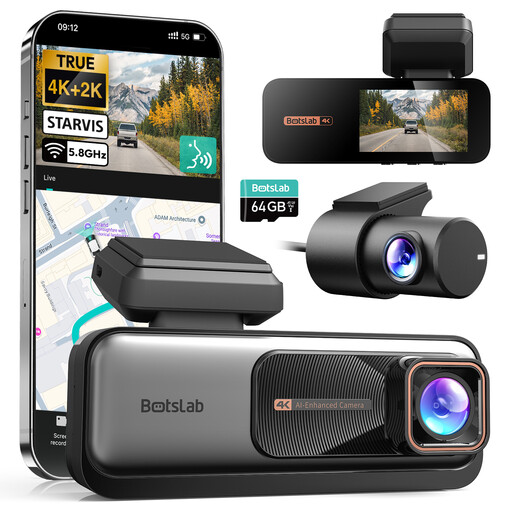
What sets it apart: This model combines a front camera with true 4K resolution, based on a Sony IMX415 STARVIS sensor, with a 2K rear camera. The ultra-wide angles of 170° front and 150° rear provide broad coverage of the traffic scene. A standout feature is its AI-powered ADAS (Advanced Driver-Assistance Systems), which warns of potential collisions, lane departures, and pedestrians.
Pros:
Who it's for: Drivers who value high-resolution recordings alongside modern, AI-based safety alerts and straightforward app control.

What sets it apart: The DDPAI Z60 Pro uses a combination of two high-quality Sony sensors: the STARVIS 2 IMX678 for the 4K front camera and the IMX662 for the 1080p rear camera. Both cameras support HDR (High Dynamic Range), which, according to the manufacturer, ensures more balanced images in difficult lighting conditions. A special feature is its dual storage, consisting of 32GB of internal eMMC and a microSD card slot.
Pros:
Who it's for: Tech-savvy users who appreciate excellent image quality from the latest sensor technology, flexible storage options, and the possibility of remote access via 4G.
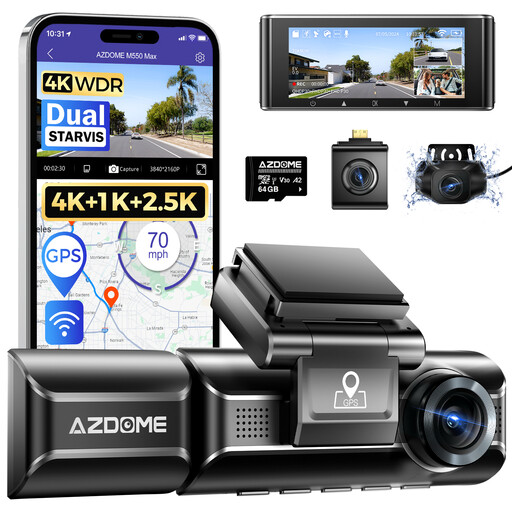
What sets it apart: The AZDOME M550 Max is a 3-channel dash cam that provides complete surveillance of the front, rear, and vehicle interior. It records simultaneously in 4K (front), 1080p (rear), and 2.5K (interior). The interior camera is equipped with 6 infrared LEDs to deliver clear images even in complete darkness.
Pros:
Who it's for: Ideal for professional drivers (taxi, ride-sharing) or families who want complete 360-degree documentation of events both inside and outside the vehicle.
The models presented cover common user needs. However, if you're looking for cameras with different features, such as models with alternative power options for more flexible use, it's worth exploring other products.
Discover a wider selection in our battery wifi camera category.
1. Is it legal to use a dash cam? Yes, using a dash cam to document your driving is generally permitted in many regions, but laws vary. In jurisdictions like the EU, usage is subject to strict data protection regulations like the GDPR. Recordings may be admissible as evidence in court. Permanent, indiscriminate recording is not allowed. Modern dash cams address this with a loop recording function (overwriting old footage), where a clip is only permanently saved if an event is detected (e.g., by the G-sensor).
2. What is the advantage of a supercapacitor over a battery? Compared to a standard lithium-ion battery, a supercapacitor is significantly more resistant to extreme temperatures. A car parked in the sun during summer can reach very high internal temperatures, which can be problematic for batteries. Supercapacitors offer greater operational reliability and a longer lifespan in these conditions, making them the more dependable choice for dash cams.
3. Does a dash cam with Parking Mode always need a hardwire kit? In most cases, yes. To ensure continuous monitoring while parked, the dash cam needs a constant power source. A hardwire kit connects directly to the vehicle's fuse box. It not only provides power but also typically includes a battery monitor to prevent the car's battery from being completely drained.