
Lieferung heute & morgen

Qualitätsgarantie

Willkommens-Angebote freischalten: KOSTENLOSE Lieferung | Bis zu 80 % RABATT | Kostenlose 30-Tage-JoyPlus-Testphase
App herunterladen
Finding the right dash cam can be a challenge, given the vast array of models and features available. Many drivers want a reliable way to document their journeys, whether for evidence after an accident or to protect against vandalism on a parked vehicle. This article serves as a guide, presenting objective criteria and a selection of models to help you make an informed decision.
Before you make a decision, you should consider several technical specifications and features that are crucial for the quality and utility of a car camera.
Video resolution is a key factor in the level of detail in your recordings. While Full HD (1080p) is sufficient for many situations, a 4K dash cam offers significantly higher clarity. This can be decisive for clearly identifying license plates or street signs, even from a distance or at high speeds.
Performance in low-light conditions is just as important. Good dash cam night vision is often achieved through high-quality image sensors (e.g., from Sony STARVIS) and technologies like HDR (High Dynamic Range). HDR balances strong contrasts between bright and dark areas of the image, ensuring a well-exposed and clear picture during night drives or in tunnels.
Modern car cameras offer more than just basic video recording.
The most common models are single cameras that record the events in front of the vehicle. For more comprehensive protection, there are systems that combine a front and rear car camera. These dual-channel solutions also document traffic behind you, which can be invaluable in rear-end collisions. Some models even offer a third channel to monitor the vehicle's interior, which can be particularly useful for ride-sharing drivers or families.
Here is a selection of models that cater to different needs and use cases. The descriptions are based on product data provided by the manufacturer.
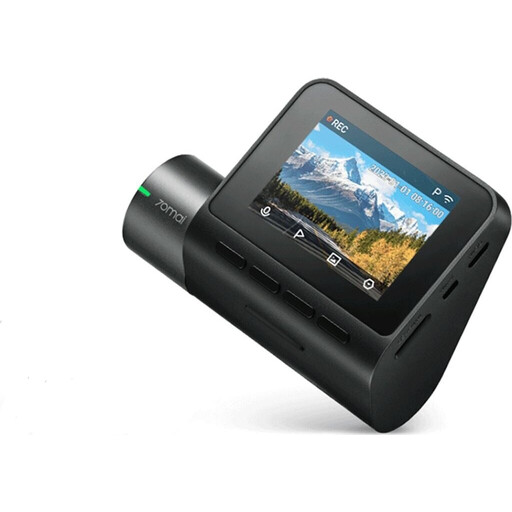
What sets it apart: The A200 stands out with its high frame rate of 60 frames per second (FPS) at 1080p resolution. This ensures exceptionally smooth recordings and reduces motion blur, improving the legibility of details during fast-paced driving. HDR technology and the proprietary "Night Owl Vision" optimise image quality in difficult lighting conditions.
Key Features:
Who it's for: This model is an excellent choice for drivers who want a reliable, high-quality front camera for their daily commute and value smooth video playback, but do not require 4K resolution or a rear camera.
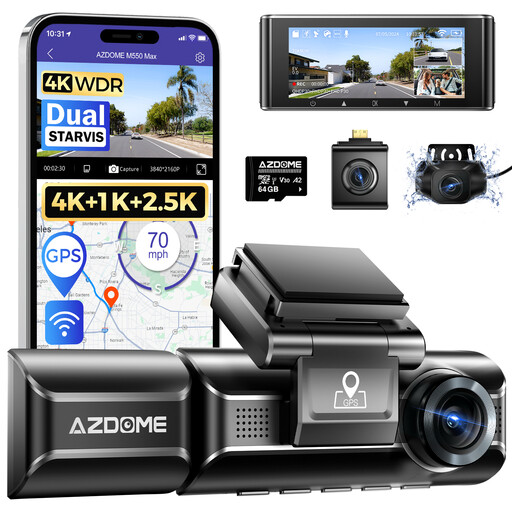
What sets it apart: The AZDOME M550 Max offers comprehensive surveillance with three channels: a 4K front camera, a 2.5K rear camera, and a 1080p interior camera. Equipped with two STARVIS sensors and WDR technology, it aims for clear image quality day and night. A convenient detail is the included 64 GB memory card.
Key Features:
Who it's for: Ideal for users who want seamless 360-degree surveillance of their vehicle. This includes professional drivers, families, and anyone looking to secure the traffic around them as well as the interior and rear of their car.
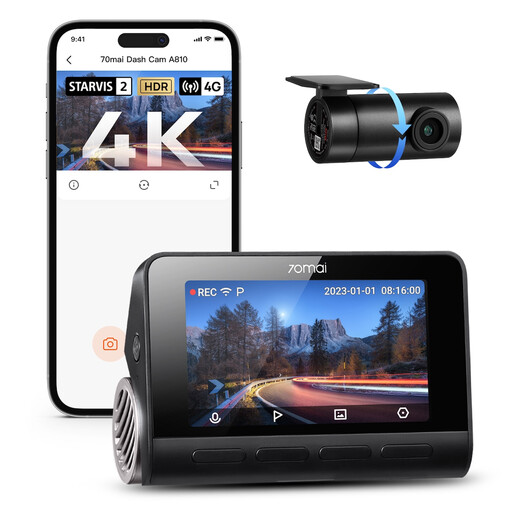
What sets it apart: This dual-channel system combines true 4K resolution with the advanced Sony STARVIS 2 IMX678 image sensor for the front camera. According to the manufacturer, this ensures outstanding image clarity and colour accuracy. The dual-HDR function for both the front and rear cameras enhances recording quality in high-contrast lighting. Another feature is the AI-powered motion detection for parking surveillance. The manufacturer states that in 2024, the model was rated "Good" by the magazines Autobild.de and Computerbild.de.
Key Features:
Who it's for: This model is aimed at tech-savvy users who demand the highest image quality day and night and want to utilise advanced features like intelligent parking surveillance and driver-assistance systems.
The products presented here already cover a broad spectrum. If you haven't found the right device for your specific needs, you can find a larger selection of car cameras and related accessories in our SD Card Camera category.
Yes, the use of a dash cam is generally permitted in Germany. Recordings may be used to document the circumstances of an accident. However, their use is subject to the strict requirements of the General Data Protection Regulation (GDPR). Permanent, indiscriminate recording of public spaces is not allowed. Many cameras solve this issue with a loop recording function, where data is stored only for a short period and saved permanently only in the event of an incident (e.g., triggered by a G-sensor).
Loop recording is a standard feature on modern dash cams. The camera records video in short segments (e.g., 1, 3, or 5 minutes). Once the memory card is full, the camera automatically starts overwriting the oldest, unlocked recordings. This ensures continuous recording without needing to manually clear the memory card. Important events detected by the G-sensor are locked in a separate folder and protected from being overwritten.
Yes, for most advanced parking surveillance modes, a hardwire kit is required. This kit connects the dash cam directly to the vehicle's fuse box, supplying it with power even when the ignition is off. It also includes a battery monitor that prevents the car battery from being drained too deeply. Without such a kit, parking surveillance typically only works as long as the camera is powered via the cigarette lighter, which in most vehicles is only active when the engine is running.