
Lieferung heute & morgen

Qualitätsgarantie

Willkommens-Angebote freischalten: KOSTENLOSE Lieferung | Bis zu 80 % RABATT | Kostenlose 30-Tage-JoyPlus-Testphase
App herunterladen
A dashcam can document your journeys, make accident sequences traceable, and provide additional footage while parked. However, not every car camera is suitable for every vehicle. High resolution claims, app features and terms like "night vision" may look convincing at first glance, but on their own they say little about everyday usability.
4K sounds impressive, but the actual recording quality also depends on the image sensor, lens quality, data compression and lighting conditions. A 4K dashcam can deliver fewer usable details in backlight or at night than a model with lower resolution and a well-matched sensor.
So don't just look for "4K" – also consider:
A dashcam with parking surveillance often requires a separately available hardwire kit to connect to the vehicle's electrical system. The standard 12-volt socket switches off with the ignition on many vehicles and does not provide continuous power to the camera when parked.
Before buying, you should check:
On some models, the parking mode is explicitly only activated with an additional connection cable.
4K and multi-channel recordings require a lot of storage space. Loop recording overwrites older, unprotected files once the memory card is full. Footage that the G-sensor locks after an impact is normally preserved. A compatible microSD card with sufficient write speed is nevertheless crucial.
Also practical are dashcams with WiFi, app control and voice control. They allow you to preview and transfer videos without having to remove the memory card. Check whether the app is compatible with your smartphone and which functions actually run locally or via the cloud.
For many commuters and families, a 4K dashcam front and rear makes sense, as it records traffic both in front of and behind the vehicle. A rear camera can also assist when reversing, but it does not automatically replace an approved reversing camera.
If you want to document side areas and the interior, you can choose a multi-channel or 360-degree dashcam. However, the installation effort increases: additional cameras must be correctly positioned and cables discreetly routed.
A dashcam with GPS can record speed, time and route in the video data. This is practical for later assigning a recording. The G-sensor detects abrupt movements and can protect event files from being overwritten.
An ADAS dashcam can, depending on the model, provide warnings about lane departure, forward collision risk or the vehicle ahead moving off. Such warnings are technical assistance functions and not a guarantee of accident prevention. Responsibility remains with the driver.
The term dashcam with night vision covers different technologies. Pay attention to details about HDR, WDR, lens aperture and sensor. Inside the cabin, infrared LEDs can be helpful, while for external recordings, light processing and handling of headlight reflections are what really count.
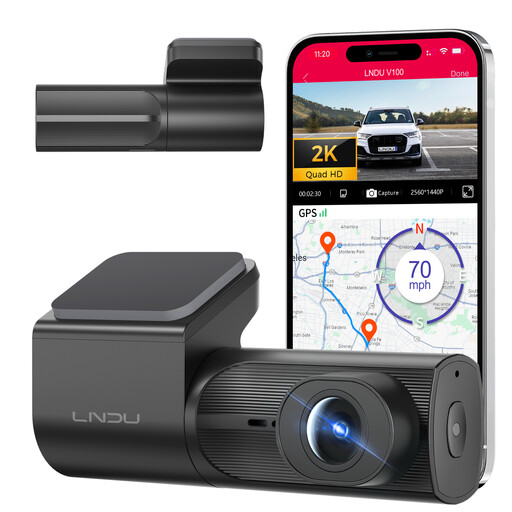
Why this product fits the profile: The compact front camera offers 2K recording, WiFi, app control and basic event protection for drivers looking for a straightforward set of features.
The technical specifications explicitly mention loop recording, G-sensor and the necessary separate hardwire solution for parking mode.
2K front recording, built-in WiFi, app management and support for event locking.
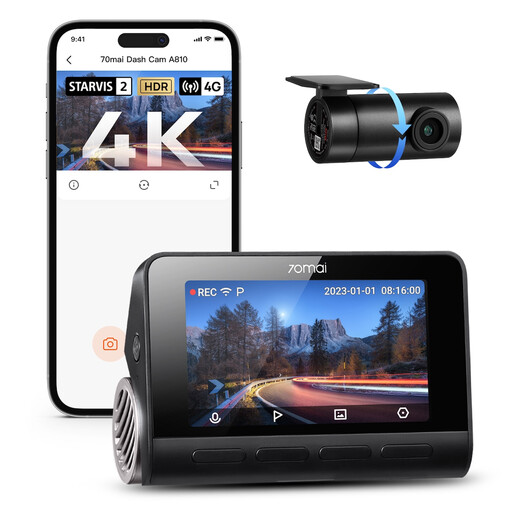
Why this product fits the profile: The combination of a 4K front camera, 1080P rear camera, Sony STARVIS 2 IMX678, HDR and GPS is aimed at frequent drivers and commuters with high demands for documented detail.
The front and rear resolutions are stated separately. The required hardwire kit for 24-hour parking surveillance is also explicitly indicated.
4K front recording, STARVIS 2 sensor, HDR, GPS, ADAS and app control with loop recording.
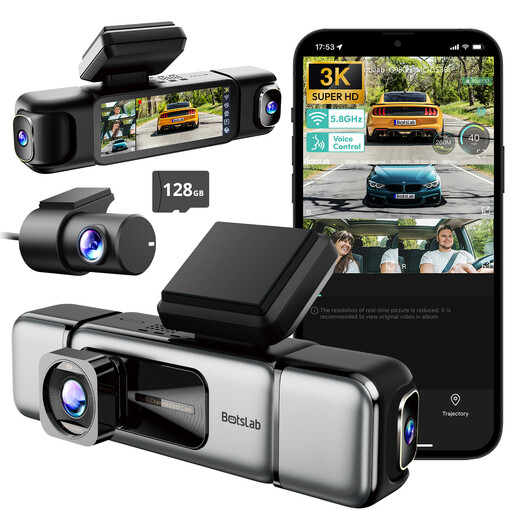
Why this product fits the profile: Four channels with front, side and rear recording are suitable for taxi and ride-sharing drivers as well as vehicle owners who want to record multiple areas simultaneously.
The system specifies the individual viewing angles and resolutions. For parking mode, the required hardwire installation is noted.
3K front camera, three additional perspectives, built-in GPS, 5.8 GHz WiFi, voice control and multiple parking modes.
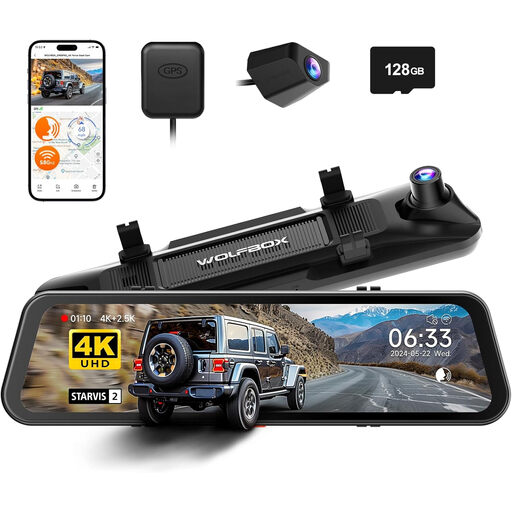
Why this product fits the profile: The mirror housing combines a 4K front recording with a 2.5K rear camera and could be of interest for larger vehicles, family cars or frequent motorway journeys.
Resolution, storage capacity and GPS are concretely stated. The included 128 GB card reduces additional purchasing steps.
12-inch mirror display, 4K front, 2.5K rear, 128 GB memory card, GPS, WiFi, voice control and G-sensor.
A dashcam should be set up so that it does not permanently and indiscriminately record all public traffic. Use the shortest possible, overwritable sequences and only save relevant event recordings. Before using it, inform yourself about data protection requirements and the specific situation in your vehicle.
The camera must not obstruct the field of vision. Cables must not be routed in the deployment zone of airbags. For a rear camera, the cable routing to the tailgate must be movement-proof and neatly executed.
We have compiled a complete, regularly updated list of products that fully meet these strict selection criteria and the safety regulations applicable in the EU.
In addition to the purchase price, you may need a microSD card, a hardwire kit and possibly installation costs. For 4K or multi-channel recordings, the memory card should be suitable for high write loads – a U3 card is often recommended. Check the manufacturer's specifications for the maximum capacity.
The front camera is usually attached behind the rear-view mirror, without obstructing the field of vision. The cable can be routed along the edge of the windscreen and the A-pillar to the 12-volt socket. For parking surveillance, a connection to the fuse box is often required. If you are unsure, the installation should be carried out by a professional.
The lifespan depends on temperature, power supply, memory card and usage. Models with a supercapacitor are designed for high temperature ranges. Nevertheless, the camera, cables and memory card should be regularly checked for correct function, and important recordings should be backed up additionally.