
Lieferung heute & morgen

Qualitätsgarantie

Willkommens-Angebote freischalten: KOSTENLOSE Lieferung | Bis zu 80 % RABATT | Kostenlose 30-Tage-JoyPlus-Testphase
App herunterladen
A dashcam for your car can document your journeys and capture important footage in the event of an accident or parking damage. However, choosing one isn't just about resolution. Specs like 4K, 360° view or "night vision" each only describe part of the actual feature set.
If you only focus on marketing claims, you'll often overlook three key points. First, a high-resolution camera needs a compatible memory card and sufficient storage space. Second, a dashcam with parking surveillance usually isn't ready for continuous use without an additional power supply. Third, a wide-angle lens can capture more of your surroundings, but it can also distort details at the edges of the image more noticeably.
A 4K dashcam generates large video files. Without a suitable MicroSD card, you may experience recording interruptions, error messages or a shorter recording duration. Pay attention to the capacity and speed class specified by the manufacturer. Many models require a U3 Class 10 card; often, one isn't included in the box.
Built-in storage is also no complete substitute for checking the specifications. What matters is whether the camera automatically overwrites older, unprotected files when the card is full and saves emergency footage separately.
A dashcam with parking surveillance usually requires a hardwired cable set to record when the ignition is off. This so-called hardwire kit is typically sold separately and connected to the fuse box. Also check whether voltage protection is included. This is designed to prevent the vehicle battery from being drained too much during long periods of inactivity.
Devices with a lithium battery or supercapacitor have different operating and temperature conditions. A supercapacitor may be rated for certain temperature ranges according to the product specs, but this doesn't automatically mean it's suitable for every vehicle or installation scenario.
A front and rear dashcam covers two directions of travel. A 360° dashcam or 4-channel dashcam can additionally capture the sides or the interior. This means more cables need to be routed, cameras correctly aligned, and files managed. In vehicles with airbags in the A-pillars, the cable routing must not interfere with their deployment zone.
For the front camera, 2K or 4K are common specifications. A 2K dashcam can be sufficient for daily commuting, while 4K can capture more image detail in good light. The actual visible quality also depends on the lens, sensor, compression, lighting and a clean windscreen.
A higher frame rate, for example 60 frames per second, can represent motion more smoothly. However, it usually increases storage requirements. So always check the combination of resolution, frame rate and maximum memory card capacity.
A wide viewing angle captures more of the road, but can produce stronger perspective distortion at the edges. Concrete figures like 130°, 140° or 170° are more helpful for your choice than vague terms like "full view".
With a front and rear dashcam, you should also consider the rear camera's resolution. Not every 4K system records in 4K at the rear as well. With a 4-channel dashcam, the resolutions of the side and interior cameras are also relevant.
A dashcam with night vision uses light-sensitive sensors, larger apertures, WDR or HDR, depending on the model. These features can balance contrast in tunnels, against bright light and in the dark. However, a clear recording still depends on street lighting, dirt and reflections from the windscreen.
A dashcam with a G-sensor detects sudden movements or impacts and can protect the corresponding file from being overwritten. Check whether the sensitivity is adjustable, as cobblestones or harsh road bumps can also trigger a lock.
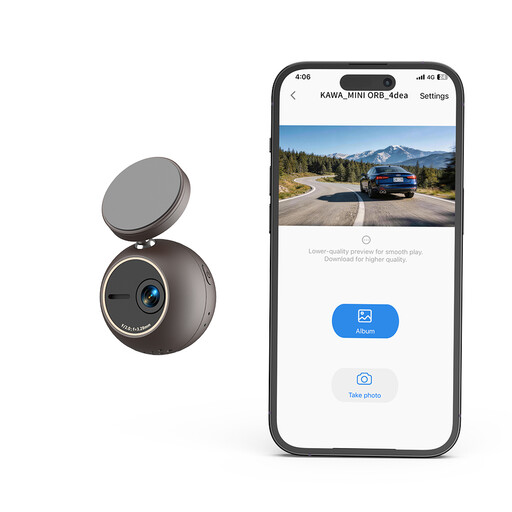
Why this product fits the profile: This compact front camera offers 2K recording, Wi-Fi, voice control and a 360° rotatable mount. It's suitable for drivers looking for a straightforward feature set for everyday use.
The 2K spec isn't the only feature: G-sensor, app connectivity and night recording are listed as concrete functions. Before buying, you'll still need to check the memory card and power supply.
2K resolution, built-in Wi-Fi, voice control and 24-hour parking surveillance according to the product spec.
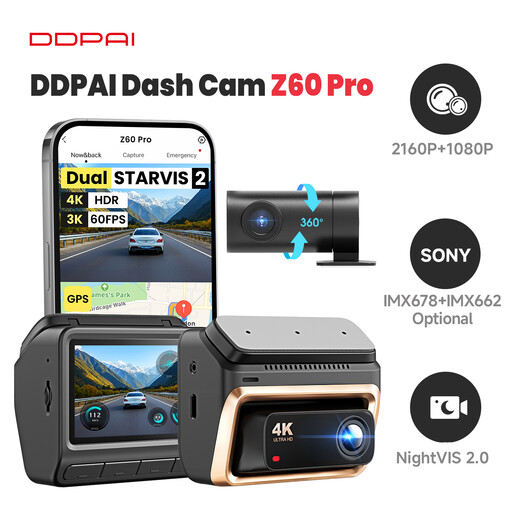
Why this product fits the profile: This two-channel system combines 4K at the front with 1080p at the rear, GPS, 5 GHz Wi-Fi and Sony STARVIS 2 IMX678 and IMX662 sensors. It appeals to commuters and frequent drivers who want to manage front and rear footage.
The rear camera is explicitly specified at 1080p. This makes it easier to assess the actual channel distribution, rather than just assuming from the 4K front camera.
4K HDR front recording, GPS, 5 GHz Wi-Fi, built-in 32 GB eMMC storage and support for parking surveillance with a hardwire kit.
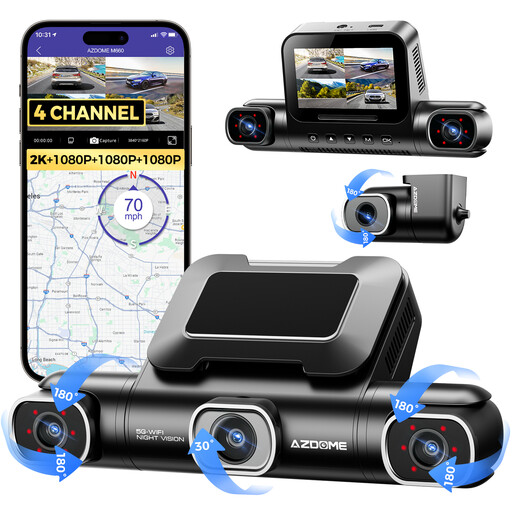
Why this product fits the profile: Four camera channels capture the front, rear and side areas according to the product spec. GPS, 5 GHz Wi-Fi, voice control and multiple parking modes suit taxi, hire car and vehicle owners with a higher need for documentation.
The resolution is split by channel: 2.5K at the front and 1K for the three additional cameras. For the parking modes, a separately available hardwire kit is required according to the spec.
Four-channel recording, built-in GPS, 5 GHz Wi-Fi, IR night vision and 24-hour parking modes according to the product description.
We've put together a complete, regularly updated list of products that fully meet these strict selection criteria and the safety regulations in force in the EU.
A dashcam should be set up so that it doesn't continuously record all traffic activity without cause. Short, overwritable sequences and automatic saving in the event of an incident can be more appropriate from a data protection perspective than uninterrupted archiving. For specific use, you should consider the guidance from the relevant data protection authorities and the instruction manual.
The camera must not significantly obstruct your field of vision. Mount it as close to or behind the rear-view mirror as possible, and route cables away from airbag zones. Avoid operating it while driving. For vehicles with extensive electronics, professional installation of the hardwire kit is advisable.
A 2K dashcam can offer a balanced solution of detail and storage requirements for daily drives. 4K provides higher front resolution but creates larger files. Also important are the sensor, lens, frame rate, HDR and the quality of night recording.
The lifespan depends on temperature, power supply, storage medium and daily operating time. Models with a supercapacitor are rated for certain temperature ranges according to their respective product specs. A high-quality, compatible memory card should be formatted regularly and replaced if recording errors occur.
In addition to the purchase price, you may need a MicroSD card, a hardwire kit for parking surveillance and possibly installation costs. With Wi-Fi or app models, there are normally no ongoing mobile data costs, as long as you don't use an optional 4G or cloud function. Check before buying which accessories are actually included in the box.