
Lieferung heute & morgen

Qualitätsgarantie

Willkommens-Angebote freischalten: KOSTENLOSE Lieferung | Bis zu 80 % RABATT | Kostenlose 30-Tage-JoyPlus-Testphase
App herunterladen
When the days get shorter and natural sunlight fades, many people feel tired, unfocused, and lacking in motivation. A daylight lamp can be a practical tool to help compensate for this lack of natural light. However, the market is flooded with products that promise similar benefits but differ in crucial details. Common misconceptions can easily lead to a purchase that doesn't deliver the desired effect.
As your Joybuy Product Recommendation Officer, I'll help you identify the important features and avoid common purchasing pitfalls. This guide focuses on the objective criteria you should check before you buy.
Before we dive into the technical details, it's important to clear up three common misunderstandings that often lead to the wrong product choice.
To make an informed decision, you should focus on three core technical features. These determine the functionality and safety of a daylight lamp.
Illuminance, measured in lux, is the most important value. An intensity of 10,000 lux is recommended for effective use. However, the crucial factor is the distance at which this value is achieved. Reputable manufacturers state this precisely, for example, "10,000 lux at a 10 cm distance." The greater the distance for the same lux rating, the more flexible and comfortable the lamp is to use. A lamp that only reaches this value upon direct contact is unsuitable for use as a daylight lamp for your desk.
Safety is the top priority. A good daylight lamp must replicate the sunlight spectrum without the harmful UV components. Therefore, always look for the "UV-free" label. Equally important is flicker-free technology. An invisible flicker can lead to headaches and discomfort during prolonged use, negating the positive effects of the light therapy.
Colour temperature describes the colour of the light and is measured in Kelvin (K). Natural daylight has a colour temperature of about 5,500 K to 6,500 K (cool white). A lamp for seasonal affective disorder should be in this range to simulate the energising effect of sunlight. Lamps with a lower colour temperature (e.g., 2,700 K to 3,300 K) produce a warm white, cosy light that is more relaxing than stimulating and thus does not serve the purpose of a daylight lamp.
Not everyone needs the same product. The choice heavily depends on the individual's intended use. Here are three recommendations tailored to different needs.

Why it's a good fit: This device is specifically designed as a light shower to compensate for the lack of natural light. It is ideal for your desk in the office or home office during the darker months.
The manufacturer transparently states the light intensity (up to 10,000 lux at approx. 10 cm) and confirms its UV-free and flicker-free LED technology. This avoids the pitfalls of misleading claims and a lack of protection.
Compact, slim design with an adjustable stand for flexible use. The colour temperature of approx. 6,500 K simulates natural daylight.

Why it's a good fit: Ideal for users who need a mobile and flexible light source for various workspaces. Thanks to its battery operation and clamp base, it can be attached to a desk, bed, or shelf.
This product is clearly positioned as a functional desk lamp, not a light therapy device. This avoids the pitfall of buying the wrong type of lamp. Its purpose is targeted illumination, not simulating daylight for well-being.
Cordless operation thanks to an integrated 1200mAh battery and a flexible silicone arm for precise light positioning. Three brightness levels via touch control.
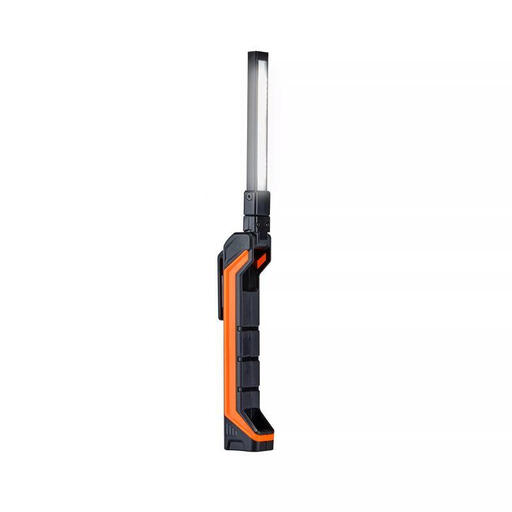
Why it's a good fit: For users who need a strong, focused light for detailed work, repairs, or crafts. A diffuse daylight lamp would be unsuitable for this purpose.
This light is clearly declared as a workshop and inspection light. By emphasising its specific use, it prevents consumers from mistakenly buying it to improve their mood, a purpose for which it is not designed.
A magnetic mount and a lamp head that pivots 180° and rotates 360° allow for hands-free work and precise illumination of the work area.
The selection of lighting solutions is vast. If you are specifically looking for lamps designed for eye-friendly and safe use, we have compiled more models for you.
The recommended duration of use depends on the light intensity and the distance from the lamp. For a 10,000 lux lamp, the typical session is about 20 to 60 minutes per day, preferably in the morning. It is advisable to position the lamp to the side, so the light falls on your face without you looking directly into it. Always follow the manufacturer's specific instructions.
No. A true daylight lamp is characterised by a combination of high illuminance (approx. 10,000 lux), a daylight-like colour temperature (5,500–6,500 K), and the guarantee of being UV-free and flicker-free. A standard LED desk lamp typically does not meet these criteria and is only intended for task lighting.
Place the lamp on a stable surface, ideally at a distance of 20 to 50 cm to the side of your field of vision. The light should reach your face but not shine directly into your eyes to avoid glare. Positioning it slightly above eye level is often comfortable.