
Lieferung heute & morgen

Qualitätsgarantie

Willkommens-Angebote freischalten: KOSTENLOSE Lieferung | Bis zu 80 % RABATT | Kostenlose 30-Tage-JoyPlus-Testphase
App herunterladen
An LED ceiling light should illuminate a room evenly, suit your existing electrical installation and work reliably over time. In practice, however, it’s not just wattage and design that can lead to the wrong purchase. Lights are often chosen based on particularly high lumen figures, without taking room size or light distribution into account.
Three common pitfalls are:
Wattage describes energy consumption, not brightness directly. For comparison, luminous flux in lumens is a more useful measure. A light with a wide beam angle can also distribute light more evenly, helping to reduce dark areas.
Before you buy, check:
A value of CRI >80 is listed for several of the products featured here. It indicates how natural colours look under the light. Good colour rendering can be especially useful in work areas, kitchens and bathrooms.
Colour temperature is measured in kelvins:
A dimmable LED ceiling light gives you more flexibility, but needs a compatible control system. If you’re considering an LED ceiling light with a remote control, also check that the product description specifically lists features such as brightness adjustment, colour temperature control, night light and memory function.
For a bathroom ceiling light, the IP44 rating is an important consideration. The first digit indicates protection against solid objects, while the second indicates protection against splashing water. You still need to take account of the fitting’s exact position in the bathroom and the applicable installation zones.
Other points to consider:
Energy-efficient ceiling lighting may use less electricity in operation than older light sources. Claims such as “up to 85% savings” or a lifespan of 50,000 hours should be treated as information provided by the relevant supplier and checked against the specific product variant.
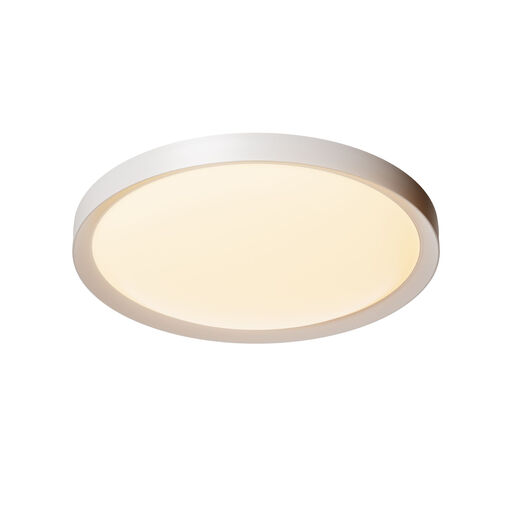
Why this product suits this profile: This round LED ceiling light, just 3 cm high, pairs a simple design with warm white light for bedrooms, hallways and smaller living spaces.
The product description specifies IP44, a sealed ABS design and a 120° beam angle. This makes it easier to assess the protection rating and light distribution than relying on design details alone.
Warm white, 48 W, IP44 and a height of around 3 cm, according to the product details.
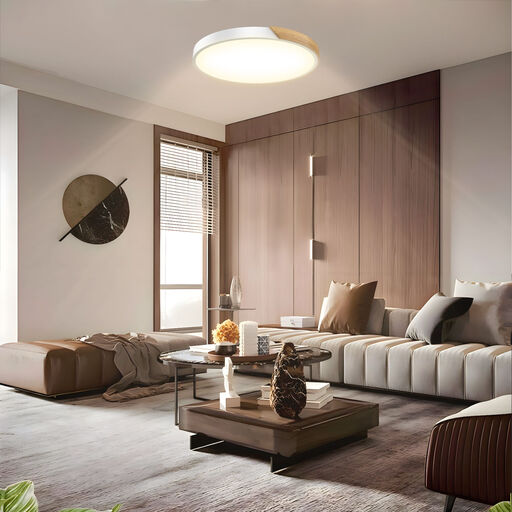
Why this product suits this profile: The combination of metal, oak and acrylic is ideal for anyone looking for a practical light with a homely look.
The product variant is clearly specified as 60 cm in diameter with a 5 cm profile. This makes it easier to check whether the light will suit your ceiling space.
Dimmable, with a 120° beam angle and CRI >80 Ra, according to the product description.
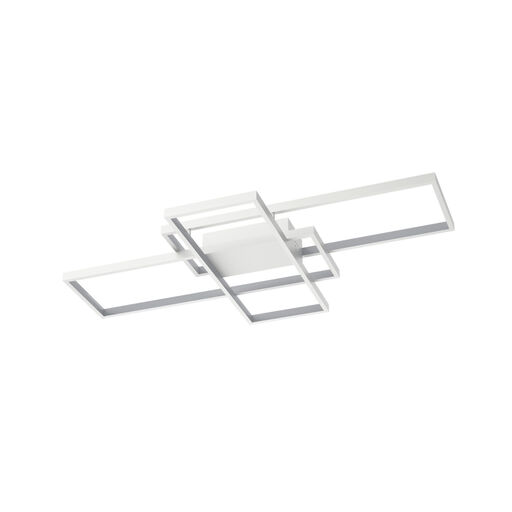
Why this product suits this profile: This LED ceiling light with remote control is a good choice for households that regularly adjust brightness and colour temperature for different activities.
The specifications list a dimming range of 10 to 100%, 2800 to 6500 K and IP44. This makes it easy to check the features that matter before you buy.
Remote control, adjustable colour temperature and up to 8400 lumens, according to the product description.
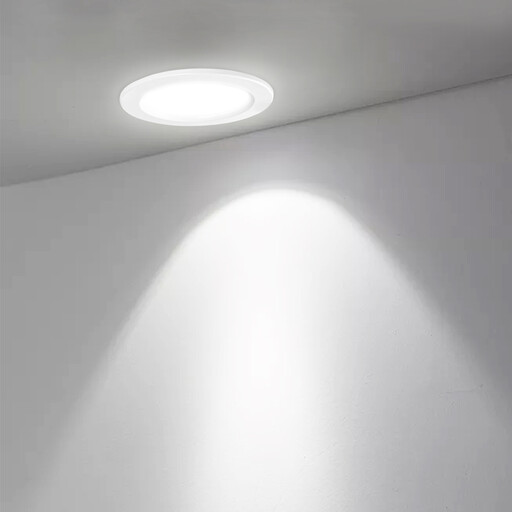
Why this product suits this profile: These spotlights are designed for suspended ceilings with limited space. They’re well suited to larger renovation projects in hallways, kitchens or bathrooms.
The product description specifies a recess depth of 25 mm, a cut-out of 90–100 mm and a direct 230-volt connection. Check these measurements against your ceiling before buying.
20 lights, each rated at 9 W and 648 lumens, with IP44, according to the product details.
We’ve put together a complete, regularly updated list of products that meet these strict selection criteria and fully comply with the safety regulations in force in the EU.
It depends on the room size, how you use it and the type of lighting you want. As a general guide, lumens are more useful than watts. Work areas usually need clearer lighting than a bedroom. In larger rooms, you can supplement a single light with several other light sources.
Lifespan depends on factors including how long the light is used, heat dissipation and the quality of its components. Some product descriptions quote around 30,000 or 50,000 hours. These figures are provided by the manufacturer or supplier and aren’t a guarantee for every installation.
Compared with older incandescent bulbs, LED technology can provide similar brightness while using less power. To work out running costs, consider the wattage, how many hours a day you use the light and your electricity tariff. A dimming function can also affect actual energy consumption when the light is used at a lower brightness.