
Lieferung heute & morgen

Qualitätsgarantie

Willkommens-Angebote freischalten: KOSTENLOSE Lieferung | Bis zu 80 % RABATT | Kostenlose 30-Tage-JoyPlus-Testphase
App herunterladen
A deep frying pan can double as a frying pan, sauté pan and casserole pan. It offers more capacity than a shallow frying pan, making it suitable for sauces, vegetable dishes, goulash, pasta and larger family portions. But size isn’t the only thing to consider when buying one. The material, coating, hob compatibility and suitability for everyday use all affect whether it will be a worthwhile addition to your kitchen in the long term.
As a Joybuy Product Recommendation Officer, I filter through the key product details and assess them in terms of practical uses. This makes it easier to avoid common marketing pitfalls.
The term non-stick coating doesn’t automatically tell you what the pan is made from or how durable it is. Check whether it has a traditional coating, a ceramic coating or a hybrid design with a textured stainless steel surface. Information about metal utensils, overheating and cleaning is also important.
If you’re specifically looking for a PFAS-free frying pan, check that the manufacturer states this explicitly. Claims such as ‘healthy’, ‘non-toxic’ or ‘chemical-free’ are of limited value without specific information about the materials. For the hybrid models featured here, the product information explicitly states that they are free from PFAS, PTFE and PFOA.
An induction frying pan needs a magnetic base. But that alone doesn’t tell you how evenly the heat will be distributed. Multi-layer designs with an aluminium core can help spread heat across the pan. By contrast, cast aluminium needs a suitable induction base.
Also check the base diameter. If the contact area is significantly smaller than the cooking zone, the pan may not heat evenly.
For an oven-safe frying pan, check the temperature limits for the pan, handle and lid separately. Glass lids and plastic handles may have lower limits. For example, a pan may be suitable for use up to 260 °C without the lid, while the lid can only be used up to 148 °C.
A pan measuring 24 to 26 cm is often large enough for two or three people. Families and households that cook larger portions may prefer a pan measuring 28 to 30 cm. A deep pan with sufficiently high sides helps prevent splashes and gives you plenty of room for slow-cooked dishes.
As well as the diameter, check the pan body and handle dimensions. A 28 cm pan with a long handle can take up a lot of storage space. Removable or compactly positioned handles are useful in smaller kitchens, if the model you choose has them.
A stainless steel frying pan is durable and heat-resistant, but you’ll need to use the right preheating and oiling technique when frying. Hybrid models often combine a textured stainless steel surface with coated areas. An aluminium core can improve heat distribution and reduce temperature fluctuations.
With a ceramic frying pan, follow the care instructions. Low to medium heat, suitable wooden, nylon or silicone utensils, and avoiding sudden changes in temperature can help protect the coating.
A dishwasher-safe frying pan is convenient for everyday use, but many manufacturers still recommend handwashing coated models. Mild washing-up liquid and soft sponges are usually gentler on the material than harsh cleaners or metal scouring pads.
Even if a pan is labelled dishwasher-safe, follow the product instructions. Let the pan cool before cleaning it. Contact with cold water while the surface is hot can cause it to warp.

Why this product suits this profile: This 28 cm model is designed for larger portions and comes with a lid, steamer insert and spatula. It’s a good choice for households looking to combine several functions in one piece of cookware.
The product details explicitly state that it’s suitable for a range of hob types, including induction. This makes it easy to check compatibility before you buy.
28 cm diameter, two-layer non-stick coating and a four-piece set with lid, steamer insert and spatula.
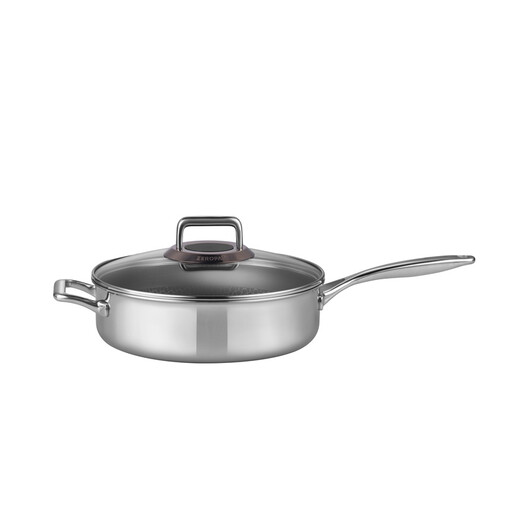
Why this product suits this profile: Its stainless steel construction, aluminium core and open honeycomb structure make it a good choice for buyers who want to compare materials and hob compatibility in detail.
According to the product description, the coating is free from PFAS, PTFE and PFOA. It’s also listed as suitable for all common hob types and for oven use up to 260 °C.
Three-layer base with an aluminium core, 26 cm size, stainless steel handle and stated dishwasher suitability.
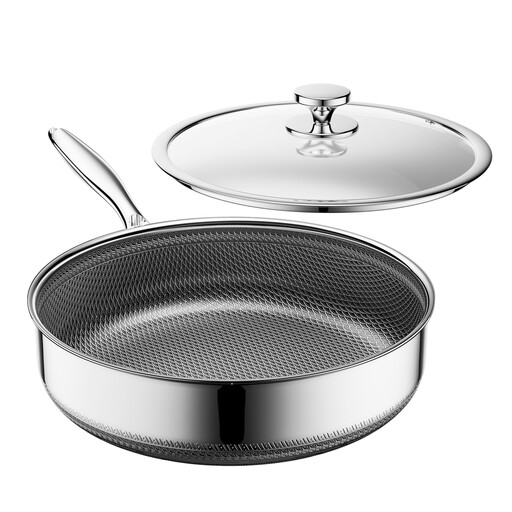
Why this product suits this profile: This model pairs a ceramic coating with a glass lid, making it a good option for households that consider material information and controlled cooking important.
The product details state that it’s free from PFAS, PTFE and PFOA, and give separate temperature limits for the pan and lid. This makes it easier to use safely in the oven.
Glass lid, stainless steel with an aluminium core, induction suitability and an oven-safe pan up to 260 °C.
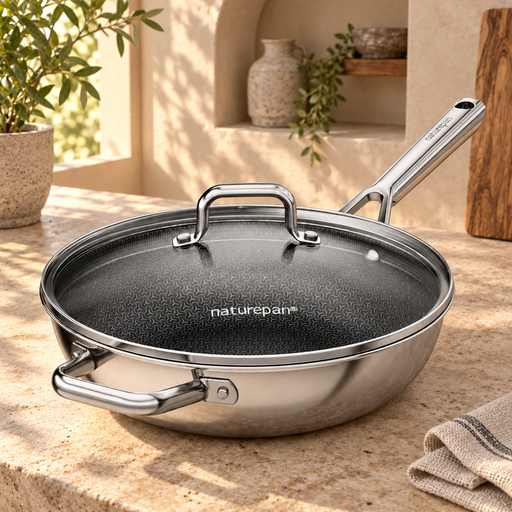
Why this product suits this profile: With a 28 cm diameter, matching lid and textured cooking surface, this model is well suited to sautéing, slow cooking and preparing larger meals.
The details clearly distinguish between the pan and the lid: the pan is oven-safe up to 230 °C without the lid. Compatibility with halogen or infrared hobs should also be checked.
28 cm diameter, aluminium heat core, hybrid structure, lid and stated suitability for induction, gas, electric and ceramic hobs.
We’ve put together a complete, regularly updated list of products that meet these strict selection criteria and fully comply with the safety regulations in force in the EU.
A 28 cm pan is often a practical choice for three or four people, especially for stews, vegetable dishes and slow-cooked meals. The height of the pan and its capacity are also important. A 24 to 26 cm pan may be easier to handle for smaller portions.
No. Look for an explicit statement confirming induction suitability. Aluminium or cast iron models need to have a suitably magnetic base. If in doubt, check the technical specifications or the manufacturer’s instructions.
Its lifespan depends on the type of coating, heat, utensils and cleaning method. There’s no single answer in years. Handwashing, moderate temperatures and avoiding metal utensils can help protect the surface. Areas of stainless steel without a delicate coating are usually more hard-wearing, but still need to be treated differently.