
Lieferung heute & morgen

Qualitätsgarantie

Willkommens-Angebote freischalten: KOSTENLOSE Lieferung | Bis zu 80 % RABATT | Kostenlose 30-Tage-JoyPlus-Testphase
App herunterladen
A high-quality deep sauté pan is a versatile tool in any kitchen. It's ideal for searing, creating sauce-based dishes, serving as a braising pan, or for deep-frying smaller quantities. However, the market is flooded with products whose marketing promises often suggest more than the pan delivers in daily use. Many buyers find that after just a few months, the non-stick effect diminishes, the base warps, or the heat distribution is uneven.
As your Joybuy Product Recommendation Officer, I'm here to help you navigate these pitfalls. Instead of falling for exaggerated advertising, we will focus on the crucial, objective features that define a durable and functional high-sided pan.
Before we dive into the essential features, let's highlight the typical problems that can lead to a poor purchase:
To make an informed decision, you should carefully examine three technical aspects. These significantly determine the performance, longevity, and safety of your new pan.
The material is the heart of any pan. The choice directly impacts cooking properties and lifespan.
For coated pans, always look for the explicit PFOA-free and ideally PFAS-free labels to ensure that no per- and polyfluoroalkyl substances were used.
The quality of the pan's base is crucial for cooking results. A multi-layered sandwich base, often with an aluminum core, ensures fast and, most importantly, even heat conduction. This prevents "hot spots" where food burns while it's still undercooked elsewhere.
For owners of an induction hob, compatibility is essential. A good induction pan has a ferromagnetic base that sits flat on the hob and remains warp-resistant even when heated. Check the manufacturer's specifications for compatibility with all hob types.
The right size depends on your household size and cooking habits.
A high rim makes the pan versatile, turning it into a braising pan. A pan with a lid is a must for reducing liquids, simmering, or keeping food warm. If you want to finish dishes or gratinate them in the oven, the oven-safe feature (including the handle and lid) is a critical criterion.
Here are some models that represent a considered choice for specific user profiles, based on their objective features.
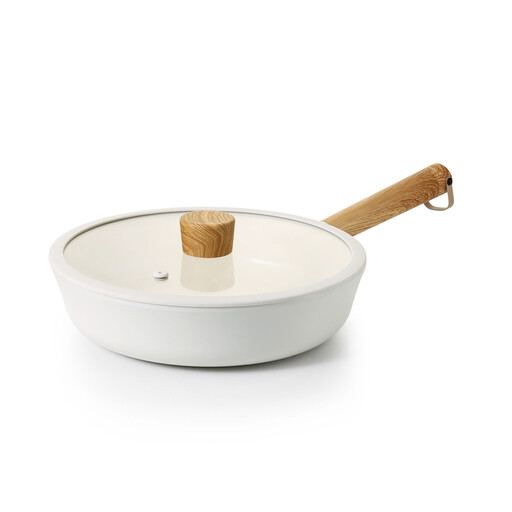
Why This Fits Their Persona: With its 28 cm diameter and high rim, this pan is ideal for family-sized portions. According to the manufacturer, the ceramic coating is free of PTFE, PFAS, lead, and cadmium, which aligns with the desire for health-conscious cooking. The included lid enhances its versatility.
Addresses concerns about harmful chemicals with a ceramic coating explicitly declared as PFOA- and PFAS-free. The magnetic stainless steel base ensures excellent suitability as an induction pan and provides even heat distribution.
Large capacity and suitable for all hob types. The smooth coating simplifies cleaning in a busy family household.
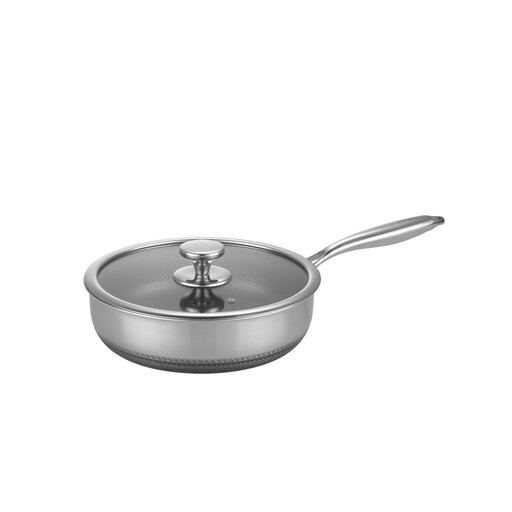
Why This Fits Their Persona: This model combines the robustness of stainless steel with a ceramic non-stick coating in a honeycomb structure. Its high oven-safe temperature of up to 260°C allows for advanced cooking techniques like finishing dishes in the oven.
The three-layer construction with an aluminum core counteracts the problem of uneven heat distribution. The physical non-stick effect of the honeycomb structure is potentially more durable than a simple surface coating.
High heat resistance and precise heat distribution. The hybrid technology offers a great balance of durability and non-stick convenience.
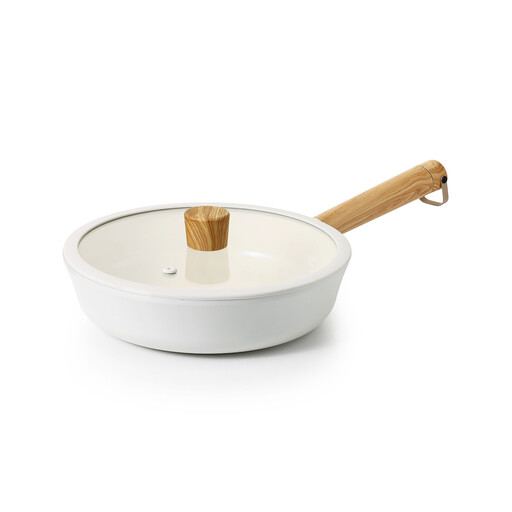
Why This Fits Their Persona: The compact 24 cm size is ideal for smaller households and quick meals. The focus is on simple handling and straightforward cleaning. The pan is suitable for all hob types, including induction, making it highly flexible.
Provides a solid set of essential features without unnecessary and expensive extras. The proven ceramic coating and sturdy base offer reliable performance for daily use, avoiding the trap of cheap pans with poor heat distribution.
Compact, versatile, and easy to care for. A practical workhorse for daily use that meets the fundamental requirements of a good high-sided pan.
We've compiled a complete, up-to-date list of products that meet these strict selection criteria and German safety standards.
To preserve the non-stick properties of a ceramic pan, you should follow a few basic rules. Avoid using metal utensils; opt for wood or silicone instead. Clean the pan by hand with a soft sponge and mild dish soap, even if it is labeled as dishwasher-safe. Always let the pan cool down completely before bringing it into contact with cold water to prevent thermal shock.
PFOA (Perfluorooctanoic acid) belongs to the PFAS group and was historically used in the production of non-stick coatings like PTFE (known by the brand name Teflon). The substance is considered a health concern and is largely regulated in the EU. A PFOA-free label means that this specific chemical was not used in the manufacturing process. For more comprehensive safety, health-conscious consumers are increasingly looking for the PFAS-free label, which excludes a broader group of chemicals.
Yes, hybrid pans offer non-stick properties, but they differ from those of a fully coated pan. The raised stainless steel honeycomb structure protects the recessed non-stick coating from scratches by cooking utensils. At the same time, the structure ensures that oil or fat is distributed evenly, creating a natural non-stick film. The cooking result is often a better sear, similar to a pure stainless steel pan, but with a significantly lower tendency for food to stick.