
Lieferung heute & morgen

Qualitätsgarantie

Willkommens-Angebote freischalten: KOSTENLOSE Lieferung | Bis zu 80 % RABATT | Kostenlose 30-Tage-JoyPlus-Testphase
App herunterladen
A musty smell in the basement, condensation on the windows, or laundry that's slow to dry indoors—high humidity is a common problem in many households. A dehumidifier can remedy the situation, but choosing the right unit is often more confusing than you might think. As a Joybuy Product Recommendation Officer, I'll help you understand the crucial features and steer clear of common purchasing traps.
Many users invest in a unit that is either too weak for their needs, too loud for their living space, or impractical for continuous operation. This guide focuses on the objective criteria that truly matter, enabling you to make an informed decision.
Before we dive into the technical specs, it's important to recognise common marketing promises that often lead to a poor purchase.
To find the right dehumidifier for your needs, you should check three core parameters. These determine the unit's performance, suitability for your intended use, and overall convenience.
Dehumidification capacity, measured in litres per day (L/day), is the most important performance metric. It describes how much water the unit can extract from the air within 24 hours. This value is typically measured under standardised lab conditions (e.g., at 30°C and 80% relative humidity).
For many users, a quiet dehumidifier is a must-have, especially in a bedroom or living room. Pay attention to the decibel rating (dB) for the fan speed you'll likely use most often, not just the minimum value.
For use while you're away or in permanently damp rooms like a basement dehumidifier setup, two features are indispensable:
Based on the objective criteria above, we have identified a model that is particularly well-suited for a demanding use case.
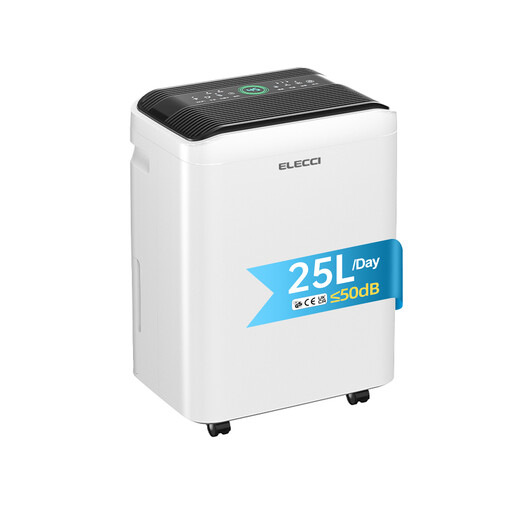
Why This Fits Their Persona: This model is designed for users who need a high-performance solution for large rooms, damp basements, or for effective laundry drying. Its high capacity and features designed for continuous operation cover demanding scenarios where smaller units would reach their limits.
The unit directly addresses the purchasing pitfalls: It offers a clear performance rating of 25 L/day for rooms up to 50 sqm, a specified low operating noise of 36 dB, and a large 4.8-litre tank along with an included drainage hose for flexible continuous operation.
The combination of high dehumidification capacity, energy-efficient operation with R290 refrigerant, and the integrated auto-defrost function makes it a reliable solution for cool and demanding environments.
We have compiled a complete, up-to-date list of products that fully meet these strict selection criteria and German safety regulations.
1. Does a dehumidifier help against mould? Yes, a dehumidifier is a key tool for mould prevention. Mould needs high humidity to grow. By consistently keeping the relative humidity below 60%, the device removes mould's life source, effectively preventing new growth. However, it does not remove existing mould.
2. How much electricity does a dehumidifier use? Power consumption depends on the wattage, daily operating time, and the room's humidity level. Modern units with energy-efficient compressors and more environmentally friendly refrigerants like R290 are designed for economical operation. The rated power consumption, such as 305W for the ELECCI model, provides a good benchmark. Using timers or hygrostat-controlled automatic modes can further optimise energy use.
3. Where is the best place to position a dehumidifier? For optimal performance, the dehumidifier should be placed as freely as possible in the room, with at least 30–50 cm of clearance from walls and furniture. This ensures unobstructed air circulation, allowing the unit to effectively draw in moist air and distribute dry air evenly. Placing it in a corner or directly against a wall will significantly limit its efficiency.