
Lieferung heute & morgen

Qualitätsgarantie
App herunterladen
Kategorien
Consistently high humidity in living spaces, exceeding the recommended range of 40% to 60%, can lead to property damage and a decline in living comfort. Condensation on windows, musty odours, or the formation of mould are direct indicators of such an indoor climate. A dehumidifier, also known as a room dehumidifier, is a technical device that counteracts this problem by reducing the water content in the ambient air. Its operation is typically based on the condensation principle: moist air is drawn in and passed over a cooled surface, causing the water vapour to condense and be collected in a tank. The dried air is then released back into the room.
Selecting a suitable device depends on objective, measurable parameters. This guide analyses the technical specifications relevant for making an informed decision.
The efficiency of a dehumidifier is determined by the interplay of several technical metrics. An analysis of these factors is crucial to find a unit that meets the specific requirements of its intended location.
The dehumidification capacity indicates how many litres of water a unit can extract from the air within 24 hours. This value is typically measured under standardised laboratory conditions (e.g., at 30°C and 80% relative humidity). A higher capacity is not universally better; it must be appropriate for the room size and the severity of the moisture problem. A lower capacity is sufficient for an occasionally damp storage room, while a permanently wet basement requires a more powerful dehumidifier.
Manufacturers typically specify a recommended maximum room size in square metres (m²). This figure is directly linked to the dehumidification capacity. It is advisable to choose a model whose recommended room size is slightly larger than the actual area to ensure it has performance reserves, especially in cases of very high initial humidity.
Modern units offer various operating modes for specific applications:
The size of the water tank determines how often it needs to be emptied manually. For largely autonomous operation, a dehumidifier with a hose connection is a practical solution. A drainage hose allows the condensed water to be channelled directly into a drain, enabling continuous operation without interruption.
The noise level, measured in decibels (dB), is a critical factor for use in living areas or bedrooms. A quiet dehumidifier typically operates at levels below 45 dB, which is comparable to the volume of a quiet conversation. Compressor-based units are inherently louder than models with Peltier technology, but they offer significantly higher dehumidification performance.
Based on an analysis of technical specifications and practical benefits, we present a selection of models here.
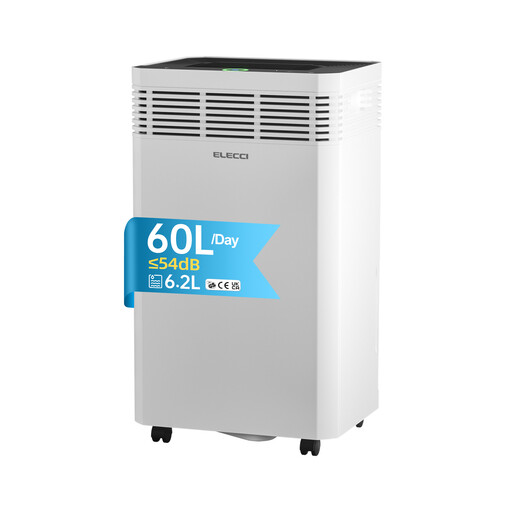
Why we recommend this product: This model stands out with its exceptionally high dehumidification capacity of up to 60 litres per day. It is designed for large rooms up to 120 m² and features R290 refrigerant, a solution that complies with current environmental standards. The combination of high performance, a large tank, and the option for continuous drainage makes it a powerful tool for demanding dehumidification tasks.
Pros:
Best suited for: Individuals with large, damp basements, open-plan living areas, workshops, or for supporting restoration efforts after water damage.
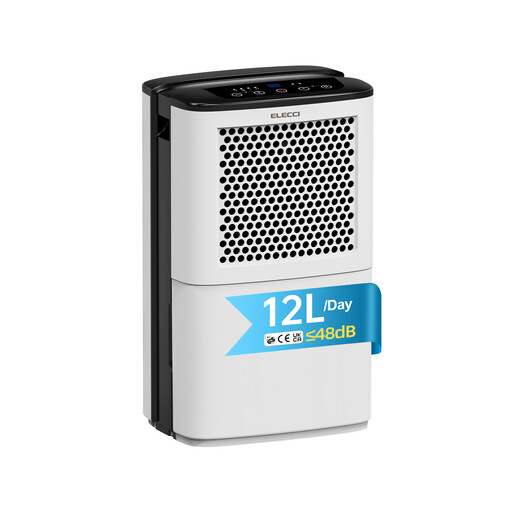
Why we recommend this product: With a capacity of 12 litres per day, this unit is designed for small to medium-sized rooms up to 25 m². Its compact design and essential, yet effective, features like continuous drainage and an auto mode make it a practical solution for everyday moisture issues in bathrooms, bedrooms, or laundry rooms.
Pros:
Best suited for: Users seeking a reliable and straightforward solution for individual rooms such as bathrooms, bedrooms, or small basement areas.
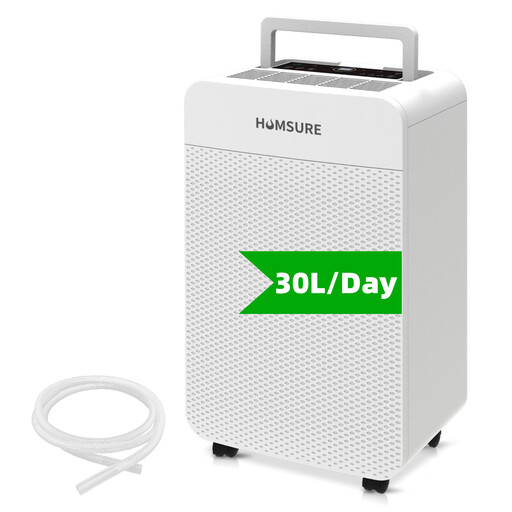
Why we recommend this product: This model offers a balanced performance of 30 litres per day for rooms up to 50 m². It combines a solid dehumidification capacity with smart features like a humidity sensor for automatic control and a quiet sleep mode. The child lock is an added safety feature for households with children.
Pros:
Best suited for: Families and individuals who need a versatile solution for medium-sized living spaces, basements, or garages and who value automatic, energy-efficient control.
While the included drainage hoses are sufficient for most applications, specific installations may require custom lengths or diameters. You can find a selection of flexible hoses and connection components in our Automotive Hoses category.
1. How does a dehumidifier help against mould? A dehumidifier acts as a preventative measure against mould. Mould requires high humidity to grow. By lowering the relative humidity in a room to a level below 60%, the device deprives mould of one of its essential living conditions. It does not remove existing mould, but it does prevent its spread and new growth.
2. Can a dehumidifier help with drying laundry? Yes. Many units feature a dedicated laundry mode. This mode generates a continuous, dry airflow that significantly accelerates the evaporation of water from wet clothes. This is an especially effective method in homes without a balcony or a dedicated drying room.
3. Where should a room dehumidifier be placed? For optimal air circulation, the room dehumidifier should be placed as freely as possible in the room, with a clearance of at least 20-30 cm from walls and furniture. The air intake and outlet must not be obstructed. In multi-level, open-plan areas, positioning it on the lower level is advisable, as cool, damp air tends to sink.