Consistently high indoor humidity, typically above 60%, can lead to a range of problems. These include condensation on windows, a musty odour, and in the worst-case scenario, the growth of mould, which can damage the building's structure and materials. A dehumidifier is an appliance designed to reduce the relative humidity in an enclosed space through condensation, thereby creating a balanced indoor environment.
Buyer's Guide: Technical Criteria for Selecting a Dehumidifier
Choosing the right model depends on measurable parameters and the specific requirements of the location. The following criteria are essential for making an informed decision.
1. Dehumidification Capacity (Litres per Day)
A unit's performance is measured in litres per 24 hours (L/day). This value is measured under standardised laboratory conditions (typically at 30°C and 80% relative humidity).
- Up to 12 L/day: Suitable for small, single rooms like bathrooms or laundry rooms (approx. 15–20 m²).
- 12 to 20 L/day: Sufficient for medium-sized living rooms or bedrooms (approx. 20–40 m²).
- From 20 L/day: Required for large rooms, open-plan living areas, or damp basements (from 40 m²). A 25L dehumidifier is a common capacity for apartments up to 50 m² or larger basements.
2. Room Size and Application
A dehumidifier's efficiency is directly linked to the room's volume. A dehumidifier for the basement often needs to cover a larger area and operate reliably at lower temperatures. Models with an auto-defrost function are advantageous here, as they prevent the condenser from icing over at temperatures below 15°C. For a 50m² apartment, a unit with a capacity of 20–25 L/day and good air circulation is a solid choice.
3. Operating Modes and Features
Modern units offer various features that enhance their practical use.
- Continuous Operation and Drainage: For unattended use, such as in basements or holiday homes, a dehumidifier with a hose for continuous drainage is a practical solution. The condensed water is channelled directly into a drain via a hose, eliminating the need to manually empty the water tank.
- Noise Level (Decibels): In living areas and bedrooms, quiet operation is crucial. A low-noise dehumidifier has a sound pressure level below 40 dB in normal mode. Pay attention to the manufacturer's specifications for each operating mode (e.g., sleep mode).
- Hygrostat and Timer: A built-in hygrostat allows you to set a target humidity level (e.g., 50%). The unit automatically shuts off when this level is reached and turns back on when it is exceeded, which reduces energy consumption. A 24-hour timer enables scheduled operation.
- Laundry Drying Function: Some models feature a special mode that generates a continuous, powerful airflow to speed up the drying of laundry indoors.
Our Top Dehumidifier Picks for 2026
The following models have been selected based on their technical specifications and feature sets for various applications.
ELECCI 25L/D Dehumidifier
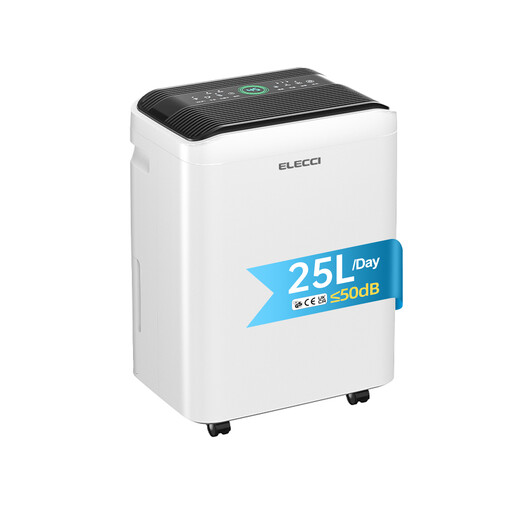
- Why we recommend this product: This model combines a high dehumidification capacity of 25 L/day with an exceptionally large 4.8-litre water tank. The smart LED display, featuring a colour indicator for the current humidity level, allows for intuitive control.
- Advantages:
- Capacity: Up to 25 litres per day (at 30°C, 80% RH).
- Tank Volume: 4.8 litres, reducing the frequency of manual emptying.
- Noise Level: Low sound level of 36 dB in quiet mode.
- Features: 3 fan speeds, 24-hour timer, laundry drying mode, auto-defrost.
- Flexibility: Includes a connection for a drainage hose for continuous operation.
- Best for: Users looking for a versatile solution for rooms up to 50 m² who value quiet operation and a large water tank.
TRULIVA 25L/Day Dehumidifier
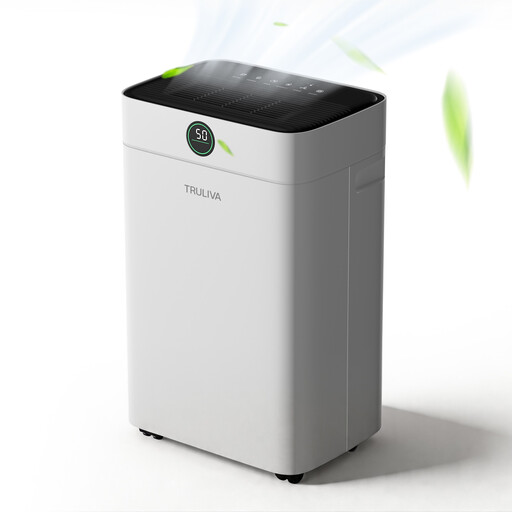
- Why we recommend this product: The TRULIVA dehumidifier stands out with its compact design and a dedicated laundry drying mode. It offers a solid capacity of 25 L/day and is easy to move and store thanks to its dimensions and 360° castors.
- Advantages:
- Capacity: Up to 25 litres per day (at 95°F, 90% RH).
- Compactness: Dimensions of 32 x 28 x 52.7 cm.
- Features: Special laundry drying mode, auto-defrost, water level indicator with auto shut-off.
- Continuous Operation: A 1.2-metre drainage hose is included.
- Best for: Users who frequently dry laundry indoors or need a mobile, space-saving solution for various areas like basements, RVs, or bathrooms.
HUMSURE Dehumidifier 30L/Day
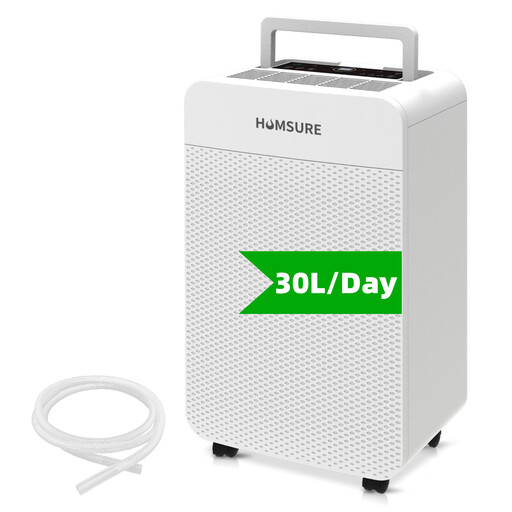
- Why we recommend this product: With a dehumidification capacity of up to 30 L/day and a large 5.3-litre tank, this unit is designed for demanding tasks and larger rooms up to 50 m². The intelligent humidity sensor ensures energy-efficient automatic operation.
- Advantages:
- High Capacity: Up to 30 litres per day (at 95°F, 90% RH).
- Large Tank: 5.3-litre capacity.
- Smart Control: A built-in sensor automatically maintains the preset humidity level.
- Safety: Child lock prevents unintentional operation.
- Continuous Operation: Includes a 1.2-metre drainage hose.
- Best for: Individuals with significant moisture issues in spacious basements, open-plan living areas, or garages who require high dehumidification performance and automatic control.
Alternatives and Accessories
For effective continuous operation, a suitable drain hose is essential. If the included hose is not the required length or a replacement part is needed, you can find a selection of compatible models and lengths in our category to ensure continuous water drainage.
Go to Category: Drain Hoses
Frequently Asked Questions (FAQ)
1. What is the ideal humidity level for a home? A relative humidity level between 40% and 60% is considered comfortable and safe for a building's structure. Persistently higher levels can promote mould growth.
2. Where is the best place to position an electric dehumidifier? Place the unit on a level, stable surface, preferably in the centre of the room. Maintain a clearance of at least 20–30 cm from walls and furniture to allow for unrestricted air circulation. In rooms with a specific source of moisture (e.g., a leaking wall), the unit should be placed nearby.
3. Does a dehumidifier help with mould? A dehumidifier for mould works as a preventative measure. Mould requires high humidity to grow. By lowering the room's relative humidity to below 60%, the appliance removes the conditions mould needs to thrive, inhibiting its growth and spread. If mould is already present, it must be professionally removed; the dehumidifier will then help prevent its return.
Written by: Joybuy Product Recommendation Officer

