
Lieferung heute & morgen

Qualitätsgarantie

Willkommens-Angebote freischalten: KOSTENLOSE Lieferung | Bis zu 80 % RABATT | Kostenlose 30-Tage-JoyPlus-Testphase
App herunterladen
Misty windows, musty smells or clothes that take a long time to dry are common reasons to look for a dehumidifier. But choosing a model based solely on a high litre capacity or eye-catching advertising claims does not automatically mean you will find the right appliance. Room size, operating time, water drainage and noise levels are the factors that really matter.
This buying guide from the Joybuy Product Recommendation Officer explains which details are genuinely important when buying an electric dehumidifier and which common pitfalls you can avoid.
Figures such as 20L dehumidifier or 30L dehumidifier usually refer to a specific temperature and relative humidity, for example 30 °C and 80% relative humidity. In a cooler German basement, the actual dehumidification performance may be lower.
The daily extraction capacity is therefore only a comparative figure. You should also check:
A dehumidifier with a high extraction capacity can fill a small tank quickly. Without automatic shut-off, there is a risk of overflowing; with automatic shut-off, the appliance pauses until the tank is emptied.
For a basement dehumidifier, utility room or permanently damp space, a drain hose is often the more practical option. Make sure there is a suitable drain, sufficient gradient and a secure hose connection. Appliances with a pump have additional requirements, which must be stated in the product description.
Noise levels are usually given in dB(A). Manufacturer figures may refer to different operating modes. A sleep mode therefore cannot be compared directly with the maximum fan setting. Compressor models can also produce different sounds when starting up or during operation.
For bedrooms and home offices, it is worth checking:
A small dehumidifier for large rooms may run continuously without reaching the desired humidity level. Wherever possible, the manufacturer’s recommendation should match your room. Product specifications may provide guidance such as:
These figures depend on ceiling height, temperature, insulation, sources of moisture and air circulation. In a very damp basement, a model with greater capacity to spare may be more suitable than one that is only just powerful enough.
A removable tank makes manual emptying easier. A visible water-level indicator is useful if the appliance is checked regularly. For longer periods away from home or operation in a utility room, a dehumidifier with a drain hose is advantageous.
Make sure the hose is not kinked and that the water can drain away reliably. Automatic shut-off when the tank is full remains important even if you only empty the tank manually from time to time.
Depending on the model, a Wi-Fi dehumidifier can be started, stopped or scheduled via an app. This is useful if you want dehumidification to take place before you return home or during a set time window. However, check that there is a stable Wi-Fi connection where the appliance is installed.
A laundry-drying function usually increases the airflow or changes the control system. It does not replace a tumble dryer, but it can support the drying environment in damp weather. Rated power, operating time and the desired target humidity are the key factors affecting running costs. The simple calculation is:
Power consumption in kW × operating hours × electricity price per kWh = approximate running costs
A hygrometer helps you monitor room humidity independently of the appliance’s display. Different measuring devices may show different readings, particularly when positioned in different parts of the room.
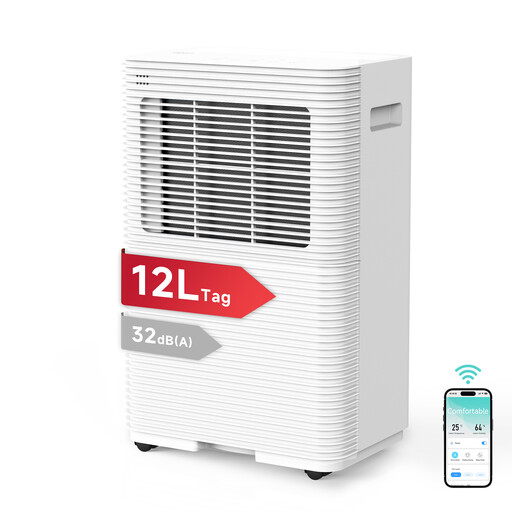
Why this product suits this profile: With an advertised capacity of up to 12 L per day and suitability for rooms of up to 24 m², this appliance is well suited to smaller living rooms, bedrooms or utility rooms. App control and scheduling allow you to use it precisely when needed.
The product specifications list both a 1.8-litre tank and a connection for continuous drainage. This helps reduce the frequent tank stoppages that can occur during longer periods of use.
Wi-Fi app, 24-hour scheduling, laundry-drying function and castors. The noise figures distinguish between 32 dB in sleep mode and 38 dB in the technical table.
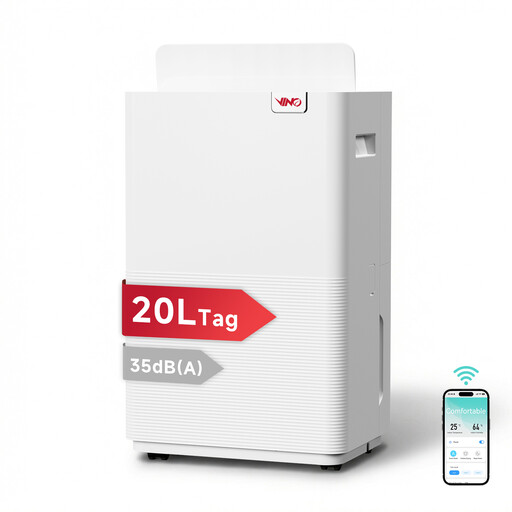
Why this product suits this profile: With an extraction capacity of up to 20 L per day and a manufacturer recommendation for rooms of up to 40 m², this appliance is designed for larger living areas, basements or utility rooms.
Water can be drained through the hose or collected in the 2.5-litre tank. Automatic shut-off when the tank is full and the child lock address common problems in everyday use.
Wi-Fi control, scheduling, automatic internal drying, laundry-drying function and 360-degree castors. The noise level is stated as 35 dB in sleep mode and 40 dB(A) in the technical specifications.
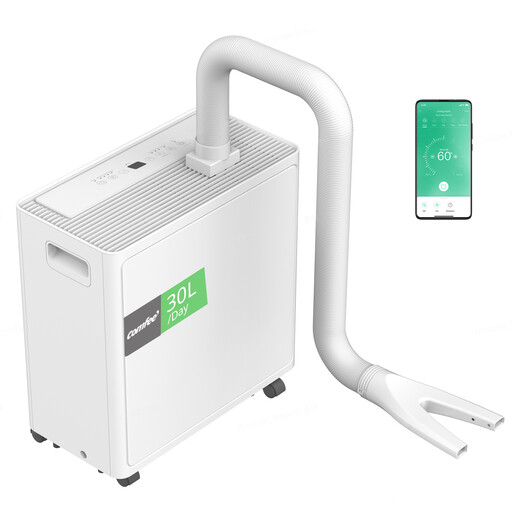
Why this product suits this profile: With an advertised extraction capacity of 30 L per 24 hours and a recommended area of 58 to 73 m², this model is designed for large rooms, basements, bathrooms and utility rooms with regular moisture ingress.
The 3.2-litre tank has a visible fill-level indicator and overflow protection. A drain hose is also available for continuous operation.
Four modes, app control, 24-hour timer, automatic defrosting, laundry-drying function and two fan speeds. The stated sound pressure level is between 45.3 and 47 dB(A).
We have put together a complete, regularly updated list of products that fully meet these strict selection criteria and the safety regulations applicable in the EU.
Place the appliance on a level, stable surface and leave enough space around the air inlets and outlets. Doors and windows should remain closed wherever possible during operation, so that a constant supply of new damp outdoor air does not enter.
When using a dehumidifier to prevent mould, remember that the appliance can reduce humidity in the room, but it cannot replace investigating the cause or carrying out structural work. If mould is visible or keeps returning, property owners or landlords and, where appropriate, suitable specialist services should be involved. Regular ventilation, repairing leaks and ensuring adequate heating remain important measures.
This depends on the rated power, operating time and control behaviour. An appliance rated at 365 watts theoretically uses 3.65 kWh after ten hours of operation. In practice, consumption may be lower if the compressor switches off intermittently. For a realistic estimate, compare the power rating with your actual usage pattern.
There is no fixed operating time that suits every room. Use a hygrometer and set an appropriate target humidity. After installation, a longer initial operating period may be necessary; later, automatic interval operation is often sufficient. Compressor models may have a start delay of several minutes.
A low dB(A) figure in sleep mode can make a dehumidifier more suitable for bedroom use. Nevertheless, the compressor, fan and airflow will produce audible operating noise. Check the figures for several modes and do not place the appliance directly next to the bed.