
Lieferung heute & morgen

Qualitätsgarantie

Willkommens-Angebote freischalten: KOSTENLOSE Lieferung | Bis zu 80 % RABATT | Kostenlose 30-Tage-JoyPlus-Testphase
App herunterladen
High humidity, condensation on windows or a musty smell in the cellar are common reasons for buying a dehumidifier. However, not every appliance is suitable for every room. A small model can quickly reach its limits in a damp cellar, while a powerful electric dehumidifier in the bedroom may take up unnecessary space and use more energy than needed.
When buying, it is therefore important to look beyond specifications such as “20 litres per day” or “suitable for large rooms”. The measurement conditions, drainage options, noise level and features for the intended use are what really matter.
The specification “20 litres per 24 hours” usually describes a maximum value measured in warm, very humid conditions. At lower temperatures or moderate humidity levels, the actual amount collected may be considerably lower. You should therefore also compare:
A dehumidifier with a daily capacity of 10 litres may be sufficient for a bedroom or smaller living space. For a large cellar or utility room, models with capacities of 20, 25 or 30 litres are generally more suitable.
A low-capacity tank needs to be emptied frequently when humidity is high. This is inconvenient in everyday use and can restrict unattended operation. A dehumidifier with a hose, on the other hand, allows water to be drained continuously into a suitable outlet.
Look out for:
A pump is not automatically included. If the water needs to be drained upwards or over a longer distance, the product description should explicitly state that a suitable pump function is available.
Noise levels can vary depending on the fan speed. An appliance with a low rating in sleep mode may be noticeably louder in standard or laundry-drying mode. For a bedroom dehumidifier, a dedicated sleep mode, timer and automatic humidity control are therefore particularly important.
When choosing a dehumidifier for your home, you should consider both the floor area and the ceiling height. An appliance specified for around 40 m³ or 16 m² is more suitable for smaller rooms. Models rated for up to 100 m³ or 40 m² are designed for larger living areas.
These figures are guidelines and depend on several factors:
A dehumidifier for preventing mould is not a substitute for investigating the underlying cause. If you can see mould, water is penetrating the building or there is structural damp, landlords, specialist contractors or the relevant authorities should be involved. The appliance can dehumidify the room air, but it cannot resolve the cause of water damage.
An energy-efficient dehumidifier should offer not only high performance but also sensible control options. A humidistat switches off the compressor or reduces operation once the target humidity level has been reached. A dehumidifier with a timer can limit operating time, for example when drying laundry.
Power consumption in watts is useful for comparison. An appliance rated at 200 watts theoretically uses 2 kWh after ten hours of operation. Actual costs depend on your electricity tariff and on how long the compressor is running. Features such as comfort mode, automatic switch-off and target-level control can make everyday operation easier to manage.
Ice can form on the heat exchanger in cooler rooms. A dehumidifier with automatic defrosting pauses the dehumidifying process when necessary and then resumes operation. This feature is particularly relevant for cellars, garages and rooms with little heating.
Many of the appliances listed use R290 as the refrigerant. As this is a flammable refrigerant, the manufacturer's safety instructions must be followed. The appliance should be placed on a stable, level surface, kept at a sufficient distance from walls and not operated near naked flames, flammable materials or splashing water.
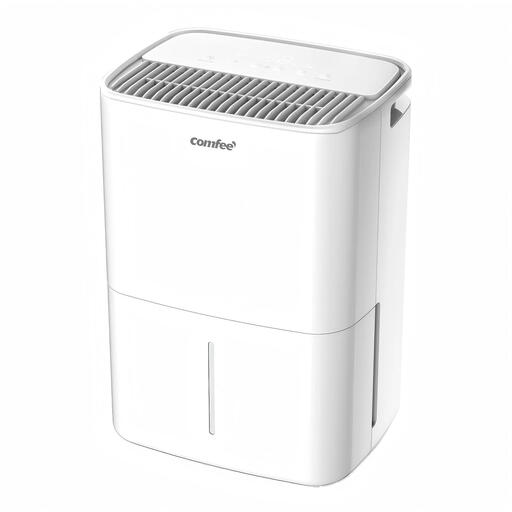
Why this product suits this profile: With a rated capacity of around 40 m³ or 16 m², it is suitable for smaller bedrooms, kitchens or poorly ventilated rooms.
The 2.5-litre tank has a water-level indicator, a warning alert and automatic switch-off when it reaches capacity.
Specifications include 10 l/24 h, three modes, a 24-hour timer, automatic defrosting and 36 dB(A) in sleep mode.

Why this product suits this profile: For households looking to combine app control, scheduling and portable use in rooms of up to around 40 m².
The product data specifies both a 2.5-litre tank and hose drainage. This gives you the choice between emptying the tank manually and using continuous drainage.
20 l/day under the stated conditions, Wi-Fi app control, 24-hour scheduling and a sleep mode rated at 35 dB according to the product description.
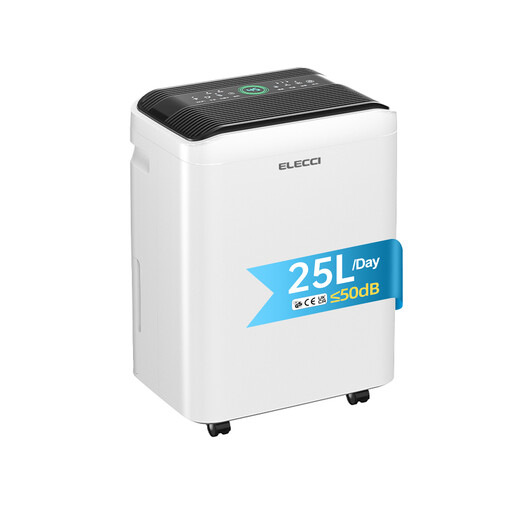
Why this product suits this profile: This model is aimed at users dealing with higher levels of moisture in cellars, utility rooms, garages or larger living spaces.
The 4.8-litre tank, supplied drainage hose and automatic switch-off reduce the need for frequent checking and emptying.
Specifications include 25 l/day at 30 °C and 80% relative humidity, three fan speeds, a laundry-drying mode and automatic defrosting.
We have put together a complete, regularly updated list of products that fully meet these strict selection criteria and the safety regulations applicable in the EU.
For reliable operation, the appliance should:
After being transported in a tilted position, several manufacturers' instructions require the appliance to stand upright for two hours before it is switched on. The filter should be cleaned regularly in accordance with the operating instructions. A dehumidifier used for drying laundry works most efficiently when the clothes are only damp, rather than dripping wet.
Consumption depends on power rating, operating time, room temperature and humidity. At 200 watts and ten hours of operation, the theoretical consumption is 2 kWh. A humidistat, timer and automatic switch-off can limit the active operating time. For an accurate calculation, multiply your consumption in kWh by your current electricity unit rate.
This depends on the humidity level and the room. It is advisable to set a target level using the humidistat rather than running the appliance continuously without any control. In laundry-drying mode, a limited operating period may be sufficient. In a cellar with continuous drainage, longer operation is possible as long as the temperature range, ventilation and safety clearances are observed.
For a bedroom, a low noise level in sleep mode, a timer, automatic switch-off and suitable room coverage are important. Small rooms do not necessarily need a model with a daily capacity of 25 or 30 litres. You should also check whether the stated noise level actually applies to sleep mode and whether the display or lighting can be dimmed.