Households that keep clothes in the living room
If you store clothes in a large living space, you’ll want to keep an eye on damp in poorly ventilated spots and behind furniture, too.


First, measure the humidity and check whether it is regularly high where you store your clothes. A dehumidifier is no substitute for regular ventilation or for investigating the cause of any structural damp. If a large, heated living room is genuinely too damp, a refrigerant dehumidifier may be suitable, provided its stated room capacity matches the room’s volume. Also compare the test conditions, noise level, power consumption and options for draining the collected water.
If you store clothes in a large living space, you’ll want to keep an eye on damp in poorly ventilated spots and behind furniture, too.
What matters is whether the stated room size and operating conditions for the specific appliance suit the area you actually need to dehumidify – not just its litres-per-day figure.
If the appliance will run in an occupied room, noise and the ongoing effort involved in electricity use and dealing with condensate are important factors to consider.
| Buying priority | What to check | Who is it important to? |
|---|---|---|
| Textiles and damp spots | Monitor humidity and temperature where you store your clothes using a thermo-hygrometer. The Verbraucherzentrale gives around 40–60 % relative humidity at approximately 18–22 °C as a guide to a comfortable indoor climate; this does not guarantee that every surface will be free from mould. | If I store clothes in the living room, I want to keep an eye on damp behind furniture, too. Around 33 % of consumers put protecting stored textiles first. |
| Capacity for a large room | Check the floor area and ceiling height, and include any connected areas in an open-plan layout. Compare room-size and litres-per-day figures only for the exact model and under comparable test conditions. | In a large or open-plan living area, I want to know whether the model’s stated capacity suits the space I actually need to dehumidify. Around 27 % of consumers prioritise performance for a large room. |
| Noise during everyday use | Compare the noise rating and the operating setting it applies to. Then consider planned running times in relation to when you use the living room. | If I’m in the living room while the appliance is running, I want its noise level to suit how I use the space. Around 20 % of consumers put a peaceful home environment first. |
| Electricity and condensate | Consider power consumption, likely running time and tank capacity together. Only plan to use a hose connection if there is a suitable drain within reach of the appliance. | If I use the appliance regularly, I want to be able to manage its electricity use and empty the tank as part of everyday life. Around 20 % of consumers put the ongoing effort of running an appliance first. |
A rated figure applies under specific test conditions. For example, De'Longhi gives the DDSX220 a capacity of 20 l/24 h at 30 °C and 80 % relative humidity.
Compare the models’ test conditions and monitor the humidity actually achieved where you use the appliance.
Depending on the actual running time, electricity use could be higher than the rated figure alone suggests.
Floor-area figures may be based on specific assumptions. Meaco bases its stated floor area on a ceiling height of 2.5 m.
Check the room volume and any open-plan areas, and verify the figures for the exact model you’re comparing.
A hose is only useful if the condensate can actually be drained away where the appliance is installed.
Check the route to the drain and the tank capacity before buying. Without a suitable drain, you’ll need to empty the tank regularly.
If there is mould or persistent damp, you need to identify and deal with the cause of the excess moisture.
If you can see mould or building materials remain damp, get the cause investigated rather than simply choosing a larger appliance.
Trotec offers refrigerant dehumidifiers for living spaces and desiccant models for cooler areas.
Meaco describes the Arete One 20L as a dehumidifier with an H13 HEPA filter.
The Tasciugo AriaDry Multi DDSX220 combines an adjustable humidistat and an electronic hygrometer with a laundry function.
Wood's recommends the MRD20GW for heated living rooms and bedrooms, and lists Wi-Fi control as well as tank or hose operation.
Midea’s DF-20DEN7-WF is an example of a model with several fan speeds and a stated dehumidifying capacity under specified conditions.
The Joybuy products below are aimed at dehumidifying larger living spaces and drying clothes. Compare each product’s stated room capacity and operating specifications with your room and the conditions in which you plan to use it.
 No image available
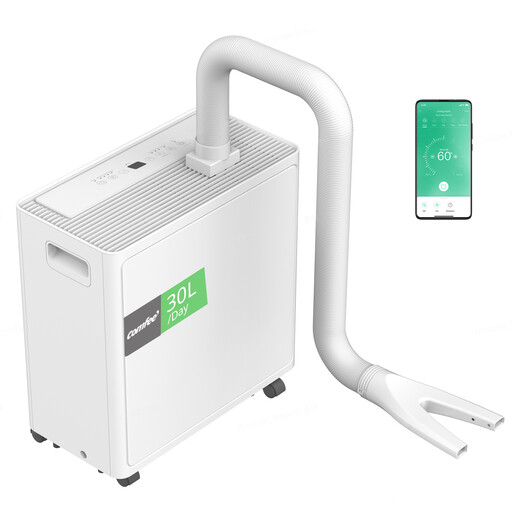
May be suitable for a large living area with extra moisture from clothes, provided the stated room size is right for your space.
The product specifications state 30 l/24 h at 30 °C and 80 % relative humidity, and a room size of up to 73 m² or 130 m³.
3.2-l tank and continuous drainage; the hose must be connected correctly and positioned lower than the appliance for drainage to work.
An adjustable humidity setting and a laundry-drying mode are listed.
 No image available
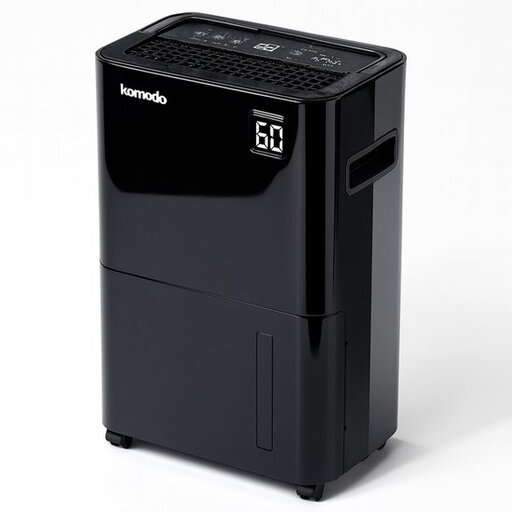
May be suitable for a larger living area affected by moisture from laundry, provided the stated room size is right for your space.
The product specifications state a room size of up to 100 m², a laundry-drying function and adjustable humidity.
2.5-l tank and hose drainage; the specifications also state 40–45 dB.
 No image available
May be suitable for a larger living area affected by moisture from laundry, if the stated room size and operating features suit your needs.
The product specifications state 16 l/day, a room size of up to 60 m² and an adjustable target humidity.
2.5-l tank, drain hoses included and a 24-hour timer. A suitable drain is needed for extended drainage.
A sleep mode at 30 dB and a humidity display are listed.
 No image available
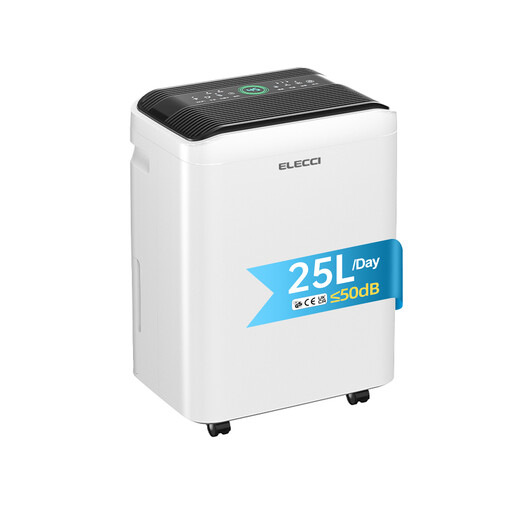
May be suitable for a larger room with extra moisture from laundry, provided its stated suitability for up to 50 m² matches your space.
The product specifications state a capacity of up to 25 l/day and a laundry-drying mode.
4.8-l tank and continuous hose drainage; a suitable drain is required. Three speed settings and a 24-hour timer are listed.
 No image available
May be suitable for a larger living area affected by moisture from laundry, provided the stated room size matches your space.
The product specifications state a capacity of up to 20 l/day, a room size of up to 40 m² and a laundry-drying function.
2.5-l tank, scheduling and a continuous-drain option. The product name states 35 dB; check the corresponding operating setting and measurement conditions before comparing.
App control and a sleep mode are listed.
The Verbraucherzentrale gives around 40–60 % relative humidity at approximately 18–22 °C as a guide to a comfortable indoor climate, and recommends using a thermo-hygrometer. Also take measurements where you store your clothes and check cooler spots behind furniture. The suggested range does not guarantee that every surface will be free from mould.
No. The Umweltbundesamt recommends regular ventilation in the living room, too; you may need to ventilate more if there are additional sources of moisture. If you can see mould or there is persistent damp, the cause needs to be identified.
Compare the capacity of the specific model’s tank and its hose connection with your chosen location. Without a suitable drain, you’ll need to empty the condensate tank. Follow the instructions for the selected appliance for filter care and other maintenance.
To calculate electricity costs, multiply the power consumption in kW by the actual running time in hours and your electricity tariff in €/kWh. De'Longhi gives the DDSX220 an input power of 470 W; this figure alone won’t tell you the daily running time or cost.
Check that the product identity, manufacturer details, applicable CE marking and German-language instructions all match the appliance. The Bundesnetzagentur provides information on market surveillance. The EU explains that the manufacturer uses the CE marking to declare that the product meets applicable requirements – it is not an independent quality mark. The Verbraucherzentrale distinguishes statutory consumer rights from a voluntary guarantee. Online purchases generally come with a right to cancel, usually within 14 days of receiving the goods; exceptions and the specific circumstances should also be taken into account.