In a regularly used, heated shared room, a suitably sized compressor dehumidifier can complement ventilation when drying laundry, but it cannot replace it. The key factors are the size of the room, the conditions behind the stated capacity, the noise level in the mode you’ll actually use and the effort involved in emptying the water tank. A desiccant dehumidifier may be an option for a cool drying room.
Who might benefit from a dehumidifier?
House share with a damp living room
If you regularly dry laundry in a shared room, you may notice and be able to limit spikes in humidity, but you should still ventilate the room regularly. The German Environment Agency (Umweltbundesamt) particularly recommends regular ventilation when damp laundry is adding moisture to a room.
Housemates who are sensitive to noise
If others use the room at the same time to work, talk or relax, check the noise rating for the specific operating mode and agree on when the appliance will run. A manufacturer’s figures don’t automatically tell you how loud it will be in your room or in laundry mode.
Household with frequent laundry loads
If you regularly dry laundry indoors, consider the room size, actual running time, electricity use and the effort involved in emptying the tank together. The German consumer advice centre (Verbraucherzentrale) recommends regularly removing moisture through ventilation.
What should you look for?
First check whether the appliance suits the room size and humidity levels. Then weigh up noise, electricity use and how practical it will be in a shared space.
| What to consider |
What to check before buying |
Who it matters most to |
| Keeping humidity in check |
Compare the room size, humidistat and stated capacity, including the test conditions. Monitor humidity and continue to ventilate the room. |
If I hang laundry in a shared room, I want to limit spikes in humidity without stopping ventilation. Around 28% of consumers put moisture protection first in this scenario. |
| Noise while running |
Check the noise rating and the operating mode it applies to for the specific model; agree running times with your housemates. |
If you use the room to work or relax at the same time as others, you need an appliance that causes as little disruption as possible. Around 22% of consumers prioritise keeping the room quiet. |
| Capacity for the room and laundry |
Make sure the stated room size and the conditions used to measure dehumidification capacity are relevant to your room. Don’t treat a laundry mode as a promise of a specific drying time. |
If I often dry laundry indoors, I want an appliance with a stated capacity that suits the room I plan to use it in. Around 22% of consumers give this capacity the greatest weight. |
| Running costs |
Check the power consumption and a realistic running time. To estimate the cost, multiply the energy used in kWh by your price per kWh. |
If I use the appliance often, I mainly want to be able to estimate the ongoing electricity costs. Around 17% of consumers consider running costs their top buying priority. |
| Emptying and positioning |
Check the tank capacity, space needed and clear airflow around the appliance. If you plan to use continuous drainage, check the drain and hose arrangement. |
If you share the room with others, you need a suitable place for the appliance and won’t want to empty the tank more often than necessary. Around 11% of consumers prioritise ease of use. |
Avoid common buying mistakes
-
Taking the litres-per-day figure as a guaranteed amount of water removed
A rated capacity applies under the stated conditions and doesn’t directly predict how much water the appliance will remove from your living room. For example, De’Longhi gives 30 °C and 80% relative humidity as the test conditions for the DNS65’s stated capacity.
Compare the room size and test conditions for each model, and monitor humidity levels in your own room.
An unsuitable appliance may run for longer than expected.
-
Skipping ventilation because you have a dehumidifier
Damp laundry adds moisture to the room. The German Environment Agency recommends regular ventilation, and the German consumer advice centre also points out that moisture that isn’t removed can encourage mould growth.
Monitor humidity, ventilate to clear excess moisture and, if dampness persists, check for cold surfaces and other possible causes.
-
Considering noise, laundry mode and the tank separately
A published dB(A) figure doesn’t automatically tell you how loud the appliance will be in laundry mode. You’ll also need to empty the tank unless you’re using a suitable continuous drain.
Check the information for the mode you intend to use, and agree with your housemates when the appliance will run and who can empty the tank.
Key brands at a glance
Comfee
The MDDF-20DEN7 is a compressor dehumidifier worth considering for a regularly used, heated drying room.
- Comfee gives the MDDF-20DEN7 a rated capacity of 20 l/24 h, a maximum room size of 40 m² and a 3-l tank.
- The manufacturer’s figures don’t confirm how well it will dehumidify or how noisy it will be in your living room. The Wi-Fi-enabled MDDF-20DEN7-WF is a separate model.
Trotec
The TTK 54 E is a compressor dehumidifier with a specifically stated laundry-drying function.
- Trotec lists a humidistat, 18 l/24 h capacity, a 3-l tank and a maximum room size of 40 m² for this model.
- For use in a shared room, you should also consider the noise level in the mode you’ll use and the space available. The rated capacity doesn’t guarantee a specific drying time.
Meaco
The Arete One compressor models come with different capacity and noise ratings. Meaco also offers desiccant dehumidifiers for cooler spaces.
- Meaco gives the Arete One 20L a capacity of 20 l/day and a noise rating of 40 dB(A), and the Arete One 12L a capacity of 12 l/day and a noise rating of 38 dB(A).
- These are manufacturer figures for different models, not an independent comparison of noise levels in laundry mode.
De’Longhi
The Tasciugo AriaDry Light DNS65 is a different type of option to consider if space and the noise rating are important to you.
- De’Longhi Germany lists a laundry-care function, 34 dB(A) and 520 W for the DNS65. The manufacturer gives a dehumidification capacity of 6 l/24 h at 30 °C and 80% relative humidity.
- This capacity applies under the stated conditions and cannot be directly applied to typical living room conditions.
Dehumidifiers at Joybuy
This selection includes dehumidifiers with a stated clothes-drying or Laundry mode for drying laundry indoors. Compare the stated room sizes and operating modes with your shared room.
 No image available
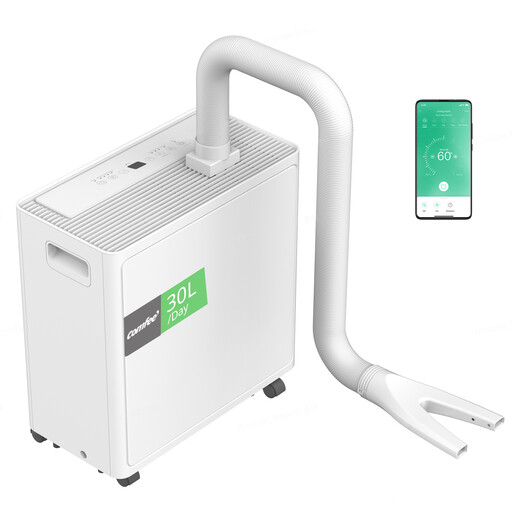
Comfee MDDA-30DEN7-SD
The stated clothes-drying mode may be useful if you regularly hang laundry indoors.
- Up to 30 l/24 h according to the product information, at 30 °C and 80% relative humidity
- 3.2-l water tank and continuous drainage
- Four modes, app control and a 24-hour timer
- Stated room size: around 130 m³ (73 m²)
View at Joybuy
 No image available
Comfee MDDO-10DEN7
The stated laundry-drying mode and Sleep mode are useful features to consider for smaller shared rooms.
- Up to 10 l/24 h
- 2.5-l water tank
- Three modes and a 24-hour timer
- Sleep mode with a stated noise level of 36 dB
- Stated room size: around 40 m³ (16 m²)
View at Joybuy
 No image available
Bosch Dry 4000
The stated Laundry mode makes this model worth considering for drying laundry indoors.
- Up to 16 l/day and a room volume of up to 75 m³
- 2.5-l tank and a stated noise level of 40 dB
- Two fan speeds, Night and Laundry modes, and an LED display
- A separately available hose is required for continuous drainage.
View at Joybuy
 No image available
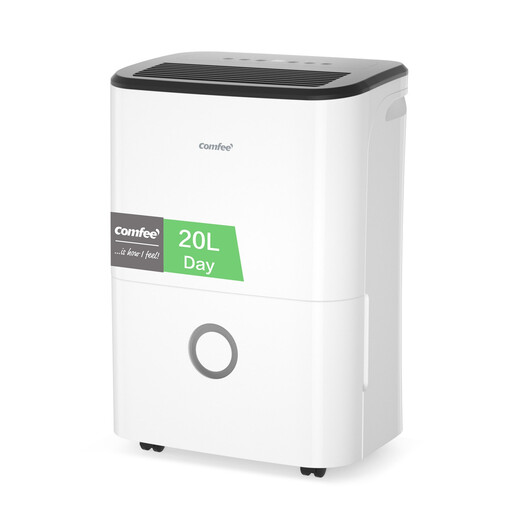
Comfee MDDF-20DEN7
The Drying mode is designed for drying clothes, while the Smart mode is described as automatically regulating humidity.
- Up to 20 l/24 h
- 3-l water tank and continuous drainage option
- Three modes and a 24-hour timer
- Stated room size: around 100 m³ (40 m²)
- A hose is needed for continuous drainage and, according to the product description, is not included.
View at Joybuy
 No image available
CONOPU CS10B
The Laundry mode and adjustable humidity range are useful features for drying laundry and monitoring humidity in the room.
- Up to 16 l/day
- 2.5-l tank
- 24-hour timer and Auto mode
- Adjustable humidity range of 40–70%
- Humidity display and continuous drainage
View at Joybuy
Frequently asked questions
Does a dehumidifier replace ventilation in the living room?
No. The German Environment Agency recommends regular ventilation when drying damp laundry in a room. You can use a hygrometer to monitor humidity levels.
How should I use the appliance when others share the room?
Position the appliance as instructed, leaving space for airflow and routing the cable safely. Agree on when it will run and who will empty the tank. Continuous drainage requires a suitable drain.
How can I work out the electricity cost of a drying cycle?
Multiply the actual power consumption in watts by the number of hours the appliance runs, then divide the result by 1,000 to get kWh. Multiply this figure by your price per kWh.
What rights do I have if an appliance bought from a trader is faulty?
According to Your Europe, the European Union’s information portal, purchases from a trader are covered by a legal guarantee of at least two years from the date you receive the goods. Contact the seller; this is separate from any additional manufacturer’s guarantee.
What does the CE marking tell me about a dehumidifier?
For appliances covered by relevant harmonised EU rules, the manufacturer uses the required CE marking to declare that the product complies with the applicable regulations. Your Europe explains that CE is not an independent quality mark and does not show how well a particular model dries laundry.


