For a small, heated room used for drying laundry, a compact refrigerant dehumidifier with a suitable room-size rating is a sensible starting point. If you regularly dry larger loads, it may be worth comparing more powerful models. You should also consider the temperature where you plan to place the unit, its tank capacity and operating noise. A dehumidifier is no substitute for regular ventilation or for investigating the cause of any existing mould.
Who might benefit from a dehumidifier when drying laundry?
Drying laundry in a studio flat
If you dry clothes in a heated living space, you’ll need to consider floor space and operating noise, as well as the moisture wet laundry releases into the air. The Verbraucherzentrale and the German Environment Agency recommend regularly replacing humid air with fresh air.
Households with frequent loads of laundry
If you regularly dry clothes indoors, check the stated capacity, the conditions behind that figure and how much effort is involved in emptying the tank. Bosch’s specifications can help you compare different appliance sizes and tank capacities.
Drying laundry in a cool utility room
If your drying area is barely heated or unheated, make sure the permitted operating temperature is suitable for the room. Trotec also describes its TTR 57 E adsorption dehumidifier as suitable for unheated rooms.
What should you look for when buying one?
Start by checking the room temperature and available space where you dry your laundry. Then compare your laundry needs and the effort involved in using the appliance, and factor in energy consumption and noise.
| What matters |
What to check when buying |
Who is this especially important for? |
| Keeping humidity under control |
Check that the stated room size and operating temperature suit the room where you’ll dry your laundry; look for a humidity display or humidistat. |
If you hang wet laundry in a cool room or one with limited ventilation, you’ll want to keep an eye on humidity. Around 31 % of consumers put humidity control first. |
| Space and noise |
Check the appliance dimensions and the space it needs; only compare noise levels if the operating modes and measurement conditions are the same. |
In a small flat, you won’t want the appliance to take up unnecessary space in your living or sleeping area. Around 25 % of consumers prioritise footprint and operating noise. |
| Load size and running time |
Check the capacity in l/24 h alongside the test conditions, laundry mode and tank capacity. |
If you regularly have larger loads of laundry, you’ll want to know whether the appliance can meet your drying needs. Around 25 % of consumers prioritise support for frequent laundry loads. |
| Running costs |
Consider power consumption alongside the likely running time; check the cost of optional accessories such as filters separately. |
If you use the appliance regularly, you’ll want to factor in its energy use and any ongoing costs. Around 19 % of consumers put running costs first. |
Figures in l/24 h are based on specific test conditions and don’t guarantee a particular drying time for a load of laundry. The German Environment Agency recommends paying particular attention to regular ventilation when drying wet laundry indoors; a hygrometer can help you monitor room humidity.
Common buying and usage mistakes
-
Assuming the litres-per-day rating tells you how much laundry each load will dry
A manufacturer’s stated capacity is based on specific test conditions. For example, Bosch gives the Dry 1000 a capacity of 10 l/24 h at 30 °C and 80 % relative humidity. Conditions in your home may be different.
Compare capacity figures alongside the stated test conditions, and don’t use them to predict an exact drying time.
-
Automatically choosing a small appliance for a cool room
According to the manufacturer, the Trotec TTK 26 E is designed for heated rooms from 15 °C, while Trotec also describes the TTR 57 E as suitable for unheated rooms.
Before choosing an appliance type, check the temperature where you’ll actually dry your laundry and make sure it’s within the appliance’s intended operating range.
-
Treating dehumidification as a substitute for ventilation or investigating the cause
Wet laundry increases the need for ventilation. If there’s already mould, you’ll also need to find and deal with the cause, as the Verbraucherzentrale explains.
Monitor room humidity, ventilate appropriately and have any existing damage investigated separately.
-
Confusing optional filter accessories with dehumidification
Some appliances offer a filter as a separate accessory. Having a filter does not, by itself, guarantee a particular laundry-drying time or mean that the cause of damp has been dealt with.
Before buying, check whether you need the extra feature and which accessories are compatible with the exact appliance variant.
Brands to consider
Trotec
The models mentioned here suit different settings: a refrigerant dehumidifier for heated rooms and an adsorption dehumidifier for cooler locations.
- Trotec says the TTK 26 E is designed for heated rooms of 4 to 15 m² at temperatures from 15 °C. It has a laundry mode and a 1.8-l tank.
- Trotec also describes the TTR 57 E as suitable for unheated rooms and operation from 1 °C. This does not establish an independently measured cost or speed advantage.
Bosch
The Dry 1000 and Dry 4000 are two different-sized models, both of which the manufacturer says have a laundry mode.
- Bosch rates the Dry 1000 for up to around 17 m², with a capacity of 10 l/24 h at 30 °C and 80 % relative humidity, and a 2.5-l tank.
- For the Dry 4000, Bosch Home Comfort gives a coverage of up to around 33 m² or 75 m³ and a capacity of 16 l/24 h. Its tank also holds 2.5 l.
- Noise figures may vary depending on operating conditions and how they’re presented. Only compare figures measured under similar conditions.
Meaco
The MeacoDry Arete One 12L is a refrigerant dehumidifier for anyone considering dehumidification alongside an optional air-filtration function.
- Meaco gives the model a capacity of 12 l/day and a noise level of 38 dB(A); the German product page lists a HEPA H13 filter and separate filter accessories.
- These figures don’t guarantee a particular laundry-drying time or show that a filter will deal with the cause of damp.
Midea
The DF-20DEN7-WF is included as a higher-capacity refrigerant dehumidifier for comparison when there’s more moisture to deal with.
- Midea Germany gives a capacity of 20 l/24 h at 30 °C and 80 % relative humidity, a 3-l tank and an operating range of 5 to 32 °C.
- Don’t choose this model for a small room based on the stated floor area alone; check the appliance’s specific operating conditions.
Dehumidifiers for different laundry-drying needs
The selection below includes appliances with a laundry mode for small rooms, as well as models with larger room-size ratings or for more frequent laundry loads. Before choosing, check that the stated dimensions, capacity and operating conditions suit the space where you’ll dry your laundry.
 No image available
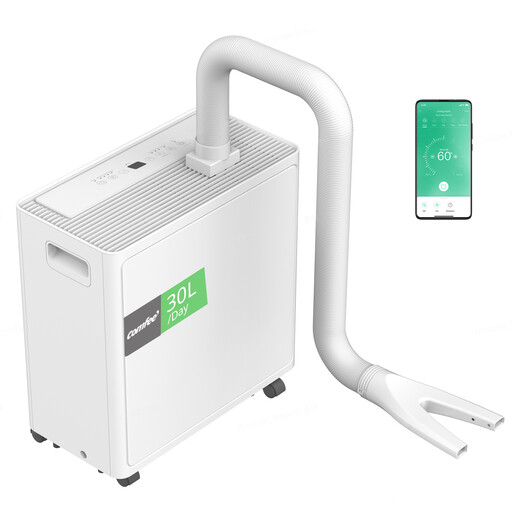
Comfee MDDA-30DEN7-SD
The stated laundry mode is useful for drying clothes indoors, and the room-size rating goes up to around 73 m².
Dehumidifying capacity: 30 l/day. Water tank: 3.2 l. Room-size rating: around 130 m³ (73 m²).
Joybuy
 No image available
Comfee MDDO-10DEN7
For a smaller drying space, the stated room-size rating of up to 16 m² is a useful point of comparison; a laundry-drying mode is also listed.
Dehumidifying capacity: 10 l/day. Water tank: 2.5 l. Sleep mode: 36 dB according to the product specifications. Room-size rating: around 40 m³ (16 m²).
Joybuy
 No image available
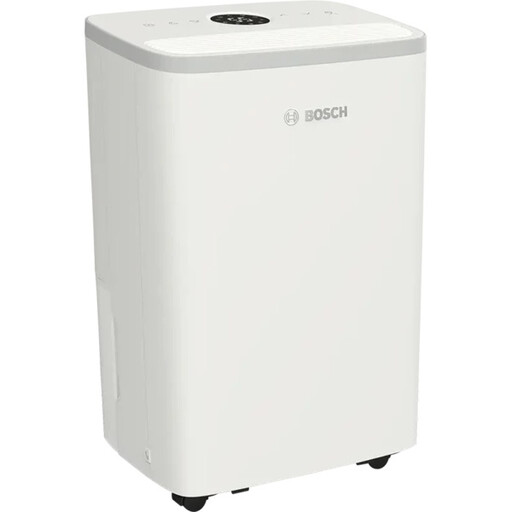
Bosch Dry 2000
The stated laundry mode may be useful for drying clothes on an airer; also check that the room-size rating suits the space where you plan to place the appliance.
Dehumidifying capacity: up to 12 l/day. Room-size rating: up to 55 m³. Water tank: 2.5 l. Noise level: 38 dB.
Joybuy
 No image available
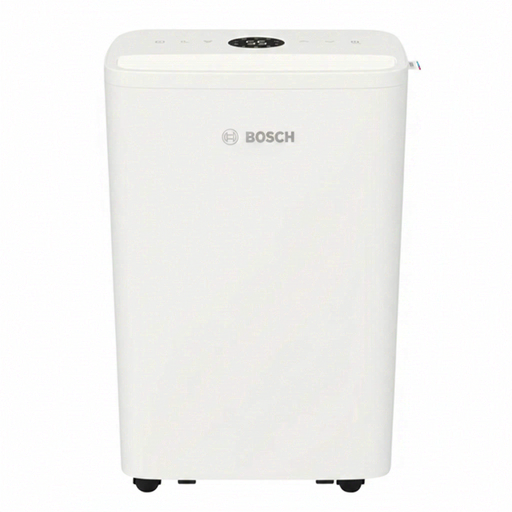
Bosch dehumidifier, 10 l/day
A laundry-drying mode is listed; check that the model’s room-size rating suits the space where you’ll dry your laundry.
Dehumidifying capacity: up to 10 l/day. Water tank: 2.5 l. Noise level: 36 dB on the highest setting.
Joybuy
 No image available
Bosch Dry 4000
The laundry mode is useful if you dry clothes regularly; the room-size rating of up to 75 m³ should suit the volume of your room.
Dehumidifying capacity: up to 16 l/day. Water tank: 2.5 l. Noise level: 40 dB.
Joybuy
Frequently asked questions
Do I need to ventilate the room while a dehumidifier is running?
Yes. Don’t treat a dehumidifier as a substitute for fresh air. The German Environment Agency recommends regular ventilation when drying wet laundry indoors; a hygrometer can help you monitor room humidity.
How do I choose an appliance for a cool room?
Compare the temperature where you’ll place the appliance with the operating range specified for that particular model. Trotec also describes the TTR 57 E as suitable for unheated rooms and operation from 1 °C. A compact appliance designed for heated rooms won’t necessarily be suitable for a cool utility room.
Where should I place a dehumidifier, and what should I bear in mind while it’s running?
Follow the instructions for your specific model and check that there’s enough space at the chosen location. Check and empty the tank; a suitable drainage connection may reduce how often you need to empty it.
Do dehumidifiers have an energy efficiency rating?
The European Commission says that no EU energy efficiency rating has been defined for dehumidifiers. Instead, compare power consumption and how the appliances perform under as similar conditions as possible; you can’t apply a tumble dryer’s energy label to a dehumidifier.
Can a dehumidifier help if there’s already visible mould?
A dehumidifier won’t automatically deal with the cause of an existing mould problem. The Verbraucherzentrale advises finding and addressing the cause promptly; for a larger infestation, it recommends calling in a specialist.


