A dehumidifier can help if the air in your home remains too damp despite regular ventilation. However, it is no substitute for fresh air or fixing the cause of damp entering the building. First, measure the temperature and humidity, then check your ventilation, heating and any potential sources of moisture. If your living room is usually heated, a compressor dehumidifier may be suitable. If the room is significantly cooler for long periods, check that the specific model is suitable for those temperatures.
Who is this relevant to?
People with a large, damp living room
If condensation repeatedly appears on your windows, compare the actual size of your room with the manufacturer's stated room coverage. Regular ventilation remains important, as explained by the German Environment Agency.
People with misted-up windows and no clear idea why
If you want to find out whether your habits, heating and ventilation, or damage to the building are contributing before you buy, monitor the room temperature and humidity. The Verbraucherzentrale and German Environment Agency highlight these factors as important when identifying the cause.
People who spend a lot of time in the living room
If you use a dehumidifier in your living space for long periods, its noise, controls and drainage can all affect your daily routine. Check the details provided by the manufacturer and the operating conditions they apply to.
What should you look for when buying?
Measure the room and humidity before comparing models. Does the stated room coverage, operating conditions, noise level and drainage suit the way you plan to use it?
| Consideration |
What to check before buying |
Who is this particularly relevant to? |
| Room coverage |
Compare the floor area and room volume with the room size stated for the specific model. |
If I want to dehumidify a large living room, suitable room coverage matters more to me than a high litre figure on its own. Around 33% of consumers prioritise room size. |
| Cause of condensation |
Measure the temperature and relative humidity, and check for sources of moisture, ventilation issues and visible damage. |
If I don't know why my windows are misting up, I want to work out whether a dehumidifier is appropriate before I buy one. Around 27% of consumers focus on identifying the cause. |
| Noise in the living space |
Check the noise rating and operating mode for the specific model, and note the operating conditions the rating applies to. |
If I spend a lot of time in the living room, I want the appliance to disrupt my daily routine as little as possible. Around 20% of consumers prioritise quiet operation in their living space. |
| Running and emptying the appliance |
Check the power consumption, expected running time, tank capacity and whether continuous drainage is an option. |
If the appliance is going to run regularly, I want to factor in its electricity use and the need to empty the tank. Around 20% of consumers pay particular attention to running costs and water drainage. |
Avoiding buying pitfalls
-
Assuming the litre rating is how much it will extract each day in your living room
Manufacturer figures depend on the test conditions. Trotec states up to 24 l per 24 hours at 30 °C and 80% relative humidity; actual performance is lower under typical living-room conditions.
Compare the test conditions and stated room coverage rather than focusing on the litre figure alone.
Lower performance in typical living-room conditions can mean longer running times.
-
Trying to treat misted-up windows with an appliance alone
Damp may be linked to how you use the room, ventilation or damage to the building envelope. A dehumidifier will not fix damp entering through a structural problem.
Monitor the temperature and humidity, check your ventilation and heating, and get persistent damp or the cause of any mould investigated.
-
Leaving drainage and running requirements until after you buy
A full tank needs to be emptied. For longer periods of use, continuous drainage can reduce the need for manual emptying, provided there is a suitable drain.
Check the tank, full-tank shut-off, connection options and power consumption for the specific model. According to the manufacturer, the filter for the Bosch Dry 4000 is sold separately.
If you need a filter for the Bosch Dry 4000, remember that it is sold separately.
Key brands at a glance
Bosch
Bosch Home Comfort states that the Dry 4000 is suitable for rooms up to around 75 m³ or 33 m². It may be worth considering for a living room within those limits.
- Bosch Home Comfort states that the model can remove up to 16 l of moisture per day. It has a noise rating of 38 dB(A), Auto and Night modes, a 2.5-l tank and an option for continuous drainage.
- These are the manufacturer's figures, not a guarantee of performance or noise levels in every operating condition. The filter is sold separately.
Meaco
Meaco offers the Arete One 25L compressor dehumidifier, as well as desiccant models in its DD8L range. Suitability depends on the specific model and room temperature.
- For the Arete One 25L, Meaco states coverage of up to 125 m² and moisture removal of 25 l per day, with a noise rating of 40/42 dB. For DD8L models, the manufacturer specifies operation from 0 °C.
- These figures apply to different models and do not show that the appliances can fix structural damp.
Trotec
Trotec states that the TTK 66 E is suitable for rooms up to 50 m² or 125 m³ and has an adjustable target humidity.
- Trotec lists a 3-l tank, a timer and moisture removal of up to 24 l per 24 hours at 30 °C and 80% relative humidity.
- Trotec notes that actual performance is lower under typical living-room conditions. The stated room coverage is not a guarantee based on measurements in your own living room.
De’Longhi
The Tasciugo AriaDry Multi DDSX220WFA is an electric option for the home, particularly if app control and water drainage are important to you.
- For combination mode, De’Longhi states moisture removal of 21 l per 24 hours at 32 °C and 80% relative humidity, a noise rating of 42/47 dB(A) and power consumption of 490 W.
- These test conditions are not directly comparable with a cooler living room or ratings defined in a different way.
Suitable products at Joybuy
This selection includes electric dehumidifiers for larger rooms, as well as a hygrostat for control. Before choosing the hygrostat, check whether you need a controller or a standalone dehumidifier.
 No image available
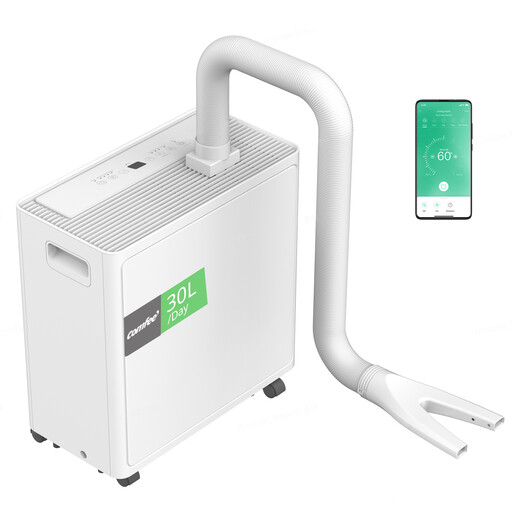
Comfee MDDA-30DEN7-SD, 30 L/day
The stated room coverage may suit a large living room; compare it with your actual room measurements.
Stated as suitable for 58–73 m² or 92.5–130 m³. Its moisture removal rate of 30 l/24 h is based on 30 °C and 80% relative humidity.
Features include a 3.2-l tank, continuous drainage, app control and a timer.
View at Joybuy
 No image available
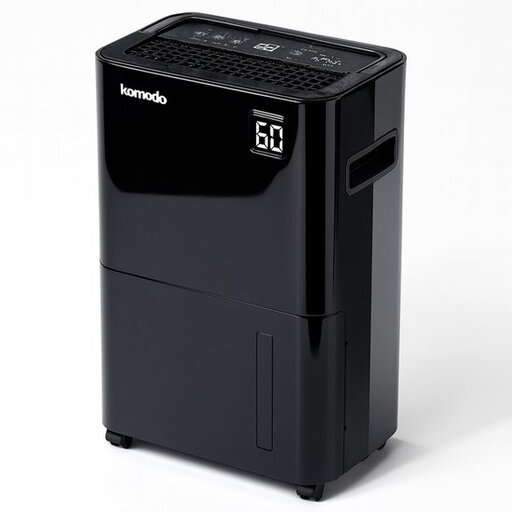
Komodo dehumidifier, 20 l/day
The stated room size may make this a good option for a larger living space; check it against your own room measurements.
Stated as suitable for rooms up to 100 m². The tank holds 2.5 l, and hose drainage is available for longer use without manually emptying the tank.
Features include adjustable humidity settings and a timer.
View at Joybuy
 No image available
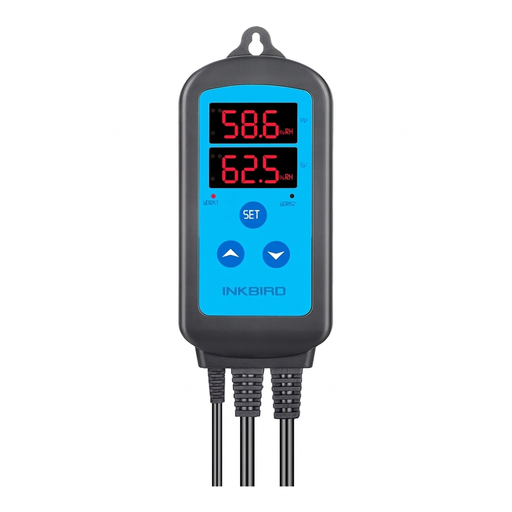
INKBIRD IHC-200 hygrostat, 220 V
The product name describes this as a hygrostat for humidifiers and dehumidifiers. Check whether you need a controller rather than a standalone dehumidifier.
Described as a plug-and-play device for 220 V.
View at Joybuy
 No image available
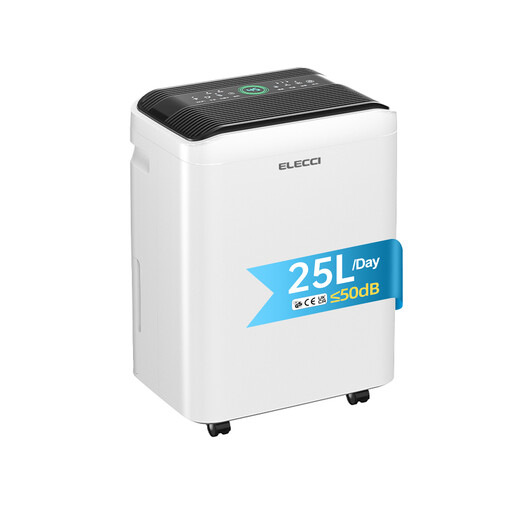
ELECCI dehumidifier, 25 l/day
Stated as suitable for a room up to 50 m²; compare this figure with the actual floor area of your living room.
The moisture removal rate of 25 l per day is based on 30 °C and 80% relative humidity. The tank holds 4.8 l, and hose drainage is listed.
Features include a 24-hour timer and automatic defrosting.
View at Joybuy
 No image available
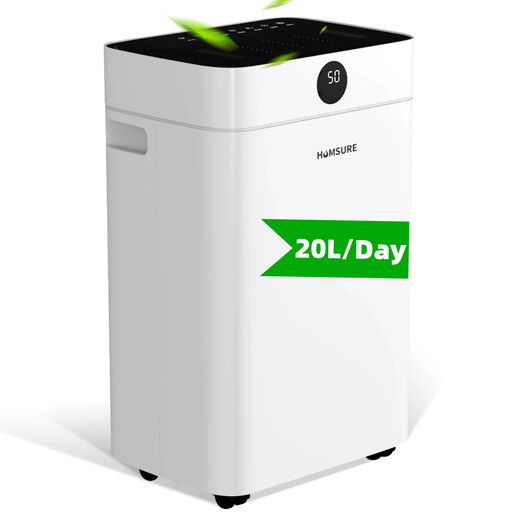
HUMSURE dehumidifier, 20 l/day
Stated as suitable for living rooms up to 50 m²; check that the stated area matches your room.
The moisture removal rate of 20 l per day is based on 86 °F and 80% relative humidity. The tank holds 2.8 l; tank and hose drainage are both described.
Features include an adjustable target humidity, a timer and automatic defrosting.
View at Joybuy
Frequently asked questions
What humidity level should I check before buying?
Use a thermo-hygrometer to take a reading rather than judging by condensation on the windows alone. The Verbraucherzentrale suggests around 40–60% relative humidity at approximately 18–22 °C as a guide to a comfortable indoor environment. This is not a one-size-fits-all setting for every home.
Can a dehumidifier replace ventilation?
No. The German Environment Agency says regular ventilation is necessary in living rooms too. A dehumidifier is no substitute for fresh air or fixing damp caused by damage to the building.
Which type of appliance is right for a large living room?
For a living room that is usually heated, consider a compressor dehumidifier with suitable stated room coverage. If the room is significantly cooler for long periods, check that the specific appliance is designed for those temperatures and that room size.
What should I look for when it comes to the tank and continuous drainage?
Check the tank capacity, full-tank shut-off and continuous drainage option for the specific model. Bosch Home Comfort lists a 2.5-l tank and hose drainage for the Bosch Dry 4000. Before buying, check whether a hose is included and whether you can connect it to a suitable drain.
Does a CE mark mean that the EU has tested the appliance?
No. Electrical appliances covered by the EU Low Voltage Directive must meet safety requirements. The European Commission states that the CE mark is not a safety approval issued by a public authority. You should also check the mains voltage and documentation for the specific appliance.


