People keeping clothes in a damp home office
If you store textiles in a room you use regularly, measure the room’s humidity and check for possible sources of damp before choosing a device.


First, measure the humidity in your home office and check whether the issue affects the whole room or just an enclosed wardrobe. If room humidity is repeatedly high, an electric dehumidifier suited to the room size and temperature may be worth considering. For a small, poorly ventilated storage space, a passive absorber may be enough. An absorber is no substitute for ventilation or investigating the cause of damp; in a home office, you should also consider noise, emptying the water tank and ongoing electricity use.
If you store textiles in a room you use regularly, measure the room’s humidity and check for possible sources of damp before choosing a device.
If you make video calls or need to concentrate, the noise level of the specific model and the setting you choose may be important factors.
If the problem is limited to a small, poorly ventilated wardrobe or storage box, a passive absorber may be more suitable for this limited area than a device designed for the whole room.
First, establish whether the damp affects the whole home office or only the wardrobe. Room size, typical temperature and operating noise can then help you narrow down the right type of device.
| Concern | What to check before buying | Who it matters to most |
|---|---|---|
| Persistent room humidity | Compare the room volume, temperature and measured humidity with the stated performance of the device. Trotec specifies that the TTK 33 E is suitable for up to 15 m² or 37 m³, with a capacity of up to 14 l/24 h; this manufacturer’s figure is not a guarantee for every room. | If I store clothes throughout my home office, I want to know whether the room air is actually affected. Around 36% of consumers say room humidity is their main concern. |
| A quiet working environment | Check the noise rating and operating setting for the specific model. Trotec gives a figure of 43 dB(A) for the TTK 33 E on its highest fan setting, while De’Longhi gives 36 dB(A) for the DEX210SF. These figures are not a like-for-like listening comparison under identical conditions. | If I make calls or need to concentrate while the device is running, I want to know how its noise will fit into my day. Around 29% of consumers put a quiet working environment first. |
| Damp in the wardrobe | Consider the size and ventilation of the storage space. For passive products, check when they become saturated, how often they need replacing and the manufacturer’s advice on contact with textiles and delicate materials. | If only a wardrobe or storage box seems damp, I don’t automatically need a device for the whole room. Around 21% of consumers prioritise targeted protection in their storage space. |
| A cool room | Check the usual room temperature and the operating range of the specific model. Trotec lists the TTR 57 E desiccant dehumidifier for areas up to 20 m² or 50 m³; with this type, you should also consider energy use and heat output. | If my home office stays cool for long periods, I want to choose a type that suits those conditions. Around 14% of consumers consider room temperature their most important selection criterion. |
The stated dehumidification capacity depends on the test conditions. For example, De’Longhi gives the DEX210SF’s 10 l/24 h figure at 30 °C and 80% relative humidity.
Compare the test conditions with your usual room temperature, room volume and measured humidity levels over time.
A device that is the wrong size may need to run for longer than expected.
The UHU Kompakt/Mobil bag is designed for small storage spaces. If room humidity is high, you should also investigate the cause; the German Environment Agency emphasises that the source of damp must be identified and dealt with.
Measure the room and storage space separately. If there is damp or mould damage, the cause should be investigated.
A saturated bag needs replacing; a refillable system requires compatible refills.
Trotec gives a maximum capacity of 0.75 l/24 h for the TTP 10 E Peltier dehumidifier and up to 14 l/24 h for the TTK 33 E. These figures relate to different devices and do not indicate performance under identical conditions.
Choose according to the area affected and the level of damp, not just the device’s size or the fact that it runs on electricity.
If it cannot dehumidify the room sufficiently, you may need another device.
At low temperatures, many compressor dehumidifiers may remove less moisture. Desiccant dehumidifiers use warmed air to regenerate their drying material, which requires energy.
Check the usual room temperature and compare the operating conditions for the different types of device.
Longer running times may mean higher electricity use than expected.
The models listed cover different uses: compressor dehumidifiers for rooms, a desiccant model for cooler spaces and a Peltier mini dehumidifier.
The compressor-powered Tasciugo AriaDry DEX210SF is a useful comparison model for a living room or home office in regular use.
The MeacoDry Arete One 12L is a compressor model to compare if the manufacturer’s advertised filter function is also important to you.
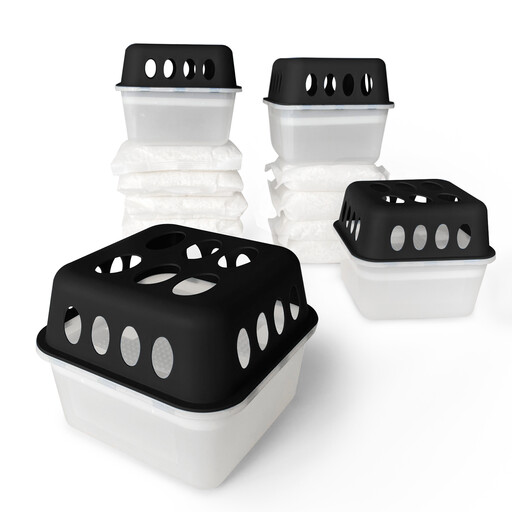
The passive absorbers featured here are designed for small storage spaces such as wardrobes and boxes.
The product options below include electric dehumidifiers for rooms and passive absorbers for smaller storage spaces.
 No image available
An active dehumidification option if the stated room size is suitable for your home office.
Features listed in the product title: 10 l/day, 2.5-litre water tank, 3 modes, 24-hour timer and suitability for rooms of around 40 m³ (16 m²). Automatic defrost, child lock and R290 refrigerant are also listed.
 No image available
A passive option for wardrobes or other small storage spaces if you do not want an electrical device.
The product title lists 4 moisture absorbers and 8 refill bags. You will need a refill bag once the granules have been used up.
 No image available
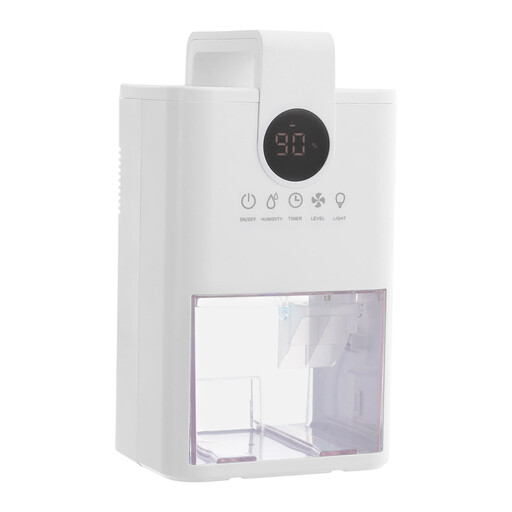
The compact design may suit a small area; check that the stated daily capacity is right for how you plan to use it.
Features listed in the product title: 200 ml/day, LED humidity display, 3 fan speeds and a timer for 6, 12 or 24 hours. Automatic shut-off when the water tank is full is also listed.
 No image available
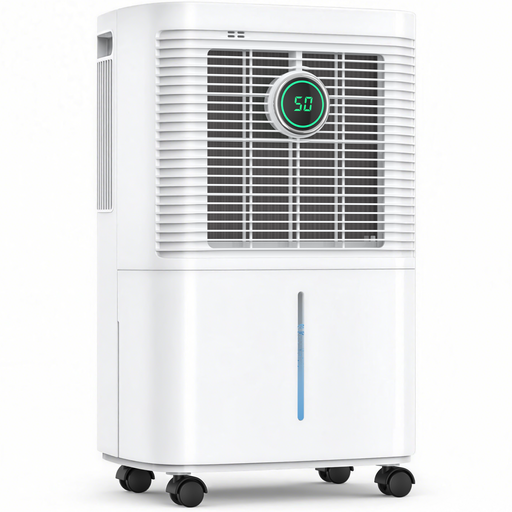
An option for room air, provided the stated room size is suitable for your home office.
Features listed in the product title: 16 l/day, up to 75 m³, 2.5-litre water tank and 40 dB. Also listed are 2 fan speeds, night mode and laundry-drying mode.
 No image available
An option for room air if automatic humidity control suits your home office needs.
The product title lists a capacity of up to 16 l/day, a 36 dB sleep mode, a laundry-drying mode and automatic defrost.
First, use a hygrometer to measure relative humidity and check for possible sources of damp, as well as how well the room is ventilated. The Verbraucherzentrale (German consumer advice centre) gives around 40 to 60% as a guide for a comfortable indoor climate; this does not mean every room needs to be kept at one set level all the time.
A passive absorber may be suitable for a small, poorly ventilated wardrobe or box. It is not the same as a device that regulates the air in a room, and it will not deal with a structural cause of damp.
Do not assume you can simply because the device is compact. Check the instructions for the specific model for its permitted location, required airflow and safety clearances. For enclosed wardrobes, UHU describes a passive bag as a separate solution.
Compare litres-per-day figures only alongside the relevant test conditions and the room temperature you expect. For example, De’Longhi gives the DEX210SF a capacity of 10 l/24 h at 30 °C and 80% relative humidity; this is not a guaranteed amount of water collected under different conditions.
Check and clean the tank and, where applicable, the filter according to the instructions for your device. Passive products need replacing or refilling, depending on the product; electricity costs for electric devices depend on factors including the model and how long it runs.
A dehumidifier is no substitute for identifying and dealing with the cause of damp. The German Environment Agency emphasises that the cause of excess moisture that has led to mould growth must be identified and dealt with.