
Lieferung heute & morgen

Qualitätsgarantie

Willkommens-Angebote freischalten: KOSTENLOSE Lieferung | Bis zu 80 % RABATT | Kostenlose 30-Tage-JoyPlus-Testphase
App herunterladen
Condensation on windows, musty smells in the cellar or washing that takes a long time to dry are typical signs of high indoor humidity. A suitable dehumidifier for your home can help reduce excess moisture in a targeted way. However, appliances vary considerably in terms of performance, noise, energy consumption and drainage options.
Simply looking at the stated litre capacity does not automatically mean you will choose the right model. The following points will help you avoid common purchasing mistakes and select an electric dehumidifier suited to the intended location.
The figure “20 litres per day” usually refers to maximum dehumidification performance under specified conditions, such as high temperature and high relative humidity. In a cooler bedroom or cellar, the actual amount of water collected can be considerably lower.
The following combination is therefore crucial:
A model with a 10-litre daily capacity may be sufficient for a small bedroom, while a large cellar or frequently used utility room may require a model with a capacity of 20 or 30 litres.
A compact tank saves space, but needs to be emptied more frequently when humidity is high. For a cellar dehumidifier, garage or utility room, the option of continuous drainage is therefore particularly important.
Look for:
A dehumidifier with a hose can enable longer operating times. However, the hose must be positioned without kinks and must not run upwards if the appliance relies solely on gravity drainage.
Noise levels are usually stated in dB(A). Even a difference of just a few decibels can be noticeable in a bedroom. Compressor models also produce operating noise from the fan, compressor and refrigerant circuit. A quiet dehumidifier should therefore not only have a low noise rating in sleep mode, but also be suitable for the time of day when you plan to use it.
Compare the recommended room area with the actual intended use. The manufacturer’s stated figure is a guide and depends on the measurement conditions. For a single bedroom, bathroom or office, a model in the range of 10 to 16 litres per day is often sufficient. For larger living areas, cellars or regular clothes drying, 20-litre dehumidifiers or 30-litre dehumidifiers may be suitable.
If several rooms are connected, bear in mind that the appliance will not circulate air evenly in every area. Closed doors limit its effectiveness.
Many condenser dehumidifiers operate within a range of approximately 5 to 35 °C. In cool cellars, ice can form on the heat exchanger. A dehumidifier with auto-defrost interrupts compressor operation when necessary and automatically defrosts the appliance. This is particularly relevant for cellars, garages and unheated utility rooms.
Place the appliance on a level, stable surface and leave sufficient clearance around the air inlet and outlet. If it has been transported in a tilted position, follow the instructions and leave it standing upright before switching it on.
An energy-efficient dehumidifier is not defined solely by a low wattage. It is also important whether a humidistat automatically reduces or stops operation once the target humidity level has been reached. A dehumidifier with a timer can adjust operating times to suit different times of day. Models with Wi-Fi control also allow you to change settings via an app.
When choosing a model, consider the power consumption, intended level of use and daily operating time together. Automatic switch-off when the tank is full and a child lock are practical safety features for households with children.
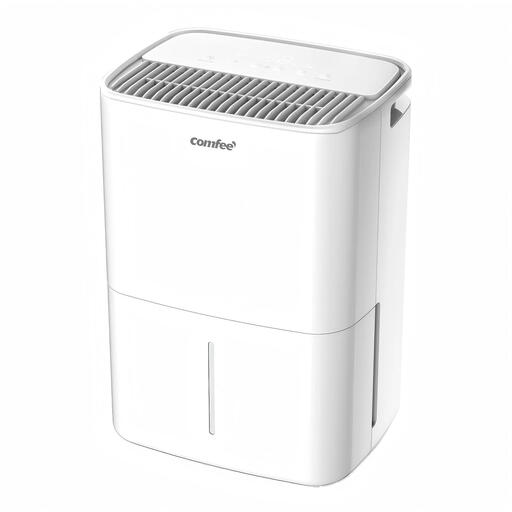
Why this product suits this profile: Designed for rooms of up to around 40 m³ or 16 m², this appliance is suitable for smaller flats, kitchens or bedrooms.
The stated room size makes it easier to assess whether the appliance is suitable. The 2.5-litre tank has a water-level indicator, warning tone and automatic switch-off.
10 l/24 h, three operating modes, 24-hour timer, auto-defrost and a sleep mode with a noise level of 36 dB(A).

Why this product suits this profile: This model combines a stated capacity of 20 l per day with app control, scheduling and a sleep mode for larger living or working spaces.
Control is based not just on marketing claims, but on adjustable target values, timers and automatic switch-off when the tank is full.
Wi-Fi app, 2.5-litre tank, automatic internal drying, clothes-drying function and a stated 35 dB in sleep mode.
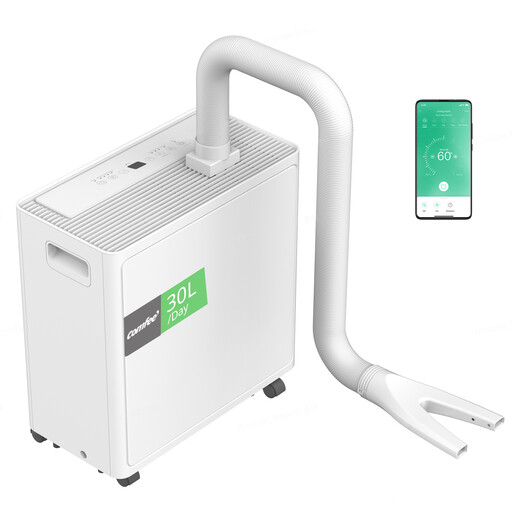
Why this product suits this profile: The combination of high stated dehumidification performance, clothes drying and continuous drainage is aimed at larger rooms, cellars and households that regularly dry damp washing.
The 3.2-litre tank can be supplemented with a hose connection. Auto-defrost and overflow protection support longer operating periods.
30 l/24 h under the stated conditions, four modes, app control, 24-hour timer and two fan speeds.
We have put together a complete, regularly updated list of products that fully meet these strict selection criteria and the safety regulations applicable in the EU.
Consumption depends on the rated power, operating time, room temperature and humidity level. A 200-watt appliance running for ten hours would use approximately 2 kWh. Actual consumption may be lower because of the humidistat, timer and automatic pauses. For a realistic estimate, multiply the power consumption by the daily operating time and your electricity tariff.
For a bedroom, room size, noise level and night mode are particularly important. Models with around 32 to 36 dB(A) in sleep mode may be more suitable for noise-sensitive users than appliances with a higher noise level. Automatic switch-off, a timer and an easily accessible tank should also be included.
Service life depends on operating hours, care, filter cleaning, location and correct handling. Unrestricted air flow, regular cleaning and placing the appliance on a level surface all help to ensure reliable operation. For appliances using R290 refrigerant, the refrigerant circuit and compressor must not be opened or modified yourself.