
Lieferung heute & morgen

Qualitätsgarantie

Willkommens-Angebote freischalten: KOSTENLOSE Lieferung | Bis zu 80 % RABATT | Kostenlose 30-Tage-JoyPlus-Testphase
App herunterladen
Condensation on windows, musty smells or clothes that take a long time to dry are common reasons to buy a dehumidifier. However, choosing one is not simply a matter of looking at its litres-per-day capacity. If you focus only on the large number on the packaging, you could end up with a model that is too noisy for the bedroom, unsuitable for the temperature in your cellar or fitted with a small tank that needs constant emptying.
As a Joybuy Product Recommendation Officer, I filter the most important product details and organise them according to typical usage scenarios. This makes it easier to assess marketing claims and avoid disappointing purchases.
Figures such as 16L, 20L or 25L per day usually refer to specific temperature and humidity conditions. In practice, a model rated at 20 litres per day may remove less water in cool cellar air. Always check the conditions under which the performance was measured.
For a bedroom dehumidifier, noise levels are also crucial. A high-capacity model may be oversized for a small room, while stronger fan noise or frequent switching on and off could disturb you.
Manufacturers sometimes specify a maximum floor area or room volume. This is a guideline, not a guarantee of even dehumidification in every home. Open-plan layouts, high ceilings, frequent ventilation and continuously wet laundry all increase the workload.
When choosing a cellar dehumidifier, you should consider the temperature as well as the floor area. A model with automatic defrost can be more practical at lower temperatures, as less ice builds up on the heat exchanger in cold conditions.
A 1.4- or 1.8-litre tank may be sufficient in a moderately damp bedroom. With a dehumidifier for drying laundry, or in persistently humid conditions, however, it can fill up quickly. Automatic shut-off prevents the tank from overflowing, but it also stops the appliance from operating.
For longer operating times, a dehumidifier with a hose is a sensible choice. The drain hose must run downhill to a suitable drain. A pump is not automatically included and should not be assumed.
As a rough guide, smaller rooms of up to around 16 to 25 m² can usually be served by models offering 10 to 16 litres per day. For larger or particularly damp areas, consider a 20L dehumidifier or 25L dehumidifier. For very large spaces, compare the manufacturer’s stated room size with the actual layout.
Also check the power consumption in watts. Running costs depend on how long the appliance operates:
Electricity costs = power consumption in kW × operating hours × electricity price
A 300-watt appliance uses 3 kWh over ten hours of operation. The actual running time may be reduced by a humidistat, timer or automatic mode.
A quiet dehumidifier is often listed at around 36 to 47 dB(A). Measurement conditions can vary, so compare like-for-like operating modes wherever possible. Sleep mode often reduces the fan speed or switches off the display illumination.
For living rooms and bedrooms, adjustable target humidity, a timer and automatic shut-off are useful features. A humidistat can switch the appliance on and off according to the measured humidity level. This is more practical than running a compressor continuously.
Check the following:
R290 is flammable. Adequate clearance, good ventilation and following the operating instructions are therefore essential safety measures. A dehumidifier must not be covered, placed in water or opened yourself.
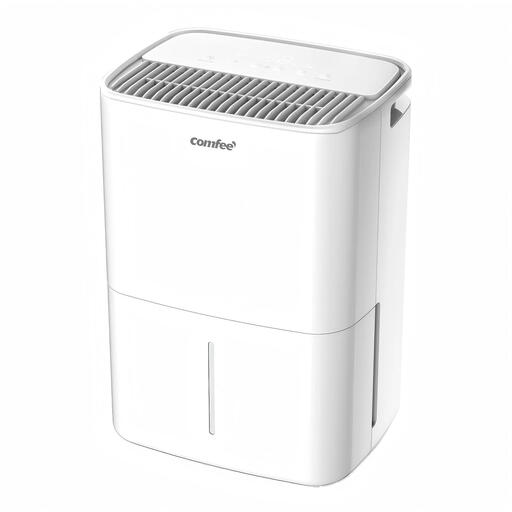
Why this product suits this profile: Its stated capacity of 10 litres per 24 hours and suitability for approximately 16 m² make it a good fit for smaller bedrooms, kitchens or poorly ventilated rooms. According to the manufacturer, sleep mode operates at 36 dB(A).
The room recommendation is more specific than a blanket maximum-area claim. The 2.5-litre tank reduces the need for frequent emptying at moderate humidity levels.
36 dB(A) in sleep mode, 24-hour timer, automatic defrost and child lock.
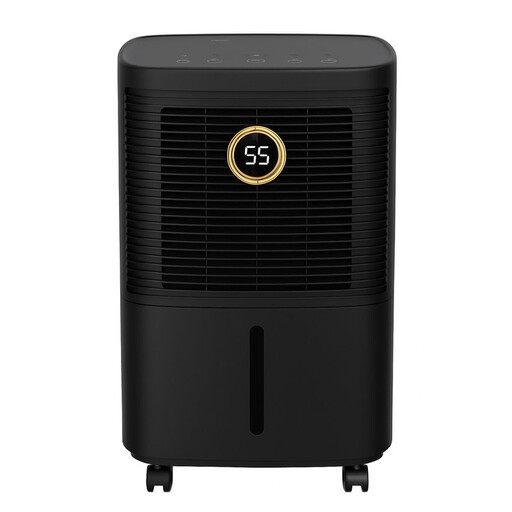
Why this product suits this profile: According to the manufacturer, this model combines a 16-litre daily capacity with adjustable humidity, three modes and a stated noise level of 40 to 45 dB. It is designed for bedrooms, bathrooms and cellars.
The combination of a 1.8-litre tank and optional hose drainage gives you the choice between mobile use and longer operation.
Washable filter, automatic defrost, timer, child lock and LED humidity display.
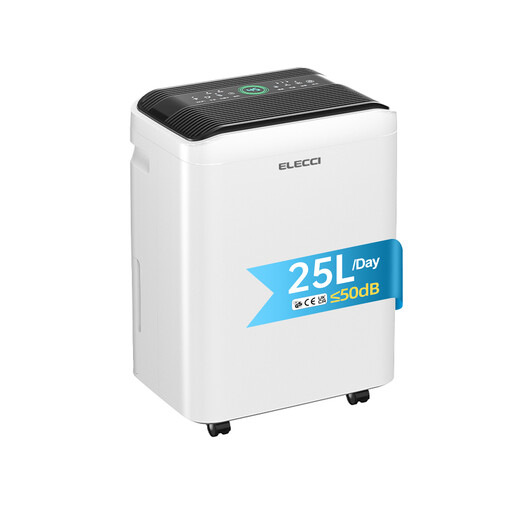
Why this product suits this profile: According to the product details, this appliance removes up to 25 litres per day and is designed for rooms of up to approximately 50 m². Three speeds, a laundry-drying mode and hose drainage make it suitable for intensive use.
The larger tank reduces interruptions. Automatic defrost is listed as a feature for cooler cellars or storage rooms.
25-litre capacity, 4.8-litre water tank, 24-hour timer, three fan speeds and continuous drainage.
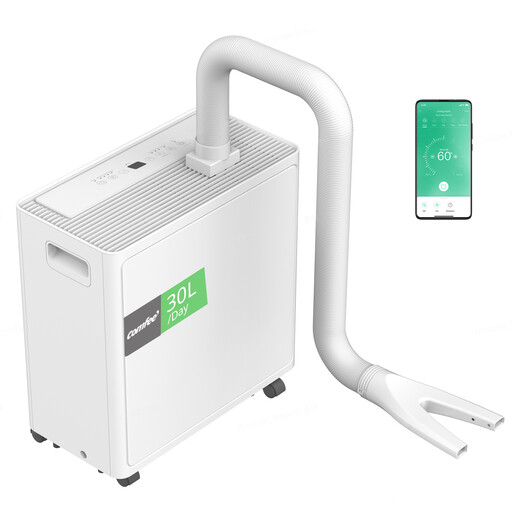
Why this product suits this profile: Its stated capacity of 30 litres per 24 hours and suitability for approximately 58 to 73 m² make it suitable for larger cellars, living areas and utility rooms. The app lets you control and monitor the appliance via your smartphone.
The manufacturer specifies both floor area and room volume. The 3.2-litre tank and continuous drainage are designed for longer periods of use.
30-litre daily capacity, four modes, app control, laundry-drying function and automatic defrost.
We have compiled a complete, regularly updated list of products that fully meet these strict selection criteria and the safety regulations applicable in the EU.
Place the appliance on a level, stable surface and leave the clearance specified in the operating instructions around the air inlet and outlet. Keep doors and windows closed wherever possible while the appliance is running. If it has been transported on its side, it may need to stand upright for a certain period before being switched on, depending on the manufacturer’s instructions.
Its lifespan depends, among other things, on operating time, ambient temperature, dust levels and maintenance. Clean the washable filter regularly, empty the tank and only move the appliance when it is switched off and empty. If you notice unusual noises, smells or smoke, unplug the appliance and contact customer services.
The cost depends on power consumption, operating time and your electricity tariff. A 240-watt appliance uses around 2.4 kWh when operated for ten hours. A timer, humidistat and automatic mode can limit the running time. The stated dehumidification capacity alone therefore does not indicate the actual electricity costs in your home.