
Lieferung heute & morgen

Qualitätsgarantie

Willkommens-Angebote freischalten: KOSTENLOSE Lieferung | Bis zu 80 % RABATT | Kostenlose 30-Tage-JoyPlus-Testphase
App herunterladen
Condensation on windows, musty cellars or washing that dries slowly indoors: a dehumidifier can help regulate the air in a room. However, the advertised capacity in litres is not the only factor to consider when buying one. Figures are often determined under specific laboratory conditions and cannot be applied directly to every room in the UK.
Three common misconceptions particularly often lead to the wrong choice:
Capacity is specified in litres per 24 hours. For a bedroom, home office or small flat, a unit with a daily capacity of around 10 to 16 litres is often sufficient. A 20-litre dehumidifier or larger can be useful for bigger rooms, utility rooms or very damp cellars.
The figures should always be considered in relation to the measurement conditions, such as 30°C and 80% relative humidity. At temperatures between 5 and 15°C, a compressor dehumidifier may collect less water. An automatic defrost function is therefore important for cellars, garages and other cool rooms.
A dehumidifier with a humidistat measures relative humidity and switches the compressor off or back on once the target level has been reached. This is more practical in everyday use than a unit that runs continuously without any regulation.
Depending on the model, you can set a target range, such as 40 to 70% relative humidity. A dehumidifier with automatic mode can adjust its operation independently. The display is primarily intended as a guide: different sensors may show different readings depending on where they are positioned in the room.
For a bedroom dehumidifier, the noise level is crucial. Levels between 32 and 40 dB(A) in sleep mode are quieter than the highest operating setting, but they are not automatically silent. Also check whether the display and indicator lights can be dimmed.
Power consumption in watts helps you estimate running costs. A simple calculation is:
Power in kW × operating hours × electricity price per kWh = electricity costs
A dehumidifier with a drain hose is suitable for longer operating periods, for example in a cellar. The hose must run downwards and must not be kinked. Alternatively, the unit will stop automatically when the tank is full. When drying laundry, keep the air circulation unobstructed; clothes must not cover either the air inlet or the air outlet.
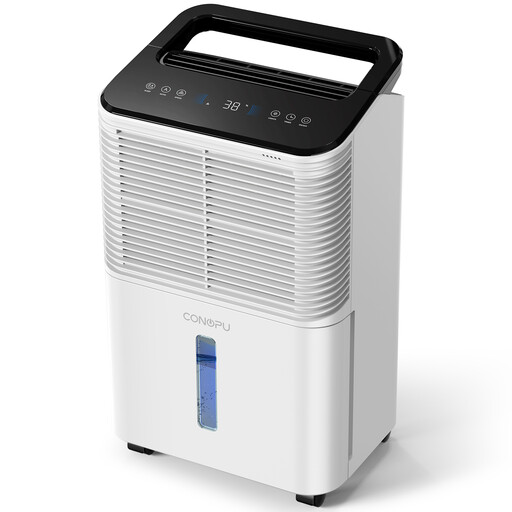
Why this product suits this profile: This unit combines a daily capacity of 16 litres with a 2.5-litre tank, automatic mode, timer and humidity display. It is suitable for living spaces of up to the specified 60 m², provided the room conditions are suitable.
The adjustable target humidity of 40 to 70% prevents the unit from running solely according to a fixed time setting. Two drain hoses support continuous drainage.
Sleep mode with a manufacturer-stated noise level of up to 30 dB; 24-hour timer and castors for moving it between rooms.
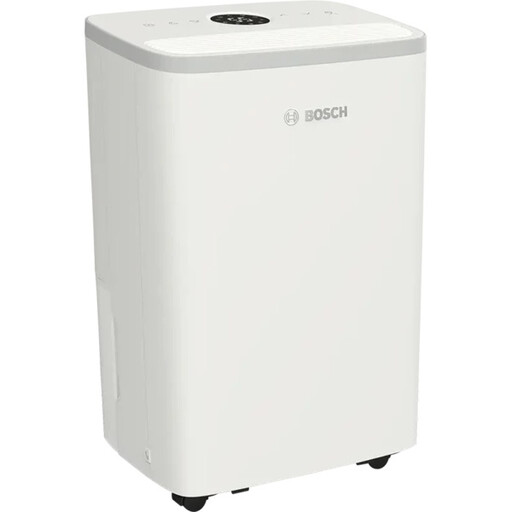
Why this product suits this profile: This model is specified for spaces of up to 55 m³ and offers automatic, night and laundry modes. The 2.5-litre tank, LED touch display and four castors make it easy to use and move.
The room size is given in cubic metres rather than square metres alone. A drain hose for continuous drainage is supported, but is not included.
Stated noise level of 38 dB; automatic shut-off and full-tank warning.
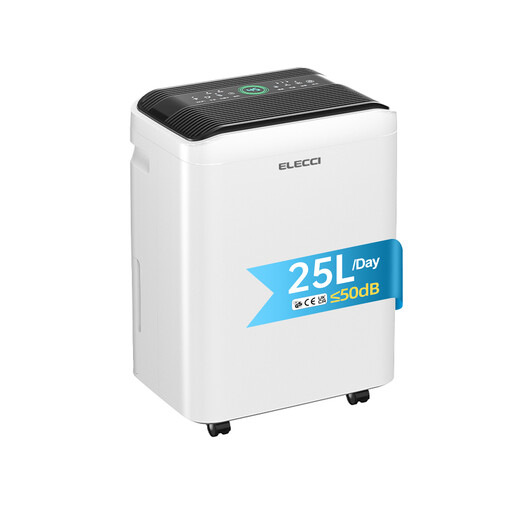
Why this product suits this profile: The 4.8-litre tank, stated capacity of up to 25 litres per day and continuous drainage are designed for larger rooms of around 50 m², as well as longer periods of use in cellars or utility rooms.
The operating conditions used for the stated daily capacity are specified. An automatic defrost function is available for cooler rooms.
Three fan speeds, 24-hour timer and stated noise level of 36 dB.

Why this product suits this profile: App control, 24-hour scheduling and a stated capacity of 20 litres per day are ideal for households that want to monitor humidity remotely on a regular basis.
Alongside the Wi-Fi function, the unit supports both tank operation and continuous hose drainage. The stated room size of up to 40 m² should be checked against the actual ceiling height.
App control with scheduling; stated sleep mode of up to 35 dB and 2.5-litre water tank.
We have put together a complete, regularly updated list of products that fully meet these strict selection criteria and the safety regulations applicable in the EU.
An electric dehumidifier should be placed on a level, stable surface with the air inlet and outlet unobstructed. Keep to the clearance from walls and objects specified by the manufacturer. Depending on the model, the unit may need to be left upright for a certain period after being transported or tilted.
Devices containing R290 refrigerant use a flammable refrigerant. The refrigeration circuit must not be damaged. The unit should not be placed close to naked flames, heat sources or flammable materials. Many models are not suitable for areas where they may be exposed to splashing water. Always follow the relevant operating instructions.
For a cellar, a model with a defrost function and drain hose is recommended. In a bedroom, the noise level, display shut-off and night mode are more important. When drying laundry, keep the door closed and ensure sufficient air circulation.
This depends on the source of moisture, room temperature and target level. A unit with a humidistat can switch off automatically once the set relative humidity has been reached. When drying laundry, a timer with a limited operating period may be useful.
Costs depend on power consumption and operating time. A 300-watt unit uses 3 kWh over ten hours of operation. The exact amount depends on your electricity tariff. Automatic mode and a timer can reduce unnecessary running time, but they do not replace choosing a suitably sized unit.
There is no single standard lifespan that applies to every model. Regularly cleaning the filter, keeping ventilation paths clear, placing the unit in a dry location and emptying the tank all help ensure trouble-free operation. If you notice unusual noises, odours or smoke, switch off the unit and disconnect it from the mains.