
Lieferung heute & morgen

Qualitätsgarantie

Willkommens-Angebote freischalten: KOSTENLOSE Lieferung | Bis zu 80 % RABATT | Kostenlose 30-Tage-JoyPlus-Testphase
App herunterladen
Condensation on windows, musty smells in the basement or laundry that takes a long time to dry are all common signs of high humidity. The right dehumidifier can help reduce moisture in a room. However, models vary considerably in their dehumidifying capacity, noise levels, energy consumption and ease of use.
If you focus only on a high litre rating or a long list of features, you could easily end up with the wrong model. The points below will help you assess marketing claims objectively and choose an electric dehumidifier that suits your home.
The rating ‘20 litres per day’ usually refers to a measurement taken in warm, very humid conditions, for example at 30 °C and 80% relative humidity. In a cool basement or bedroom, the actual dehumidifying capacity may be lower.
That’s why it’s important to consider several factors when choosing a model:
A 20-litre dehumidifier may be suitable for large living spaces or damp areas in the basement, but that doesn’t mean it’s the right choice for every small room.
A low decibel rating often refers to sleep mode or the lowest fan setting. A compressor dehumidifier may be noticeably louder when running at a higher setting. If you’re looking for a quiet dehumidifier for your bedroom or office, check the stated noise level and the operating mode it applies to.
A dehumidifier with Wi-Fi or app control is convenient to operate remotely. However, the app can’t compensate for blocked air outlets, draughty windows or an unsuitable room size. A model with a laundry-drying function also needs enough space around it and good air circulation.
Daily capacity is measured in litres. A compact model with a lower capacity may be enough for a bedroom or small office. For a dehumidifier for larger rooms, living rooms or basements, a higher capacity and sufficient airflow are more important.
Treat the manufacturer’s recommended room size as a guide. Open-plan layouts, high ceilings and particularly damp rooms may require extra capacity.
A small tank needs emptying more often. That’s usually not a problem for occasional use. If you plan to run the dehumidifier in a basement, utility room or while you’re away for an extended period, a dehumidifier with continuous drainage is more practical. Connect a drain hose and position it so that it slopes down towards a suitable drain.
Check the following:
Many electric dehumidifiers use R290 refrigerant. This is a technical product specification, not a promise of performance. For models that use flammable refrigerant, follow the manufacturer’s safety and positioning instructions. Keep the appliance away from heat sources and naked flames, and don’t block the ventilation openings.
A washable filter, or one that can be cleaned regularly, helps keep dust and pet hair out of the airflow. This can be particularly useful in homes with pets. However, cleaning the filter won’t replace a professional assessment of the cause of damp or an existing mould problem.
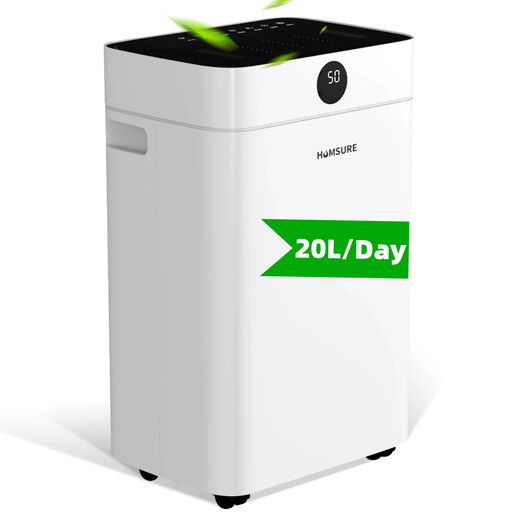
Why this product suits you: The appliance has a stated dehumidifying capacity of up to 20 litres per day and, according to the product description, is designed for areas of up to 50 m². That makes it suitable for a range of living spaces, basements and utility rooms.
Automatic humidity control lets you select a target between 40 and 80%. It also has a 2.8-litre tank and comes with a drain hose.
20-litre capacity, auto defrost, castors and two drainage options.
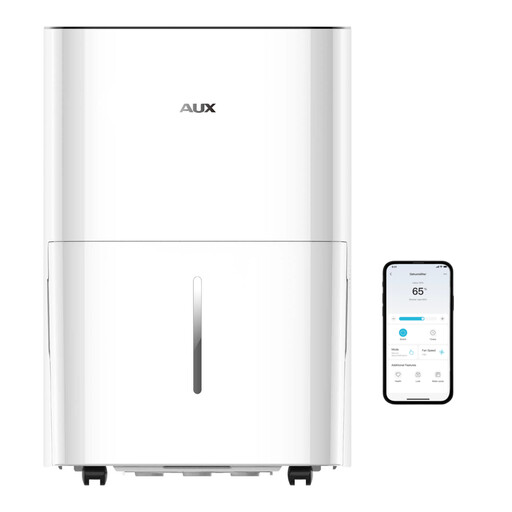
Why this product suits you: This model combines a stated capacity of 20 litres per day with Wi-Fi control, sensors and a stated noise level of no more than 45 dB(A).
App control adds to the controls on the appliance, but doesn’t replace checking the room size, air outlet and tank level. The product is also stated to restore its settings automatically after a power cut.
Wi-Fi control, 200 m³/h airflow and a stated standby power consumption of 0.3 W.
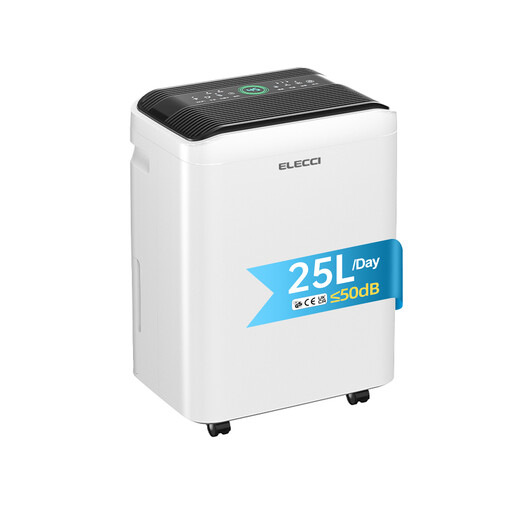
Why this product suits you: This model is aimed at people who dehumidify frequently or want to dry laundry indoors. It has a stated capacity of up to 25 litres per day, three fan speeds and a dedicated laundry-drying mode.
The 4.8-litre tank means you won’t need to empty it as often. Continuous drainage is also provided for longer periods of use; the manufacturer advises routing the hose downwards.
Stated capacity of 25 litres, 4.8-litre tank, 36 dB according to the product information and auto-defrost function.
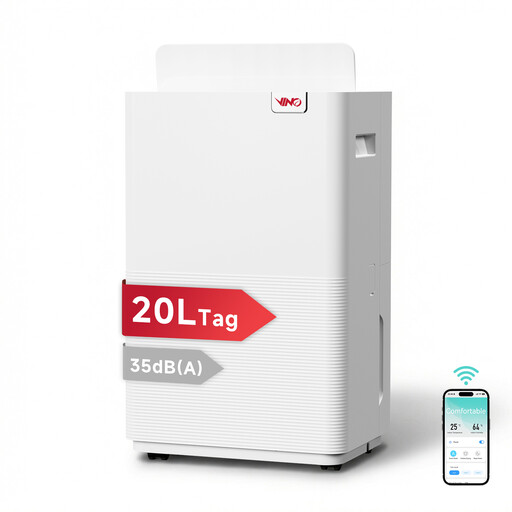
Why this product suits you: The product description states a capacity of up to 20 litres per day for rooms of up to 40 m². App control, scheduling and a laundry-drying mode make it a good fit for a regularly used living or working space.
The stated noise level should be considered in relation to the operating mode; the description gives 35 dB in sleep mode. The clear 2.5-litre indicator makes it easy to check the water level.
App control, 24-hour scheduling, continuous drainage and automatic drying function.
We’ve put together a complete, regularly updated list of products that meet these strict selection criteria and fully comply with the safety regulations in force in the EU.
Place your dehumidifier on a flat, stable surface. Don’t block the air intake or outlet with walls, furniture, curtains or laundry. You can close doors and windows while it’s running, unless the instruction manual says otherwise.
Switch off the appliance and empty the water tank before moving it. Check the filter, tank and drain hose regularly. If you notice an unusual smell, smoke, a damaged cable or unusual noises, unplug the appliance and contact customer services.
Consumption depends on the rated power, running time, room temperature and humidity level. A 300-watt appliance uses 0.3 kWh per hour of operation when running at full power. Actual consumption may be lower if it runs in automatic mode or switches off between cycles. A plug-in energy meter can help you get a more realistic estimate.
A mid-range reading is often used as a general guide. However, room temperature, the condition of the building and your individual circumstances all matter. A hygrometer can show differences between the area by a window, an external wall and the centre of the room. If humidity remains high or you can see mould, the underlying cause in the building should also be investigated.
Its lifespan depends on operating hours, dust levels, maintenance, transport and ambient temperature. Keeping the filter clean, leaving enough space around the appliance and following the manufacturer’s instructions all help ensure it’s used correctly. A dehumidifier isn’t a permanent solution to water ingress or structural damage.