Banana snackers short on space
If you want to dry small batches now and then, you’ll need to find room for both the appliance and its trays in a small kitchen.


For the occasional small batch, a stackable dehydrator is a sensible option, provided its actual footprint fits your kitchen. If you regularly want to arrange larger quantities of banana slices with space between them, a larger drying area could be useful, but you’ll also need room for the appliance itself. Temperature control, air circulation, cleaning and running time matter too; wattage alone won’t tell you the running cost or drying time.
If you want to dry small batches now and then, you’ll need to find room for both the appliance and its trays in a small kitchen.
If you want to arrange banana slices in a single layer more often, you’ll need to weigh the extra drying space against the room the appliance takes up.
Before buying, you’ll want to work out whether cleaning and long drying cycles suit the way you plan to use it.
| What matters | What to look for | Who will find this especially important? |
|---|---|---|
| Counter space and storage | Check the external dimensions and allow room for the air circulation needed where you plan to use it. | If worktop space is limited, I want to make sure there’s room for the appliance and clearance around it before I buy. Around 36% of consumers say footprint is their top priority. |
| Drying area and results | Check the tray area and temperature control; arrange the slices with space between them rather than overlapping. | If I’m drying several bananas at once, I want the slices to have enough room and to be able to control the results. Around 29% of consumers put batch size and results first. |
| Cleaning | Read the cleaning instructions for the trays supplied; don’t assume they’re dishwasher-safe based on the material alone. | After drying a sticky batch of fruit, I want to be able to clean the parts I’ve used without fuss. Around 21% of consumers say cleaning effort is their top concern. |
| Use and running costs | Consider how often you’ll use it and the timer range; calculate electricity use based on actual consumption, running time and your own tariff. | If I only dry small quantities occasionally, I want to know whether an extra appliance is worthwhile for the way I’ll use it. Around 14% of consumers focus first on how often they’ll use it and the effort involved. |
Banana slices need air to circulate around them to dry evenly. If the trays are too crowded, you may need to run another drying cycle.
Check the usable tray area and space out the slices rather than overlapping them.
The rated power alone doesn’t tell you how much electricity a drying cycle will actually use.
Calculate the cost using actual consumption, running time and your electricity tariff. Only compare an oven and a dehydrator on the same basis.
Drying time depends on factors such as the thickness of the slices and the appliance, so a timer doesn’t replace checking the results.
Check the slices as they dry, and only pack them away once they’re sufficiently dry and have cooled.
The KÜCHENminis Snack to go dehydrator is an option for small kitchens and smaller batches of fruit. WMF lists five stackable trays, temperature control from 30–70 °C and a timer of up to 24 hours.
For the DA 350, Rommelsbacher lists five adjustable-height tiers and a total drying area of 0.42 m². This may be worth considering if you want to lay out several bananas at once.
The ED 5 is another option, with five trays that can be used individually to suit different batch sizes.
The following Joybuy products are described as suitable for drying fruit. Before choosing one, check that the footprint, number of trays and settings suit the quantities of banana you plan to dry.
 No image available
Described as a dehydrator for fruit; check that its dimensions fit your kitchen and that the trays are large enough for the quantity you want to dry.
10 stainless steel trays, variable temperature control, 48-hour timer and 10 preset programmes.
Rated power: 850 W. This alone doesn’t indicate actual consumption per drying cycle.
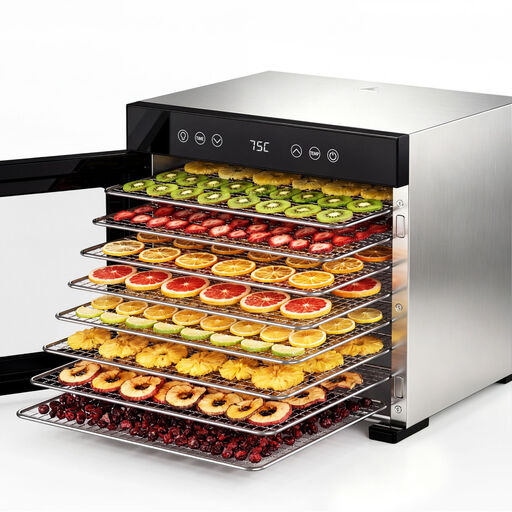 No image available
Described as a dehydrator for fruit; compare its footprint and number of trays with the quantity you want to dry.
8 stainless steel trays, temperature control from 35–85 °C and a 48-hour timer.
Rated power: 650 W. The touch display and interior light are also listed in the product name.
Slice the bananas evenly and follow your appliance’s instructions for drying time. Utah State University recommends using yellow bananas with a few light brown speckles, rather than overripe ones; treating them with ascorbic acid can help reduce discolouration. The Federal Centre for Nutrition describes dried fruit as still slightly pliable: when pressed firmly, it shouldn’t release any juice.
That depends on the appliance and its trays. Check the cleaning instructions for the specific model and the parts supplied before putting them in the dishwasher.
For electricity use, what matters is the actual consumption during a drying cycle, not just the rated power. You’ll also need the running time and your tariff to compare costs. If you buy online from a trader in the EU, you generally have a 14-day right to cancel from the date of delivery. You must be told about any return costs before buying; your statutory rights relating to faulty goods are separate from any additional manufacturer’s warranty.
Look for clear manufacturer information and a properly affixed CE marking. The German Federal Network Agency explains that by using the CE mark, the manufacturer declares, under their own responsibility, that the product meets the relevant requirements; it is not proof of an independent product test.