Choose a dehydrator based on how many tomato slices will fit on the trays at once, with enough space between them, and plan to dry them before the day of your class. Penn State Extension gives a drying time of six to 24 hours for the tomato pieces described in its guidance. This isn’t a guaranteed running time for every slice thickness or appliance. Larger tray-style dehydrators offer more stated drying area, while compact models take up less space but may require extra batches. The German Federal Institute for Risk Assessment advises against making and storing homemade vegetables in oil for long-term use at home.
Who might need a food dehydrator for a cooking class?
Class organisers preparing lots of portions
If several participants are preparing tomatoes, the usable tray area and the space between slices are key. Rommelsbacher and Graef specify the drying area and tray details for their respective appliances or variants, which you can compare with your planned batch.
Class organisers working to a tight schedule
If the tomatoes need to be ready before the class starts, allow for the possible drying time, as well as time to check them and dry them further if needed. Penn State Extension gives a drying time of six to 24 hours for the tomato pieces described in its guidance. A manufacturer’s timer settings don’t guarantee that the tomatoes will be ready at a particular time.
Small teaching kitchens
If worktop space is limited, weigh the appliance’s footprint against the number of portions you want to prepare. WMF describes the KÜCHENminis Snack to go as compact; a smaller appliance may require several batches to dry enough for the class.
What matters when drying tomato slices?
Larger tray-style dehydrator
A good fit if: you’re preparing lots of slices for the class and have enough space for the appliance. Graef lists six trays and 0.65 m² of drying area for a DA506 set; Rommelsbacher lists seven trays and 0.5 m² for the DA 650.
What to consider: The stated drying area doesn’t tell you how many slices of your chosen size will fit with enough space for air to circulate. Check how much of the area you can actually use.
Compact food dehydrator
A good fit if: worktop space is limited and you’re happy with smaller batches or several runs. WMF lists five drying racks supplied with the KÜCHENminis Snack to go.
What to consider: The number of racks doesn’t prove that a particular quantity for your class will fit in one batch.
Use your existing oven
A good fit if: you’re planning a one-off class and your oven can be set to a suitably low temperature. Penn State Extension describes an oven as an alternative to a food dehydrator.
What to consider: Before you start, check whether you can control the temperature and drying process well enough for your intended use.
| What you need |
What to check before you buy |
Especially important if |
| Capacity for your class |
Compare the size of your slices, the usable dimensions of each tray and the number of batches you’ll need. Rommelsbacher lists 0.5 m² and seven trays for the DA 650; a Graef offer for the DA506 lists 0.65 m² and six trays. These figures relate to the specifications and variants shown. |
I want to dry several portions in one batch, so the key thing for me is how much area I can actually use while leaving space for air to circulate. Around 36% of consumers put capacity first. |
| Finishing before the class starts |
Check the temperature range and maximum timer setting, and allow time to check the slices. Penn State Extension gives a drying time of six to 24 hours for the tomato pieces described in its guidance; Rommelsbacher lists a timer of up to 99 hours for the DA 650. The timer’s run time doesn’t guarantee that the tomatoes will be ready when it ends. |
If the slices need to be ready before the class starts, I need to allow extra time and check how dry they are. Around 29% of consumers prioritise having them ready on time. |
| Footprint and access |
Check the appliance’s dimensions and allow room to load and remove the trays. WMF lists five racks for the KÜCHENminis Snack to go; Graef says the DA506 trays slide out at the front, so you’ll need space in front of the appliance. |
In a small teaching kitchen, I want to be able to set up the appliance without losing space for the rest of the preparation. Around 21% of consumers prioritise the space it takes up. |
| Preparation and cleaning |
Check what’s included, how the trays are removed and the cleaning instructions for the specific variant. Severin recommends draining very juicy tomatoes before drying, or removing the seeds and juice. |
With juicy tomatoes, I want to factor in the preparation and cleaning involved. Around 14% of consumers prioritise ease of use and cleaning. |
Common misconceptions about food dehydrating
-
The number of tiers automatically tells you how much you can prepare for the class
Tomato slices need space for air to circulate. A high number of racks alone doesn’t tell you how many slices of your chosen size will fit in one batch.
Try a test batch using the tomato variety and slice size you plan to use.
If the slices don’t fit on the trays, you may need extra drying runs and more preparation time.
-
The timer guarantees when the tomatoes will be ready
Penn State Extension gives a drying time of six to 24 hours for the tomato pieces described in its guidance. The actual time isn’t fixed for every preparation method or appliance.
Start before the day of the class, check how dry the tomatoes are and leave time for further drying if needed.
The batch may need extra time in the appliance before the class.
-
Dried tomatoes in oil are automatically safe to store long term
The German Federal Institute for Risk Assessment advises against making and storing homemade vegetables in oil for long-term use at home, as these methods cannot rule out the formation of botulinum toxin in all cases.
Don’t present homemade tomatoes in oil as suitable for long-term storage unless you’ve used an appropriate, tested method.
Notable brands and product ranges
Rommelsbacher
The DA 650 is a tray-style dehydrator for prepared batches where the stated drying area and timer may be useful considerations.
- Rommelsbacher lists seven trays, 0.5 m² of drying area, a temperature range of 35–75 °C and a timer of up to 99 hours.
- The manufacturer’s claim about even temperature distribution isn’t an independent test using tomato slices. The right loading depends on their size and spacing.
Graef
The DA506 is an option with trays that slide out at the front.
- Graef lists six trays; an offer for the DA506 specifies 0.65 m² of drying area.
- You’ll need space in front of the appliance to remove the trays. Check what’s included with the specific variant.
WMF
The KÜCHENminis Snack to go is worth considering for smaller batches and a more compact appliance.
- WMF lists five racks supplied, a temperature range of 30–70 °C and a timer of up to 24 hours.
- The number of racks alone doesn’t tell you whether the quantity you need for your class will fit in one batch.
Stöckli
Dörrex appliances offer another design, with temperature control and active warm-air circulation according to the manufacturer.
- The stated temperature control and warm-air circulation are useful product features to consider when choosing an appliance.
- Check the specific model, racks and what’s included separately. These details don’t establish whether it can handle a particular cooking class’s requirements.
Severin
Severin describes the OD 2940 as an appliance for fruit and vegetables, and provides advice on preparing juicy tomatoes.
- Severin recommends draining very juicy tomatoes before drying, or removing the seeds and juice.
- This preparation advice doesn’t indicate that the appliance has a comparable drying area or is suitable for a particular class size.
Food dehydrators at Joybuy
The Joybuy options below include compact food dehydrators, as well as models with multiple trays and adjustable time and temperature settings to suit different batch sizes.
 No image available
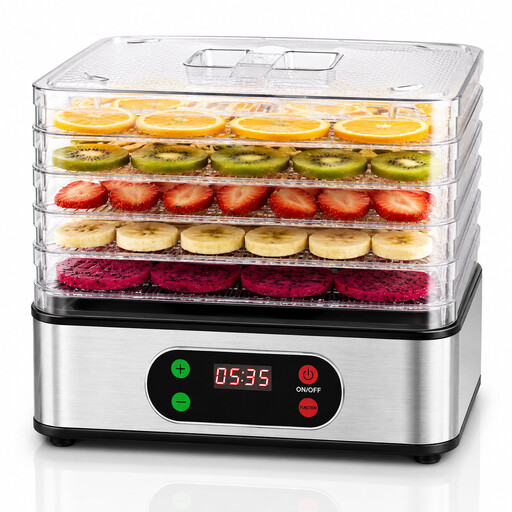
Food dehydrator with LED display, 35–70 °C and timer
An option if an adjustable temperature range and flexible timer settings are useful for planning your class. Check that the usable tray area suits your slice size.
35–70 °C; timer from 0.5 to 72 hours in 30-minute increments; 350 W; BPA-free.
View at Joybuy
 No image available
Havenwell food dehydrator with 10 stainless steel trays
For preparing a larger number of portions if several trays suit your workflow. The number of trays alone doesn’t tell you how much you can make for your class.
10 stainless steel trays; adjustable temperature; timer up to 48 hours; 10 programmes; 850 W.
View at Joybuy
 No image available
Havenwell food dehydrator with 8 stainless steel racks
An option with several trays and timer settings for longer drying runs. Compare the usable area with the slice size you plan to use.
8 stainless steel racks; 35–85 °C; timer up to 48 hours; 650 W; touch display and interior light.
View at Joybuy
 No image available
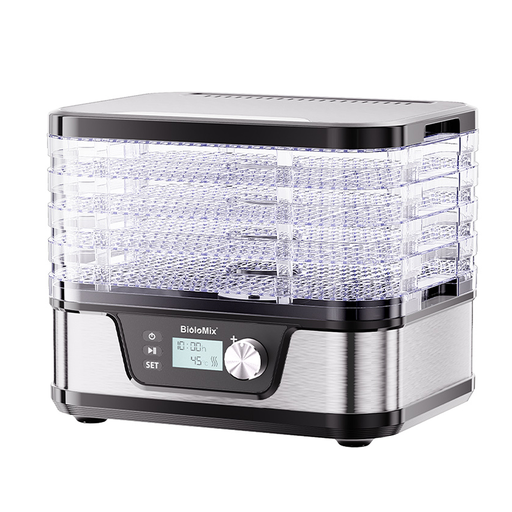
BioloMix BFD1300 food dehydrator with 5 trays
If an adjustable temperature range and a timer of up to a day are enough for your planned batch, check whether the five trays have enough room for your slices.
5 trays; 35–75 °C; adjustable timer up to 24 hours. The product description also mentions 360° hot-air circulation; this isn’t an independent test of how evenly it dries.
View at Joybuy
Frequently asked questions about drying tomatoes
Can I dry the tomato slices during the weekend cooking class?
If possible, plan to dry them before the class: Penn State Extension gives a drying time of six to 24 hours for the tomato pieces described in its guidance, with a leathery to crisp texture as the end result. This is a guide, not a guarantee for your slice thickness, batch size or appliance.
How should I prepare particularly juicy tomatoes, and how can I tell when they’re ready?
As manufacturer guidance, Severin recommends draining very juicy tomatoes before drying, or removing the seeds and juice. Then check how dry they actually are instead of relying on the timer alone; Penn State Extension describes dried tomatoes as leathery to crisp.
Can I preserve dried tomato slices in oil for the participants?
The German Federal Institute for Risk Assessment advises against making and storing homemade vegetables in oil for long-term use at home, as these methods cannot rule out the formation of botulinum toxin in all cases. This doesn’t mean that every dried tomato product in oil is prohibited.
Do I need to register the cooking class as a food business?
The term ‘weekend cooking class’ alone isn’t enough to determine this. According to the German Federal Office of Consumer Protection and Food Safety, food business establishments generally need to be registered. An exception may apply to activities without a certain degree of continuity and organisation, and this must be assessed on a case-by-case basis. If you’re running an organised class that provides food, check the details of your activity with the relevant local food safety authority.


