Storing clothes in a cool hobby room
If you store clothes in a room that is heated only occasionally, or not at all, check that the unit can operate at the temperature the room actually reaches.


A desiccant dehumidifier is worth considering if your hobby room stays cool for long periods and readings show that humidity remains high. Start by measuring the temperature and humidity, and investigate possible causes of damp. If the room is warm, compare specific compressor models under suitable operating conditions. Also check how the unit controls humidity and drains away the water.
If you store clothes in a room that is heated only occasionally, or not at all, check that the unit can operate at the temperature the room actually reaches.
If you want to protect stored textiles, taking readings and identifying the source of the damp will be more helpful than relying on a single litres-per-day figure.
If you are not in your hobby room regularly, plan how humidity will be controlled and how water will be drained while the unit is running.
Measure the temperature and relative humidity in your hobby room at the times you use it. Then compare the suitability and performance figures of each unit with those conditions.
A good fit if: the room stays cool for long periods and ventilation alone does not keep persistent damp under control. Check the temperature range of the specific model: Trotec states that the TTR 57 E operates from 1 °C, while Wood’s says the WDD80 works down to 0 °C.
Bear in mind: electricity use and heat output are part of planning how you’ll use the unit, along with noise and water drainage.
A good fit if: your hobby room is heated most of the time and you can compare specific models under conditions that match the room’s temperature and humidity.
Bear in mind: don’t compare figures taken under different test conditions. The type of technology alone does not guarantee lower electricity costs.
A good fit if: you’re not sure whether the room has persistently high humidity, or you’ve noticed mould or damp building materials. The Verbraucherzentrale recommends checking humidity with a thermo-hygrometer.
Bear in mind: a dehumidifier won’t fix an underlying structural cause of damp. The Umweltbundesamt advises identifying and addressing the cause of excess moisture if mould is present.
| Buying priority | What to check | Who it matters most to |
|---|---|---|
| Dehumidifying a cool room | Check the model’s temperature range and performance figures under stated conditions. | If my hobby room gets cold at times, I need a unit designed to work at that temperature. Around 33% of consumers put suitability in cold conditions first. |
| Protecting clothes from persistent damp | Measure relative humidity and check whether the unit has an adjustable target humidity. | If clothes are stored in the room for a long time, I want to monitor humidity levels and identify the cause of persistent damp. Around 27% of consumers prioritise this protection. |
| Water drainage in a room that is checked infrequently | Check the tank, automatic shut-off when the tank is full, and whether there is a suitable hose connection and drain. | If I only check the room occasionally, the drainage needs to suit how often I can visit. Around 20% of consumers first look for a low-maintenance way to dispose of the water. |
| Electricity use and noise while pursuing hobbies | Compare power consumption and noise levels for the mode you intend to use and the planned running time. | If I spend time in the hobby room while the unit is running, noise and electricity use matter in day-to-day life. Around 20% of consumers prioritise these operating conditions. |
Performance figures apply to specific temperature and humidity conditions. For example, Aktobis gives the WDH-DS3’s figure at around 8 °C and 80% relative humidity; figures measured under different conditions are not directly comparable.
Measure conditions in your hobby room first, then compare units using test conditions that are as similar as possible and clearly stated.
The Umweltbundesamt recommends identifying and addressing the cause of excess moisture if mould is present. A dehumidifier is no substitute for investigating the cause.
Check for visible mould, water ingress and damp building materials before storing clothes there.
You’ll need to empty the tank often enough for the intervals between checks. A hose connection only helps if water can drain reliably from where the unit is installed.
Before buying, plan where the water will go and how often you’ll be able to check the room.
The TTR 57 E is described as a desiccant dehumidifier for smaller rooms, including unheated ones.
The WDH-DS3 is a desiccant model for cooler rooms; the manufacturer recommends it for areas up to 25 m².
Wood’s offers its WDD range for small, cold rooms; this article focuses on the WDD80.
The Joybuy products below are described as dehumidifiers with humidity-control or clothes-drying features. If your hobby room is cool, check that the specific model is suitable for the temperature there before choosing one.
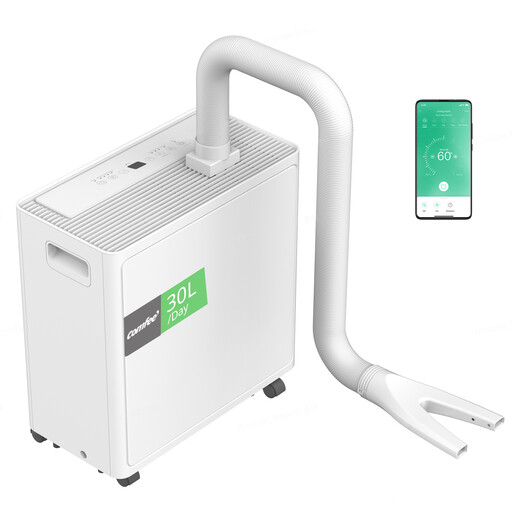 No image available
The Laundry-Drying mode and adjustable humidity setting are useful if you want to combine drying clothes with controlled dehumidification.
30 l per day at 30 °C and 80% relative humidity; 3.2-litre tank with overflow protection and a stated water drain.
App control and a 24-hour timer. A suitable installation is needed to use the water drain; alternatively, you can use the tank.
 No image available
The Laundry-Drying mode is designed for clothes in the room. The Smart mode and adjustable target setting are useful if you want to control humidity.
10 litres per day and a stated room size of around 16 m²; 2.5-litre tank and 24-hour timer.
According to the description, the unit switches off automatically when the tank is full; you’ll then need to empty it.
 No image available
The Laundry mode is useful if you want to dry clothes in your hobby room. A drain hose connection is provided for longer periods of operation.
Up to 16 litres per day and up to 75 m³ according to the product description; 2.5-litre tank, Auto, Night and Laundry modes, and two fan speeds.
The drain hose is not included, according to the description. Alternatively, you’ll need to empty the tank.
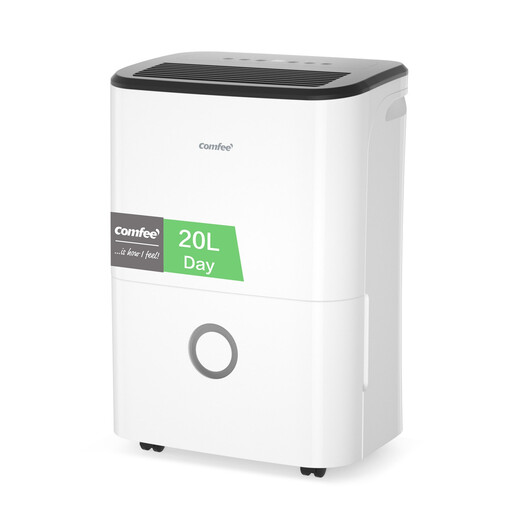 No image available
The stated clothes-drying function and continuous drainage are useful if you want to dry clothes or avoid having to empty the tank regularly.
Up to 20 litres per day and up to 100 m³ according to the product description; 3-litre tank, Smart mode with a target humidity range and a 24-hour timer.
The drain hose is not included, according to the description. Alternatively, you can use the tank.
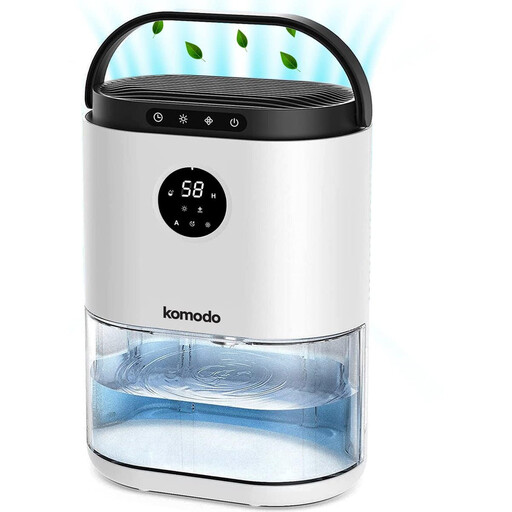 No image available
This model is described as a compressor dehumidifier with a hygrometer and humidity display, not a desiccant unit. It is therefore only worth considering if you’re also open to compressor models.
Features listed include an adjustable target range of 40–70%, automatic humidity control, a timer and two hoses for continuous drainage.
Use a hygrometer to measure the relative humidity in the room. The Umweltbundesamt gives 40–60% as a guide for keeping the risk of mould low indoors; also check for cold surfaces and investigate the source of any damp. This range does not guarantee protection for every textile.
Place it on a stable, level surface and keep the airways clear. The Aktobis WDH-DS3 manual requires a stable, level surface and sufficient air supply; refer to the manual for your chosen model for any other clearance requirements.
Estimate electricity costs using the power consumption of the mode you actually use, the running time and your electricity tariff. Check the tank or drain, and follow the model’s care instructions.
Old electrical appliances must be handed in at a collection point or to an authorised operator, such as a local authority collection point. According to the Federal Ministry for the Environment, retailers must take back appliances under the conditions set out in the Electrical and Electronic Equipment Act; this does not mean you can return an appliance free of charge to any retailer.
No. For products that require the mark, the manufacturer uses the CE marking to declare that the relevant requirements have been met. It is not an independent assessment of the dehumidifying performance or the unit’s suitability for your hobby room.