A desiccant dehumidifier isn’t automatically necessary for a large living room. First, deal with moisture in the bathroom after showering, then check whether humidity in the living room stays high repeatedly. If you need extra dehumidification, a desiccant model may be suitable for a cool room. In a heated living room, compare compressor models too, and check each model’s room-size recommendations, operating conditions and practical features.
Who is this relevant to?
Households with moisture after showering
If you want to find out whether shower moisture is making its way into your living room, deal with it in the bathroom first wherever possible. The German Environment Agency and the Verbraucherzentrale recommend airing the room after showering to replace moist air with fresh air.
People with a large, cool living room
If you need extra dehumidification, check the stated room size and permitted temperature range for the specific desiccant model. Manufacturers’ figures for floor area or performance apply to the particular model and the conditions specified.
People with a heated living room
If you still need to dehumidify after airing the room, it’s worth comparing desiccant and compressor models. Depending on the model, consider power consumption, noise levels and how often you’ll need to empty the water tank.
What should you look for when buying?
Deal with moisture in the bathroom
A good option if: humidity in the living room only rises briefly after showering and then falls again.
Bear in mind: this approach relies on having an effective way to air the bathroom.
Use a desiccant dehumidifier in the living room
A good option if: humidity in the living room repeatedly stays high despite dealing with moisture in the bathroom, and the room is cool.
Bear in mind: the desiccant material needs heat to regenerate, so the appliance releases warm air.
Use a compressor dehumidifier in a heated living room
A good option if: the room is heated consistently and still needs dehumidifying after airing.
Bear in mind: compressor models can lose dehumidifying performance or defrost at low temperatures.
First check whether you can deal with the moisture in the bathroom. Only choose a dehumidifier for the living room if the air there repeatedly stays damp.
| Consideration |
What to check before buying |
Who should pay particular attention? |
| Source of moisture |
Measure humidity in the living room repeatedly after showering; close the bathroom door when airing it. |
If I want to stop shower moisture spreading into the living room, I’ll first check whether airing the bathroom is enough. Around 36% of consumers put the source of moisture first. |
| Room coverage |
Measure the floor area and ceiling height; check the stated floor area or volume and the conditions given for the exact model. |
For a large living room, I want to make sure the manufacturer’s figures are suitable for my space. Around 29% of consumers prioritise adequate room coverage. |
| Power consumption and type |
Compare the typical room temperature, power consumption for each operating mode and expected running time. |
If the appliance will run regularly, I want to compare desiccant and compressor models for my heated or cool room. Around 21% of consumers prioritise power consumption and appliance type. |
| Comfort and emptying |
Check noise levels for each operating mode, as well as the tank, full-tank shut-off and whether a hose can be connected. |
In the living room, I want to keep operating noise and the need for frequent emptying to a minimum. Around 14% of consumers prioritise quiet operation and ease of use. |
Avoid common buying mistakes
-
Letting shower steam spread into the living room first
This allows the spike in humidity to spread through the home before a living-room appliance can do anything about it. The German Environment Agency recommends keeping the bathroom door closed while dealing with moisture.
Deal with the moisture in the bathroom first, then monitor humidity levels in the living room.
Running an appliance unnecessarily can increase your electricity consumption.
-
Assuming litres per day means a model will suit any large room
Dehumidifying capacity alone doesn’t tell you whether a model is suitable for your room size and actual operating conditions. Trotec recommends the TTR 57 E for spaces up to 20 m²; Aktobis gives a figure of up to 25 m² for the WDH-DS3 and states that its capacity of up to 10 l per day applies specifically at around 8 °C and 80 % relative humidity.
Measure the floor area or volume and compare it with the figures and performance conditions for the specific appliance.
-
Taking a floor-area figure from a ranking at face value
Testberichte.de lists the Wood’s WDD80 with a floor-area figure of 50 m². Wood’s itself describes the WDD series as being for small, cold rooms and recommends a different product range for larger spaces.
Check any conflicting figures against the specific model and the size of your living room, rather than assuming it’s suitable based on its position in a list.
-
Choosing a desiccant model for a warm living room without comparing types
Desiccant dehumidifiers use heat to regenerate the drying material. Meaco offers both desiccant and compressor models, but that doesn’t mean either type is automatically suitable for every living space.
Compare both types under the conditions in your living room, taking power consumption and intended use into account.
Brands to consider
Meaco
Meaco offers both desiccant and compressor models, making it a useful brand to consider when comparing the two types.
- Meaco specifies a coverage area of up to 46 m² for each of the DD8L Zambezi, Pro and Junior models.
- This figure applies to the specific models and isn’t an independent measurement of performance after showering. Check the features and what’s included separately for each variant.
Wood’s
The WDD series includes desiccant models that Wood’s recommends for small, cold rooms.
- Wood’s specifies that the WDD80 can operate from 0 °C and has a 2-l tank and a hose connection.
- Wood’s describes the WDD series as a solution for small rooms and recommends a different product range for larger spaces.
Trotec
The TTR 57 E is an electric desiccant dehumidifier for smaller rooms, including unheated areas.
- Trotec recommends the model for spaces up to 20 m² or 50 m³.
- This manufacturer’s figure doesn’t show that the appliance can dehumidify a larger living room on its own.
Aktobis
Aktobis describes the WDH-DS3 as a desiccant model for cool rooms.
- Aktobis recommends it for spaces up to 25 m² or 62 m³. Its figure of up to 10 l per day applies specifically at around 8 °C and 80 % relative humidity.
- You can’t apply this performance figure directly to a heated living room.
Product options at Joybuy
The following Joybuy products are options for dehumidifying living spaces. The ELECCI description specifically mentions a compressor; check the type and stated room size for each model.
 No image available
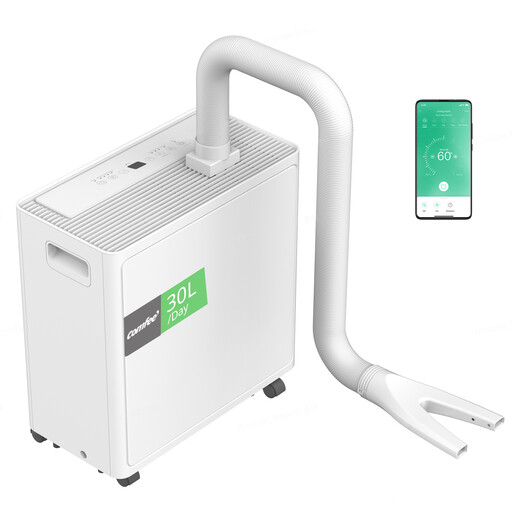
Comfee’ MDDA-30DEN7-SD, 30 l/day
Its stated coverage of up to 73 m² may suit a large living room; check this against the actual size of your space.
3.2-l tank, continuous drainage, 640 W rated power and 45.3–47 dB(A). The 30 l/24 h figure applies at 30 °C and 80 % relative humidity.
Joybuy
 No image available
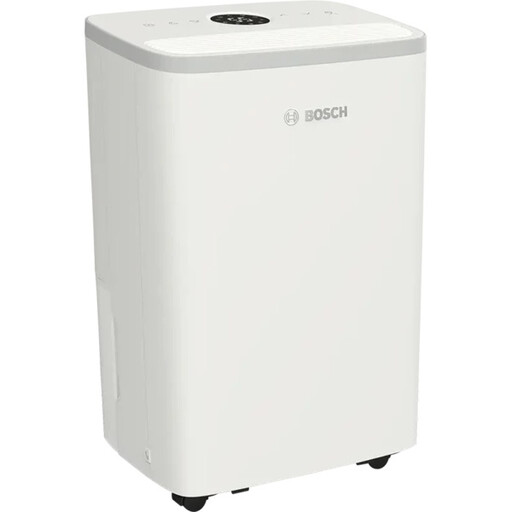
Bosch Dry 2000, 12 l/day
The automatic mode may be useful in a living space where you can monitor humidity levels; the stated room capacity is up to 55 m³.
2.5-l tank, 38 dB and automatic shut-off when the tank is full. According to the product description, a hose isn’t included.
Joybuy
 No image available
Bosch Dry 4000, 16 l/day
Its stated coverage of up to 75 m³ and automatic mode may be useful in a living space where dampness keeps returning.
2.5-l tank, 40 dB and continuous drainage. According to the product description, a hose isn’t included.
Joybuy
 No image available
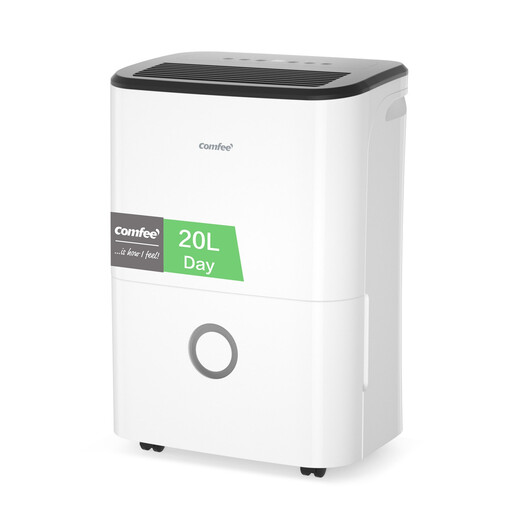
Comfee’ MDDF-20DEN7, 20 l/24 h
Its stated coverage of up to 40 m² and smart mode, which maintains relative humidity at 45–55 %, are useful points to consider for a living space.
3-l tank and hose drainage. The dehumidifying capacity of 20 l/24 h applies at 30 °C and 80 % relative humidity.
Joybuy
 No image available
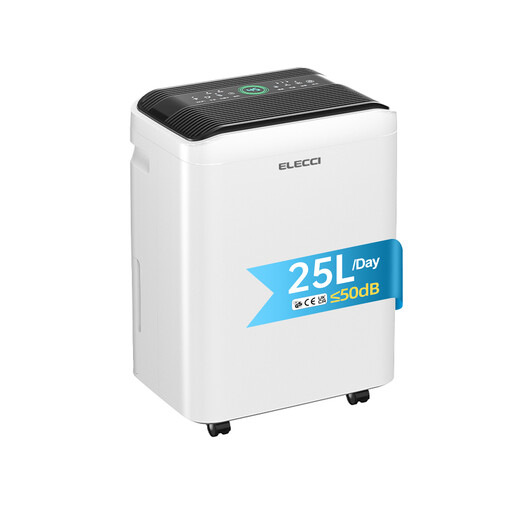
ELECCI 25L/D, 25 l/day
The description specifically mentions a compressor. This could be an alternative for a heated living room if the stated room coverage of up to 50 m² suits your space.
4.8-l tank and hose drainage. The capacity of 25 l/day applies at 30 °C and 80 % relative humidity.
Joybuy
Frequently asked questions
Should I buy a dehumidifier straight away if humidity briefly rises after showering?
No. First check whether airing the bathroom is enough. The German Environment Agency recommends keeping the bathroom door closed while airing it; then check whether humidity in the living room repeatedly stays high.
How can I tell whether a desiccant dehumidifier is right for my living room?
Compare the size of your room and its usual temperature with the figures for the specific model. Manufacturers’ figures for floor area, volume and dehumidifying capacity only apply under the conditions specified for each one.
How can I estimate a dehumidifier’s power consumption?
Compare the power consumption of the operating mode you’ll actually use with the expected running time. To calculate energy use, multiply the power in kilowatts by the number of operating hours. The result is the consumption in kilowatt-hours.
What should I bear in mind when positioning and maintaining the appliance?
Follow the instructions for your specific model. The Meaco DD8L Zambezi instructions require a stable, level surface; the Aktobis WDH-DS3 needs clear air inlets and outlets. Check the tank, filter and any hose you use in line with the instructions for the relevant model.
Is the CE marking an independent test?
No. According to information from the European Union, the CE marking is the manufacturer’s declaration that the product meets the relevant EU requirements. It isn’t a general certificate issued by an independent testing body.


