People with a cool guest room
If a rarely heated spare room stays damp, it’s important to check whether the appliance is designed for the temperature there.


An electric desiccant dehumidifier may be a good choice if your small guest room stays cool for extended periods and measurements show high humidity. If it is heated regularly, you should also compare suitable compressor models. Check the operating temperature range, room size, drainage options, noise and power consumption under comparable conditions: quoted figures do not automatically reflect performance in your own room. If walls remain damp or mould is present, the cause needs to be investigated. A dehumidifier will not repair building damage or remove existing mould.
If a rarely heated spare room stays damp, it’s important to check whether the appliance is designed for the temperature there.
If you want to measure and manage humidity in your guest room as needed, compare the controls, tank shut-off and drainage options.
If the appliance will be close to your living area, its footprint, fan noise, heat output and how easy the tank is to empty may all affect your choice.
First, check that the temperature in your guest room falls within the stated operating range. Then consider the room size, practical drainage options and the day-to-day effort involved.
| What matters | What to look for | Who will find this particularly important? |
|---|---|---|
| Dehumidifying cool rooms | Check that the operating temperature and stated room size suit the conditions in your guest room; don’t treat the l/24-h rating as a guaranteed amount of water removed. | If my guest room stays cool for long periods, I want an appliance with a temperature range to match, rather than focusing only on its daily extraction rate. Around 33% of consumers put suitability for cool rooms first. |
| Measurable humidity control | Measure humidity with a hygrometer and check whether the appliance offers a target setting, an automatic shut-off when the tank is full and, where needed, a drain. | When damp keeps coming back, I want to monitor how it changes and adjust the appliance accordingly. Around 27% of consumers prioritise humidity control that responds to their needs. |
| Noise, space and heat | Compare the dimensions, noise rating and operating setting, clearance for airflow and heat output. | If the appliance is close to my living area, I want to know whether its noise, footprint and heat output could be disruptive. Around 20% of consumers put this aspect of home comfort first. |
| Electricity, emptying and maintenance | Compare power consumption and planned running time on the same basis; check access to the tank, filter maintenance and the requirements for continuous drainage. | If I use the appliance regularly, I want to be able to estimate the ongoing effort involved in running, emptying and maintaining it. Around 20% of consumers focus first on these running requirements. |
Even with desiccant models, the amount of water removed depends on temperature, humidity and any further moisture entering the room. A rated figure cannot therefore be transferred directly to your own room.
Compare performance figures only when you know the conditions they were measured under, and use a hygrometer to monitor changes in room humidity.
Depending on the room and the amount of moisture entering it, the appliance may need to run for longer than expected.
A non-electric moisture absorber is not automatically comparable to an electric appliance with a fan, target humidity control and drainage.
Before buying, check how the complete model works and what features it includes, then choose one that offers the humidity control you need.
Dehumidifying the room air will not address the cause of ongoing damp on a wall or fix existing mould damage.
Measure the humidity, check your heating and ventilation, and have the cause investigated if damp walls or mould persist.
Depending on the cause, you may also need to arrange an investigation or have the problem remedied.
The TTR 57 E is a desiccant dehumidifier that Trotec says is suitable for small rooms and use at low temperatures.
The desiccant range includes the DD8L, DD8L Zambezi, DD8L Junior and DD8L Pro; the specifications for each model are key to choosing the right one.
Wood’s positions the WDD range for cold rooms; the WDD80 is the model without the Wi-Fi feature advertised for the WDD90.
The DD1 Classic MK6 is an electric desiccant dehumidifier with humidity control, tank shut-off and a drain hose.
The selection below covers dehumidifiers with details of humidity control, a tank or drainage. If you’re choosing one for a cool guest room, make sure the type of appliance and permitted operating temperature are suitable.
 No image available
For anyone looking for adjustable humidity control and a way to drain away water. Specifications include a Smart mode with a target range of 45–55%, tank shut-off, an optional drain hose and a room size of around 40 m³ (16 m²).
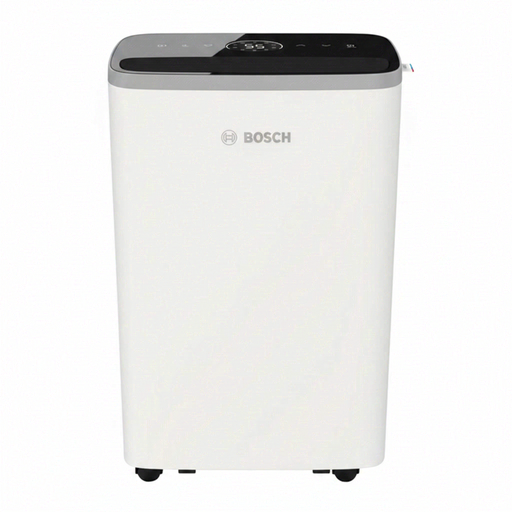 No image available
For anyone comparing an Auto mode and options for longer running times. Specifications include a 2.5-l tank, tank shut-off, an optional drain hose and a noise rating of 40 dB in Night mode; the stated room size is up to 75 m³.
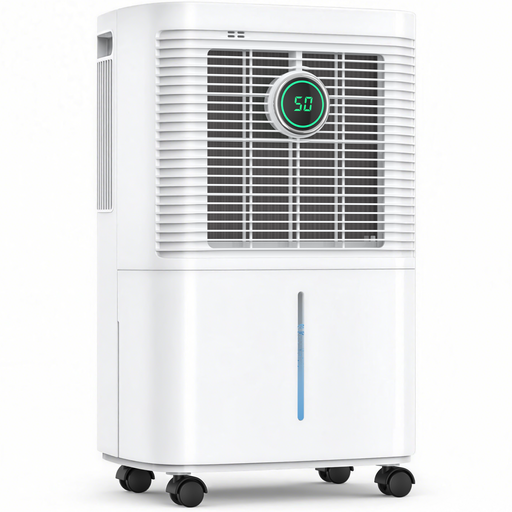 No image available
For anyone who wants a humidity display and timed operation. Product specifications state up to 16 l/day, 36 dB in Sleep mode, an LED display and a timer.
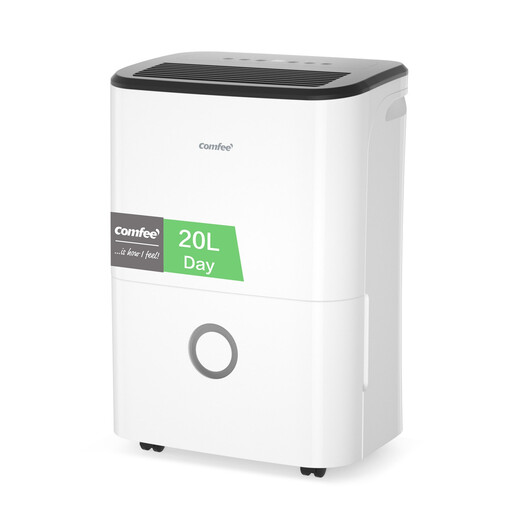 No image available
For anyone comparing an adjustable target range and a drain hose. Specifications include a Smart mode set to 45–55%, a 3-l tank, continuous drainage and a room size of around 100 m³ (40 m²); the noise rating is 46 dB.
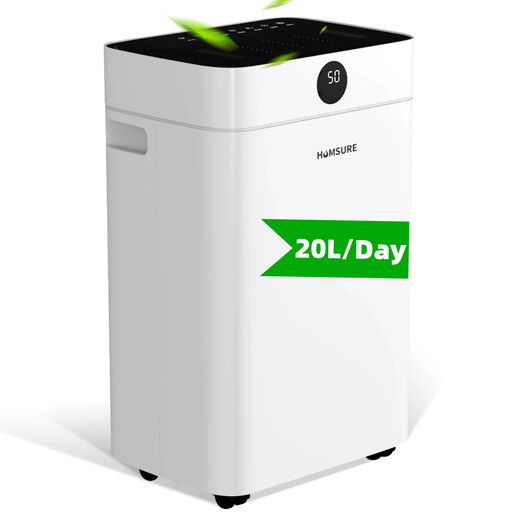 No image available
For anyone comparing adjustable humidity settings and water drainage. Specifications include a target range of 40–80%, automatic shut-off when the target is reached, a supplied drain hose and a room size of up to 50 m².
The German Environment Agency recommends a relative humidity of 40 to 60% indoors and using a hygrometer to monitor it. Humidity can be higher on cold surfaces than in the centre of the room, so an appliance’s target setting is no substitute for checking damp walls.
No. Regularly opening windows wide or creating a through-draught helps remove stale indoor air. For a cooler spare room, the German Environment Agency recommends keeping the door closed to limit the amount of warm, moist air entering from other rooms.
Keep the airflow clear and follow the positioning clearances given in the instructions. Empty the tank or correctly connect a suitable drain, and maintain the filter as directed by the manufacturer. Tanks and drainage options vary by model.
Multiply the power consumption in kW by the actual running time in hours to calculate energy use in kWh. You can then work out the cost using your electricity price per kWh. A dehumidifying capacity in l/24 h is neither the power consumption nor a reliable indication of the cost of running the appliance in your room.
No. You need to find and address the cause; for larger areas of mould, the consumer advice centre recommends getting professional help. An appliance that controls room humidity will not repair building damage.