USB listeners at a standing desk
You want to use wired headphones with your computer and keep the volume control and connections within easy reach. Make sure the device and cables are positioned appropriately when you adjust the desk.


For listening to lossless music at a height-adjustable desk, a USB DAC with a built-in headphone amplifier is a natural starting point if your computer is the source and you want to control your headphones and volume right at your desk. An analogue amplifier is a good fit if you already have a suitable analogue output. Also check the connectors, power ratings for the output you’ll actually use and the power supply. A higher supported sample rate alone is no proof of an audible benefit or sufficient power for your headphones.
You want to use wired headphones with your computer and keep the volume control and connections within easy reach. Make sure the device and cables are positioned appropriately when you adjust the desk.
You want to assess the power ratings for the exact headphone output and load you’ll be using, rather than comparing maximum figures in isolation.
You already have a suitable analogue output and want to decide whether a standalone amplifier will do, or whether you need a USB DAC option.
The key is whether your main priority is the digital signal path, your headphones, your desk set-up or an existing analogue source.
| Buying priority | What to look for | Who is this especially important to? |
|---|---|---|
| A suitable digital signal path | Check that your source, lossless setting and USB or optical input are compatible. | If I want to listen to lossless music from my computer, I want to know that my source, playback settings and DAC input work together. Around 40% of consumers put a suitable digital signal path first. |
| Headphone connection and drive | Match the connector and headphone model to the power rating for the relevant socket and load. | For my headphones, a suitable connection and controllable volume matter more than an isolated maximum figure. Around 30% of consumers prioritise the headphone connection and its drive capability. |
| Desk placement and controls | Check the position of the controls, cable routing throughout the desk’s full range of movement and the power supply required. | When I raise and lower my desk, I want the controls to stay within reach and the cables to accommodate its movement. Around 20% of consumers focus first on desk placement, controls and power. |
| Existing analogue source | Check that your source’s output matches the amplifier input and the exact device variant. | If I already use a suitable analogue output, I don’t want to pay for a DAC function I won’t use, but I also want to know whether the variant supports USB audio. Around 10% of consumers prioritise their existing analogue source and choosing the right device version. |
A power rating applies under specific connection and load conditions. For example, FiiO lists 1400 mW for the K11’s balanced output at 32 Ω; you can’t automatically apply that figure to another output.
Only compare ratings for the socket you plan to use and a suitable load.
Playback settings, input and signal processing are separate considerations. Audioengine specifies native USB playback up to 96 kHz for the D1; according to the manufacturer, USB signals at 188.2 or 192 kHz are converted to 96 kHz. A format specification alone is no proof of an audible benefit.
Check the signal path from your source to the amplifier, and only choose support for additional formats if it’s relevant to how you’ll use the device.
The iFi ZEN DAC 3 manual states that a separate 5 V power supply is not included. With the Schiit Magni Unity, direct USB use depends on choosing the version with the integrated DAC card.
Before buying, check the power supply, what’s included in the box and the full variant name.
The K11 is a desktop DAC with a headphone amplifier and USB, optical and coaxial inputs.
The ZEN DAC 3 is a USB-C desktop combination with headphone and other audio outputs.
The D1 is a compact, USB-powered desktop combination with USB-C and optical inputs, plus a 3.5 mm headphone output.
The Magni Unity is designed for set-ups with an analogue source; according to Schiit Europe, a version with an integrated USB DAC card is also available.
This selection features a USB DAC with a built-in headphone amplifier for connecting to a computer.
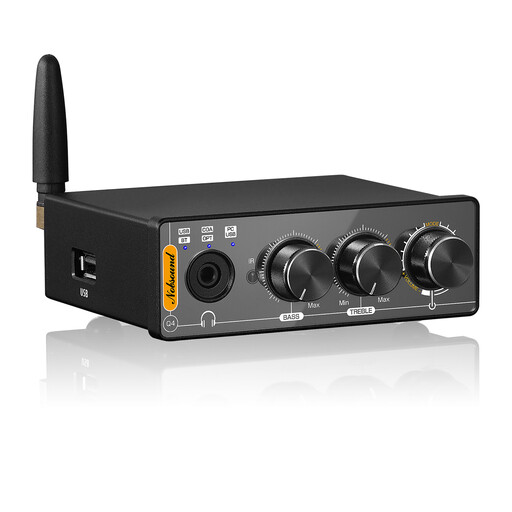 No image available
For a computer signal path over USB, with input and volume controls at your desk.
PC USB, optical and coaxial inputs; headphone amplifier for 16–300 Ω; 24 Bit/192 kHz.
Input selection via rotary control, input indicators and remote control. An external DC power adapter is required.
No, not necessarily. Whether you need an external DAC depends on your source and the sample rate you want. Apple specifically recommends an external DAC for certain devices and songs above 48 kHz, while other devices may offer more extensive support. Check your source’s requirements and enable lossless playback in the app you use.
Before adjusting your desk, check that the cables reach throughout its full range of movement, and start at a low volume. The iFi ZEN DAC 3 manual warns against switching PowerMatch at high volume. The World Health Organization notes that both volume and listening time affect the risk to your hearing.
Under the consumer rules explained by the European Union, the seller is generally responsible for providing a remedy if goods are faulty or do not work as described. The minimum legal period is two years from the date you receive the goods. Any additional manufacturer’s guarantee does not replace these rights.
Only if harmonised EU rules apply to that specific product and require CE marking. Electrical and electronic devices may fall within these rules, but you need to check whether they apply to the particular device. According to the European Union, the mark is a declaration by the manufacturer, not a quality certificate issued centrally by the EU.