
Lieferung heute & morgen

Qualitätsgarantie

Willkommens-Angebote freischalten: KOSTENLOSE Lieferung | Bis zu 80 % RABATT | Kostenlose 30-Tage-JoyPlus-Testphase
App herunterladen
A new desk can transform a workspace, gaming corner, or study area. However, the selection is vast, and not every model that looks appealing online holds up in daily use. Many buyers only realise after assembly that the desk lacks stability or that its advertised features are more of a hindrance than a help. To save you from this disappointment, we'll highlight the most common pitfalls and show you which criteria truly matter.
The three most common mistakes when buying a desk are:
To avoid a bad purchase, you should carefully examine three core aspects: material and stability, the right dimensions for your space, and the actual utility of the features.
The durability of a desk is largely determined by the material of the tabletop and the frame.
The right size and shape of the desk depend on your available space and intended use.
Additional features should be practical and well-implemented.
Instead of making a one-size-fits-all recommendation, we have selected models for different user profiles that meet the criteria mentioned above.
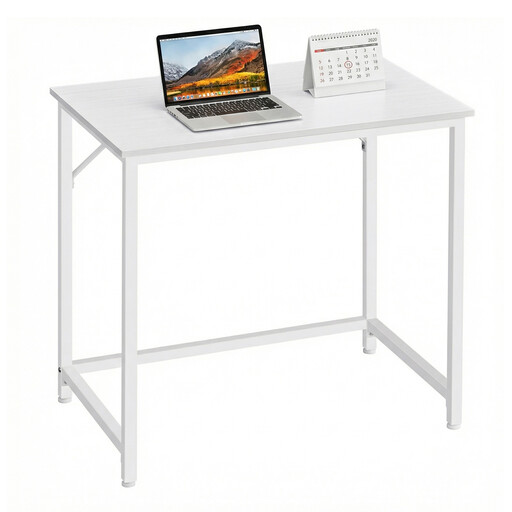
Why This Fits Their Persona: Ideal for students or residents of smaller apartments who need a functional yet unobtrusive workspace. The minimalist design and compact dimensions of 80 x 50 cm blend seamlessly into existing interiors.
This model deliberately avoids costly extras and focuses on the essentials: a stable work surface. The steel frame and adjustable feet counteract the problem of instability.
Compact dimensions for limited spaces. Solid base construction with a steel frame and a static load capacity of up to 50 kg according to the manufacturer.
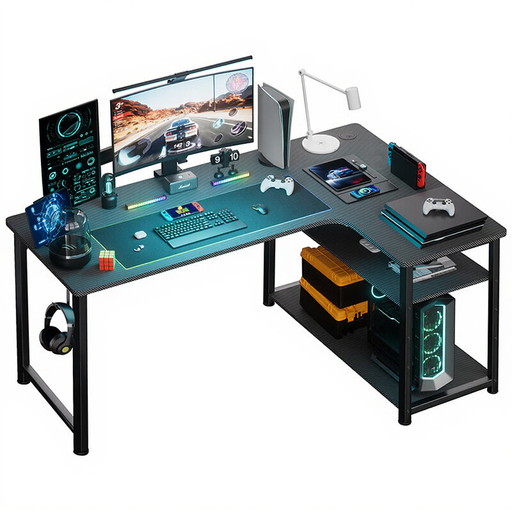
Why This Fits Their Persona: Perfect for home office professionals who need a tidy and efficient workspace. The L-shape makes optimal use of room corners, while the integrated ports significantly simplify cable management.
The integrated power outlets and USB ports are not a gimmick here, but a thoughtful solution to an everyday problem: easy access to power for a laptop, monitor, and smartphone right on the desk.
Efficient use of space due to the L-shape. Integrated power supply with 2 USB ports and one power outlet. Additional storage via an adjustable shelf.
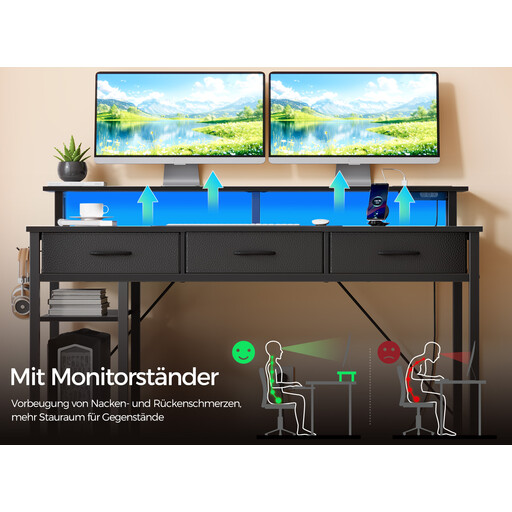
Why This Fits Their Persona: This desk is tailored to the needs of gamers. It provides an immersive atmosphere with RGB lighting, an ergonomic monitor stand, and ample storage for accessories and games.
The features here are functional and tailored to the target audience. The app-controlled LED strip with a music-sync mode and the monitor stand to relieve neck strain offer real value for long gaming sessions.
All-in-one solution with a charging station, RGB lighting, and storage. Reversible design allows for flexible adaptation to the room. The carbon fibre texture tabletop is durable.
We've compiled a complete, up-to-date list of products that fully meet these strict selection criteria and relevant safety standards.
The standard height for desks is typically between 72 cm and 76 cm. This height is ergonomically suitable for most people of average size when sitting in a height-adjustable office chair. The key is that your forearms should form a right angle with your upper arms and rest comfortably on the tabletop.
MDF (Medium-Density Fibreboard) is made from finer wood fibres pressed together under high pressure and heat. This makes it denser, heavier, and more resistant to bending than particleboard, which is made from coarser wood chips. MDF boards offer a smoother surface for finishes and are more resistant to sagging, while particleboard is a more cost-effective alternative.
The load capacity varies greatly depending on the construction and material. Simple, small desks often have a maximum static load capacity of around 50 kg. More stable models with a robust steel frame can support 100 kg or more, according to manufacturer specifications. Always check this information in the product description, especially if you plan to place heavy equipment like multiple monitors or a large PC tower on it.