If your legs and feet tend to get cold at a fixed desk, consider an under-desk panel or a folding freestanding panel. If you want to warm more of your home office, look instead at a suitably positioned wall panel or a convector heater. The key considerations are how much heat you need, safe positioning and installation, how you control operating times, and the cost of electricity on your tariff.
Which option is right for you?
People with cold legs at a fixed desk
If you want to warm your legs specifically without heating the whole room, consider an under-desk panel or a freestanding panel. VASNER describes the iTab as an under-desk option, while Mi-Heat calls its folding model a desk heater.
People who use heating for long periods
If you use a heater regularly or for extended periods, its power consumption, running time and your own unit rate all matter. The Verbraucherzentrale notes that discounted heating electricity is often unavailable for infrared heaters. The Bundesnetzagentur explains how the unit rate features in your electricity bill.
People who work in different places
If you want to use the panel at different desks, look for a portable design and make sure you have enough clear floor space. The Federal Institute for Occupational Safety and Health recommends consulting the instruction manual as an important source of information on using electrical products safely.
What should you look for when buying?
Under-desk infrared panel
A good fit if: you usually sit at the same desk and want warmth focused on your legs.
Consider: the panel stays attached to the desk and, according to VASNER, is not designed to heat a room.
Folding freestanding panel
A good fit if: you want to set up the heater at different workstations.
Consider: it needs floor space and must not get in the way of your legs or cables.
Wall-mounted infrared panel
A good fit if: you want warmth beyond your immediate seating area and have a suitable wall.
Consider: installation and performance depend on the panel’s position and room conditions. Choose the right output and controls for the specific model.
Wall-mounted convector heater
A good fit if: your main aim is to warm the air in your home office.
Consider: a convector heater meets a different heating need from a radiant panel fitted right by your seat, and requires a suitable place to install it.
| What to consider |
What to check before buying |
Who it matters most to |
| Warmth where you sit |
Check the direction of heat, a suitable position under or beside the desk, and the manufacturer’s installation instructions. |
If I mainly get cold legs at a fixed desk, I want focused warmth rather than heating the whole room. Around 36% of consumers put warmth where they sit first. |
| Electricity costs and controls |
Consider the rated power, timer or controls, planned hours of use and your own unit rate in ct/kWh. |
If I use heating for long periods, I want to estimate what it will cost on my tariff. Around 29% of consumers focus primarily on running costs. |
| Portability and floor space |
Check the dimensions when set up, stability, cable routing and the intended method of installation. |
If I move between workstations, I need an option I can move without blocking the space around my legs. Around 21% of consumers prioritise portability. |
| Heating the whole home office |
Take into account the size of the room, insulation, suitable wall space and the controls on the specific model. |
If I want more than just my seating area to feel warmer, what matters is whether the heater suits the room and the level of warmth I need. Around 14% of consumers prioritise heating the room. |
Common buying mistakes
-
Assuming focused warmth will heat the whole room
According to VASNER, an under-desk panel is designed to warm the area around your seat, not the whole home office. If the rest of the room stays cool, you may need additional heating.
Before you buy, decide whether warm legs are enough or whether you also want to raise the room temperature.
You may need additional heating for the rest of the room if you use a localised seat-warming option.
-
Assuming a low wattage automatically means lower overall costs
Power consumption alone doesn’t tell you what your electricity will cost in practice. Your actual hours of use and unit rate matter too. The Verbraucherzentrale notes that discounted heating electricity is often unavailable for infrared heaters.
Take the rated power, planned hours of use and your tariff into account, rather than comparing wattage alone.
-
Assuming every model in a range has the same features
The Könighaus P-Series models vary in power and available controls. Details or test results for one model don’t automatically apply to another.
Check the full model name, power, controls and what’s included for the specific version.
-
Treating the CE mark as the only proof of compliance with ecodesign requirements
Electric local space heaters covered by Regulation (EU) 2024/1103 and newly placed on the EU market from 1 July 2025 are subject to its ecodesign requirements. The European Commission explains that the CE mark indicates that the manufacturer declares the product meets the relevant requirements; it does not provide blanket confirmation that a specific model complies.
Check the details for the specific model and the requirements that apply to it, rather than assuming compliance based only on its design or CE mark.
Relevant brands and product ranges
VASNER
According to the manufacturer, the iTab under-desk panel is designed to provide focused warmth around your legs while you sit in one place.
- The manufacturer lists 150 W, a rotary control and self-adhesive installation without drilling.
- The manufacturer says this model is not a room heater; the product page currently lists it as unavailable.
Mi-Heat
The folding 260 W panel reviewed is described as a portable option for warming your legs and feet at your desk.
- The supplier lists three surface temperature settings, a three-hour timer and a tip-over switch.
- It needs space when set up, and the stated surface temperatures don’t guarantee a particular room temperature.
ETHERMA
According to the manufacturer, the LAVA DESK ZONE combines desk and under-desk components for your workspace.
- The combination described is designed to warm more than just your legs.
- Check exactly what’s included in the set before buying. Manufacturer claims about comfort or energy savings are not independent measurements.
Könighaus
According to the manufacturer, the P-Series includes wall-mounted infrared panels with different power ratings and thermostat options.
- The manufacturer lists power options from 130 to 1200 W across the range.
- The right power rating depends, among other things, on insulation, windows and external walls. Details for one model don’t automatically apply to the whole range.
STIEBEL ELTRON
The CNS 500 Plus LCD is a wall-mounted convector heater worth considering if you’re looking to warm the air in the room.
- According to the manufacturer, this 500 W model has room temperature control, a weekly timer and overheat protection.
- It isn’t a radiant panel fitted directly under your desk and needs a suitable place on the wall.
Heater panels at Joybuy
The selection below includes infrared panels for extra warmth in your home office. Depending on the model, they’re designed for wall mounting or freestanding use; they aren’t the same as a seat-warming panel attached directly under your desk.
 No image available
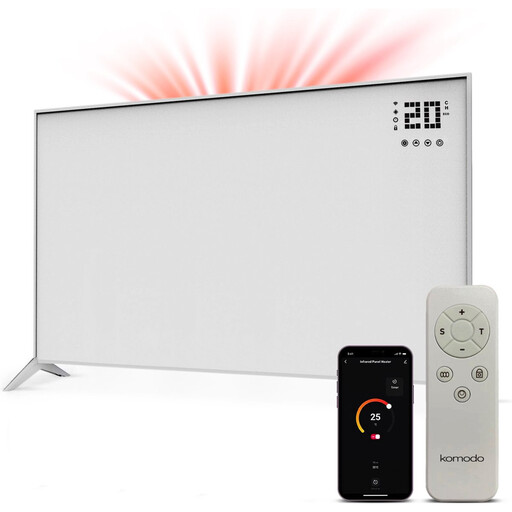
Komodo Blazi infrared heater panel, 800 W, 100 × 80 cm
The description says it can be freestanding or wall-mounted, making it easy to position flexibly around the room.
According to the description, it can be controlled using a thermostat, timer, LED display and Wi-Fi app. It’s listed for rooms up to 20 m²; this doesn’t replace checking your room conditions. Don’t cover it while it’s operating, and keep it away from flammable materials; the surface can get hot.
View at Joybuy
 No image available
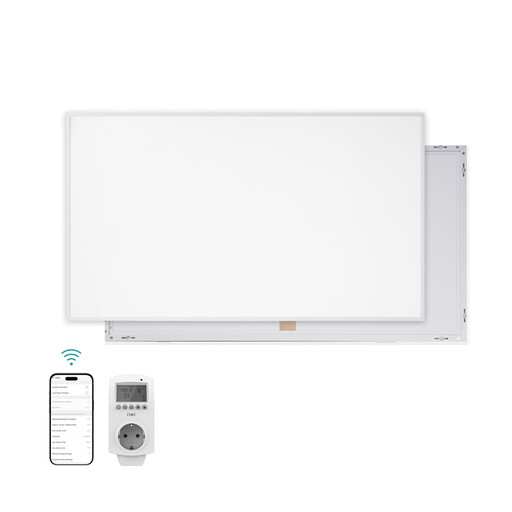
EMKE infrared wall heater, 600 W, 1005 × 595 mm, white
The description lists a home office as one possible use; this model is designed for wall mounting.
According to the description, it comes with a plug-in thermostat, app control and programmable schedules. Installation should only begin once both deliveries have arrived: the heater and the thermostat. The surface reaches around 85–125 °C, according to the description; install it out of children’s reach and don’t cover it.
View at Joybuy
 No image available
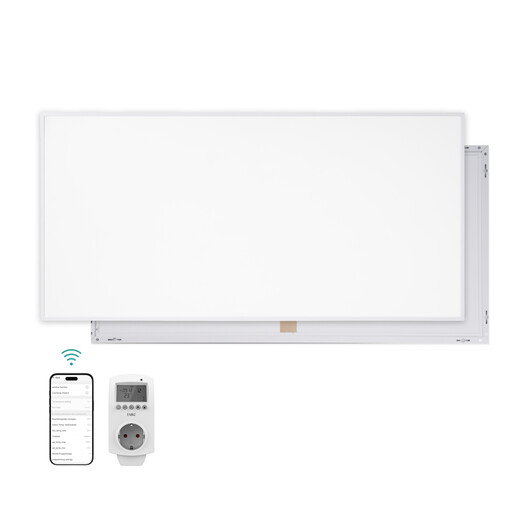
EMKE infrared wall heater, 1000 W, 1195 × 595 mm, white
The description lists this model as a possible extra heater for a home office; it’s designed for wall mounting.
According to the description, it comes with a plug-in thermostat, app control and programmable weekly scheduling. The heater and thermostat from both deliveries should be on hand before installation and use. The surface reaches around 85–125 °C, according to the description; install it out of children’s reach and don’t cover it.
View at Joybuy
 No image available
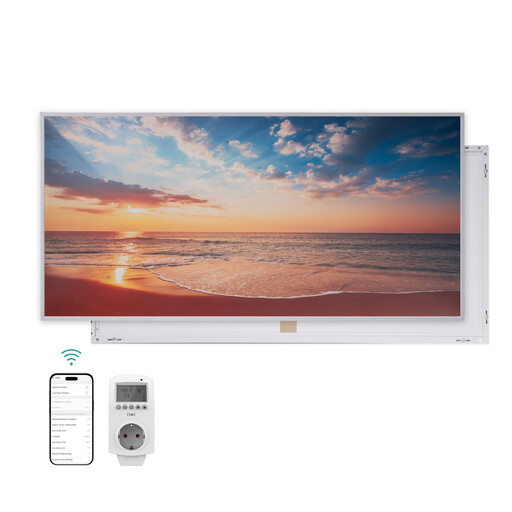
EMKE infrared wall heater, 1200 W, 1195 × 595 mm, seascape design, aluminium frame
The product description lists a home office as one possible use; the panel is designed for wall mounting.
According to the description, it comes with a plug-in thermostat, app control and weekly scheduling. Use it only with the supplied thermostat, and wait until both deliveries have arrived before installation. The surface reaches around 85–125 °C, according to the description; install it out of children’s reach and don’t cover it.
View at Joybuy
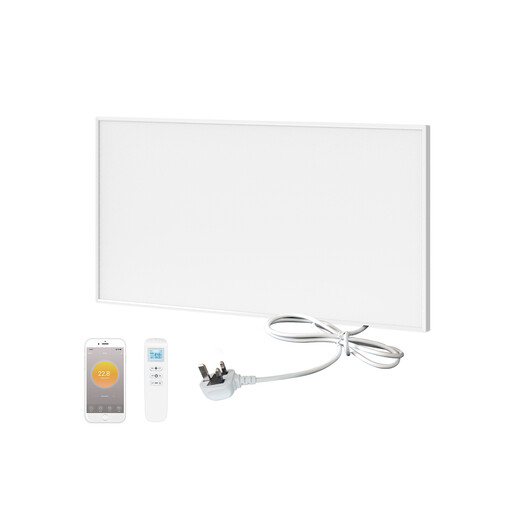 No image available
Welltin infrared heater panel, 60.3 × 30.3 × 1.4 cm, white
The description lists studies and offices as possible uses, and says it can be wall-mounted or used freestanding with feet.
According to the description, it comes with a remote control and overheat protection. The surface operates at 80–100 °C, according to the description; keep it away from children and flammable materials.
View at Joybuy
Frequently asked questions
Will an under-desk panel heat the whole home office?
No. This isn’t a stated feature of the VASNER under-desk panel reviewed. VASNER describes it as providing focused warmth at your seat, not as a way to heat an entire room.
What should I bear in mind when installing and using a heater near paper, cables and furniture?
Follow the instructions for your specific heater and check the installation conditions and clearances listed there. Check the heater and cables for damage. The Federal Institute for Occupational Safety and Health identifies the instruction manual as an important safety resource for using electrical products at home. There isn’t one standard clearance that applies to every design.
How can I estimate the extra electricity costs?
Multiply the power in kW by the actual hours of use and your unit rate in €/kWh. This gives you an estimate based on the heater running at its rated power, not a measured figure; controls and periods when it’s switched off will change consumption. The Verbraucherzentrale notes that discounted heating electricity is often unavailable for infrared heaters.
Does the CE mark alone prove that a panel complies with current ecodesign rules?
No. The European Commission explains that the CE mark indicates that the manufacturer declares the product meets the relevant requirements; no central EU body issues a certificate for this as a matter of course. Electric local space heaters covered by Regulation (EU) 2024/1103 and newly placed on the EU market from 1 July 2025 are subject to its ecodesign requirements. Each specific model must be assessed separately.


