If you mainly feel cold at your desk, you could consider a desk or under-desk panel positioned to provide targeted warmth. If you want to warm the rest of your hobby room too, a convector designed for that purpose may be a better option. The key factors are which part of your body the heat reaches, whether the installation position is suitable and safe, how long you’ll actually use it, and your electricity tariff.
Who might benefit from a heating panel?
People who feel cold at a fixed desk
If you mainly want extra warmth where you sit, check which part of your body a desk or under-desk panel will reach. ETHERMA describes its LAVA DESK TOP and SUB models as suitable for different areas of the workspace.
People using a chilly hobby room
If you need warmth away from your desk too, compare targeted radiant heat with a solution that warms the air in the room. The ADAC explains the difference between radiant heat and heat transferred to the room air.
People who move between workspaces
If you want to move your heat source around, consider the available floor space and cable route, and check whether feet are compatible with the specific model. TROTEC lists feet for selected heaters in its TIH S series.
What should you look for when buying?
The Verbraucherzentrale points out that infrared heaters are generally not eligible for a discounted heating electricity tariff. So factor in your own unit rate and the expected running time.
| What you need |
What to check before buying |
Who is this important for? |
| Targeted warmth where you sit |
Which part of your body you want to warm, and whether the panel can be positioned suitably at your existing desk. |
If you mainly want to warm your hands, upper body or legs at a fixed desk, the right positioning matters. Around 28% of consumers have this as their main priority. |
| Warmth throughout the rest of the room |
Whether you want to warm just your workspace or the room air too; also consider the room size and available space. |
If you spend time in your hobby room away from your desk, you’ll need a solution suited to the area you want to heat. Around 17% of consumers prioritise warmth throughout the room. |
| Safe positioning |
Check the installation instructions, the clearances for the specific appliance and the load on the power supply. Do not cover the appliance. |
A safe place to position and install the appliance is especially important if craft materials or furniture are nearby. Around 17% of consumers prioritise safe integration. |
| Electricity costs |
Compare the rated power in kilowatts with the actual running hours and your own price per kilowatt-hour. |
If you plan to use the appliance regularly or for long periods, include the running time in your cost calculations. Around 22% of consumers prioritise predictable running costs. |
| Flexible positioning |
Check whether compatible feet are available and included, or whether the appliance needs to be permanently installed. |
If you move between workspaces, a portable heat source may be more important than a fixed installation. Around 16% of consumers prioritise flexibility. |
Common buying mistakes
-
Choosing a 300 W panel as your only room heater just because of its wattage
Positioning determines which part of your body the radiant heat reaches. A convector transfers heat to the room air. A lower wattage rating alone doesn’t prove that a panel will warm the whole hobby room.
First decide whether you need warmth where you sit or throughout the room. Then check the power rating and positioning for that specific purpose.
-
Taking advertising claims about lower electricity costs at face value
Power consumption alone tells you nothing about the total cost without knowing the actual running time and the area being heated. Your electricity tariff matters too.
Do the sums using your tariff and a realistic usage period. Only compare cost claims when the heating needs and comparison conditions are the same.
-
Assuming feet will fit every panel model
Manufacturers sometimes list accessories for specific models only. For example, the feet described for the VASNER Citara range are not compatible with the 300 W and 550 W models.
Check the full model name against the accessories list and the items included in the box.
If compatible feet aren’t included or aren’t available for your model, you may need to plan a different installation.
Brands to consider
ETHERMA
According to ETHERMA, its LAVA DESK TOP and SUB models are designed to provide targeted warmth at your desk.
- The manufacturer’s data sheet lists a 50 W desk model and a 90 W under-desk model.
- These power ratings don’t demonstrate a specific heating effect throughout the whole hobby room.
TROTEC
TIH heating panels offer an alternative to mounting a heater directly on your desk.
- TROTEC lists 300 W and an integrated thermostat for the TIH 300 ST model.
- The feet documented by the manufacturer are designed for selected models. Check compatibility with the exact version you’re considering.
STIEBEL ELTRON
According to the manufacturer, the CNS 2000 Plus LCD Move is a freestanding convector that transfers heat to the room air.
- For this model, the manufacturer lists temperature control, a tip-over switch and a rated power of 2,000 W.
- The appliance needs floor space and is not an under-desk panel.
Klarstein
According to the manufacturer, the Wonderwall Infinite 300 W is designed for wall or ceiling installation.
- The manufacturer lists a thermostat and fixed installation options on the wall or ceiling.
- A manufacturer’s claim about lower electricity costs isn’t proof of a cost saving when the heating needs are the same.
VASNER
The Citara range includes panels. According to VASNER, feet are compatible with selected models only.
- Compatible models may be suitable for use with feet.
- The feet described are explicitly not compatible with the 300 W and 550 W Citara models.
Related products at Joybuy
This selection includes infrared panels for extra warmth in your hobby room, as well as a convector if you also want to warm the room air.
 No image available
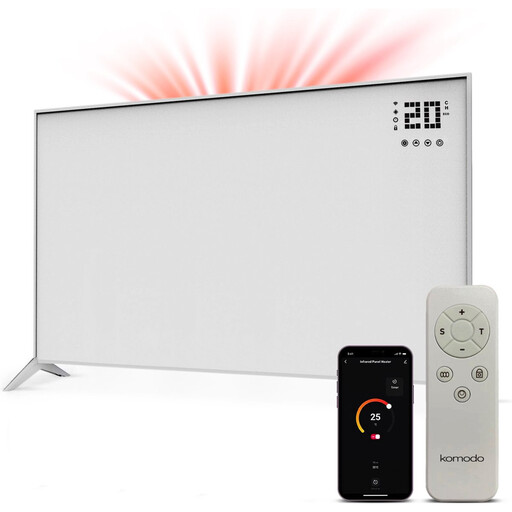
Komodo Blazi 800 W infrared heating panel
According to the product title, you can choose between freestanding use and wall mounting for extra infrared warmth.
800 W; 100 × 80 cm; IP24; for rooms up to 20 m², according to the product title. The description lists a thermostat, timer, app control, overheat protection and child lock. Do not cover the appliance and keep it away from flammable materials.
View at Joybuy
 No image available
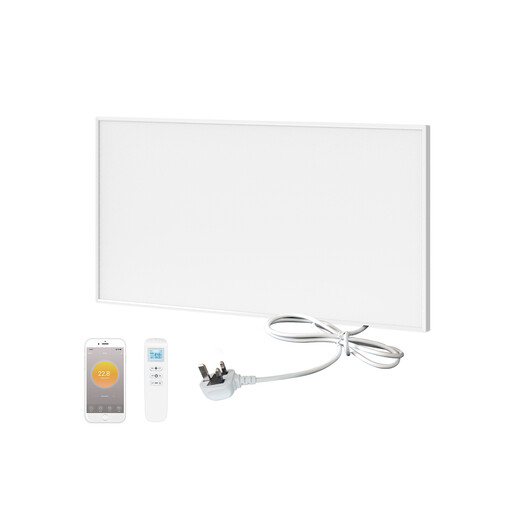
Welltin infrared heating panel with graphene heating element, 60.3 × 30.3 × 1.4 cm
For extra warmth indoors, check that the intended installation method works with the space available at your desk.
The description lists wall mounting or feet, as well as a remote control and overheat protection. Stated surface temperature: 80–100 °C. Keep away from children and flammable materials.
View at Joybuy
 No image available
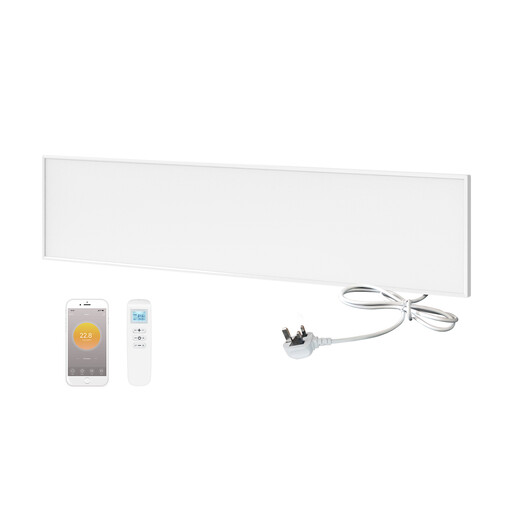
Welltin infrared heating panel with graphene heating element, 90.3 × 20.3 × 1.4 cm
For extra warmth indoors, check that the intended installation method works with the space available at your desk.
The description lists wall mounting or feet, as well as a remote control and overheat protection. Stated surface temperature: 80–100 °C. Keep away from children and flammable materials.
View at Joybuy
 No image available
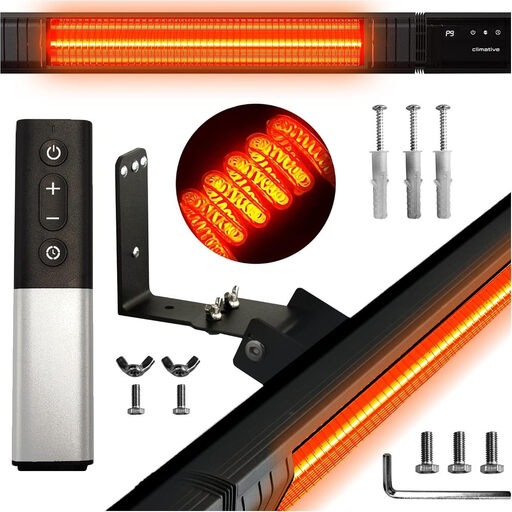
Infrared heater with 2500 W and 9 heat settings
If you’re looking for an extra infrared heat source for an indoor space, first check whether the intended positioning is suitable for your hobby room.
The description lists wall mounting or freestanding use, a remote control and a timer.
View at Joybuy
 No image available
Aigostar convector with 2000 W and remote control
If you want to warm the room air as well as the area around your desk, a convector is a different type of heater from a panel aimed at a specific spot.
The description lists natural convection, a coverage area of 20–25 m², a thermostat, timer, remote control, and tip-over and overheat protection.
View at Joybuy
Frequently asked questions
Should you put the panel under the desk or on the wall?
Choose the installation position based on the part of your body you want to warm and the instructions for the specific appliance. ETHERMA describes the LAVA DESK SUB as an under-desk model, while Klarstein specifies wall or ceiling installation for the Wonderwall Infinite. Check the clearances, fixings and surface you’ll be mounting it on against the relevant instructions.
How can I use a heater safely at my craft table?
Follow the clearances specified in the instructions, don’t cover the appliance and don’t continue using damaged cables. The German Fire Service Association also warns against overloading sockets by plugging in too many heaters.
How much does an hour of heating cost?
Multiply the rated power in kilowatts by the actual running time in hours, then multiply that figure by your price per kilowatt-hour. One hour running at the full rated power of 300 W uses 0.3 kWh; a thermostat can change the actual time the heater is switched on. The Verbraucherzentrale advises against assuming that infrared heaters qualify for a discounted heating electricity tariff.
Which labels and regulations matter when buying in Germany?
Mains-powered electrical appliances within the scope of the relevant rules must meet the applicable German safety requirements. The Bundesnetzagentur specifies the required CE marking and accompanying documentation, including safety instructions in German. Affected local space heaters must also comply with the ecodesign requirements in force since 1 July 2025. Older product documentation alone doesn’t prove that an appliance meets the requirements currently in force.


