People who feel cold at their desk
If you sit in one place for long periods, targeted warmth for your body or legs may matter more than a new heating system for your whole home.


If your legs or the area around your seat are the main problem, a directional infrared or under-desk panel could be a good option. If you want to warm the air throughout the room, a thermostatically controlled convector may be a better fit. Your decision will depend on the space available, permitted installation and controls, and energy use over your actual running time. A blanket claim that infrared heating saves energy is no substitute for comparing these factors.
If you sit in one place for long periods, targeted warmth for your body or legs may matter more than a new heating system for your whole home.
If your desk and furniture leave little room, the right design depends on whether you can mount a panel under the desk or on the wall, or set up a portable one.
If you want to warm not just your seat but the rest of a small room too, a directional panel designed for a workspace may not be the right heating solution on its own.
First, decide whether you mainly need warmth at your seat or throughout the room. This will determine the design, installation and controls to look for.
| What you need | What to check before buying | Who is this particularly relevant to? |
|---|---|---|
| Warmth at your seat | Check that the panel can be directed towards your seat, how it is installed and whether there is enough space. For an under-desk option, also check that your desktop is suitable for the specified installation method. | If I mainly want to warm my legs and feet, where the panel is positioned matters more than whether it is designed to heat the whole room. For around 31% of consumers, targeted warmth at their seat is the main priority. |
| Ongoing energy use | Consider the power rating in kW and how many hours you expect to use it for. To calculate consumption at full power, multiply kW by hours; a thermostat can change the actual running time. | If I use heating at my desk for several hours, I want to estimate consumption based on how long I use it and my electricity tariff. Around 25% of consumers prioritise ongoing energy use. |
| Positioning and use | Check the appliance dimensions, suitable locations for standing or mounting it, and whether feet or brackets are included. Factor the cable, plug and model instructions into your plans. | If space is limited or installation could be difficult, I first need to work out where the appliance can stand or be mounted. For around 25% of consumers, safe positioning is the most important consideration. |
| Warmth throughout the room | Decide whether you want to warm the air in the room or a particular area, and check the installation position and control range of the specific appliance. | If I spend time elsewhere in the room as well as at my desk, targeted warmth may not be enough. Around 19% of consumers prioritise heating the room air. |
A marketing comparison that doesn’t use like-for-like conditions does not prove that an infrared panel uses less electricity to meet the same heating needs. The power rating and actual running time matter for all direct electric heaters.
Compare the power rating and expected running time for the way you plan to use the appliance. Treat targeted warmth at your seat and heating the whole room as two different goals.
Longer running times increase electricity consumption, so factor in the number of hours you expect to use the heater when choosing one.
Depending on the model, feet or different thermostat options may be sold separately. A wall panel and a freestanding version do not necessarily come with the same features.
Check the full model variant, what’s included and the instructions. If the version you choose doesn’t have built-in controls, you’ll also need to check which compatible controls are intended for use with it.
An under-desk heater is designed to warm the area beneath your desk; it isn’t necessarily intended to heat the entire room.
Before choosing, decide whether you need warmth at your desk or throughout the room. For the latter, consider a design intended to warm the room air.
According to the manufacturer, the iTab range is designed as an under-desk solution for targeted warmth at your workstation.
Compact infrared heating panels, including the documented TIH 300 ST version.
According to the manufacturer, the P Series includes wall-mounted panels, as well as separately available freestanding versions.
Wall- and ceiling-mounted panels, including the 360 W RadiantSmart infrared panel.
Slimline wall-mounted convectors are an alternative if you want to warm the room air rather than mainly direct heat towards your desk.
This selection includes infrared panels for targeted warmth or wall mounting, as well as convectors for warming the room air. Check the instructions and manufacturer’s information for each model. A CE marking alone is not an independent product test.
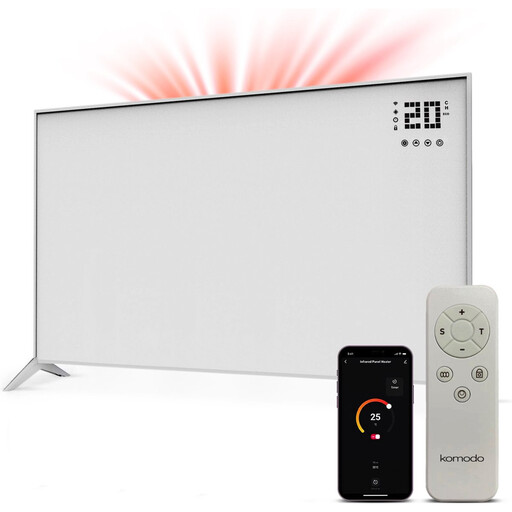 No image available
This freestanding or wall-mounted version may suit you if you want to direct the warmth towards your desk and choose where to install it.
The product information lists 800 W, 100 × 80 cm, app control and a timer. Feet and castors are listed for freestanding use; check the space required and the recommended positioning.
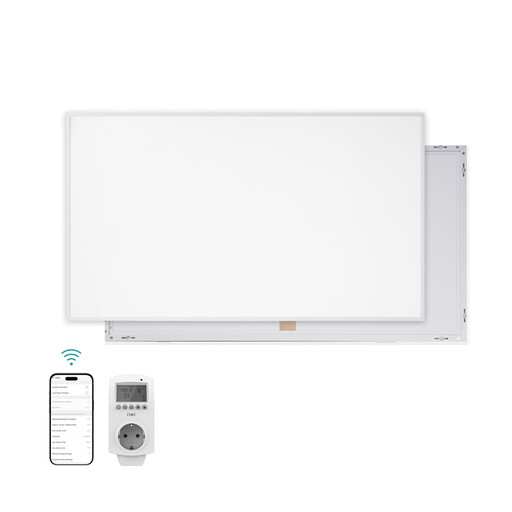 No image available
A wall-mounted option may work well if you want to keep floor space clear and have a suitable surface for installation.
The product information lists 600 W and 1005 × 595 mm, as well as app control and a plug-in thermostat. The appliance description gives a surface temperature of 85–125 °C; take care around hot surfaces and follow the instructions.
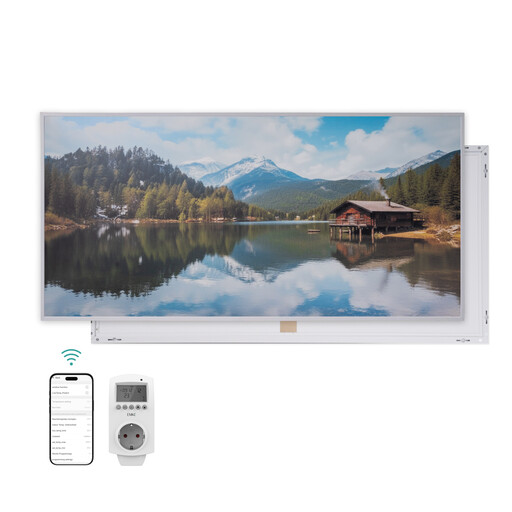 No image available
Wall mounting may suit a workspace with limited floor space, provided there is a suitable wall available.
The product information lists 1200 W and 1195 × 595 mm, as well as app control and a plug-in thermostat. The appliance description gives a surface temperature of 85–125 °C; take note of the guidance on hot surfaces and positioning.
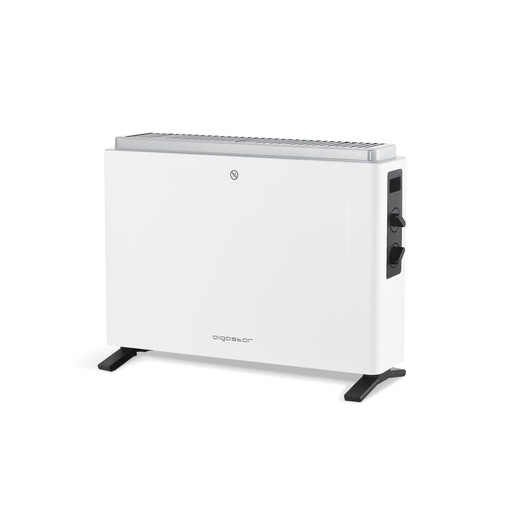 No image available
As a convector, this model may be a good option if you want to warm the room air rather than direct infrared warmth towards your seat.
The product information lists 2000 W, three heat settings and adjustable temperature control. The appliance instructions state that the convector must be used upright.
 No image available
If you want to warm the air in a small room, a convector may better suit your needs than an infrared panel designed for use at a desk.
The product information lists 1500 W, a recommended room size of up to 15 m², a weekly programme and an Eco mode. According to the product information, feet for freestanding use are available separately.
If you want warmth in one regular spot, it’s important to be able to direct an infrared panel towards your seat. If your main aim is to warm the room air, consider a thermostatically controlled convector. Neither the type of heater nor its wattage alone proves that it is suitable for your room.
At full power, multiply the power rating in kW by the number of hours of use to calculate the estimated consumption. The thermostat’s actual on-and-off times may change this, so take your typical running time and electricity tariff into account.
Not until you’ve checked which controls are required for that specific version. The European Commission explains that electric local space heaters placed on the market without controls must not be able to emit heat without suitable controls. The relevant requirements of Regulation (EU) 2024/1103 apply to appliances intended for indoor use that are newly placed on the market in Germany from 1 July 2025. Check the instructions and make sure the intended combination is compatible.
Follow the instructions for your specific model on positioning, clearances and cleaning. Don’t use an appliance with a damaged cable or visible scorch marks, and keep objects away from hot surfaces. Overheat protection is no substitute for taking these precautions.
Check that the model name and manufacturer’s details match the version on offer, and find out what documentation the manufacturer provides. Appliances covered by the Low Voltage Directive must meet EU safety requirements. According to the European Commission, the manufacturer is responsible for the conformity assessment, technical documentation, EU declaration of conformity and CE marking. A CE mark alone is not an independent product test.