
Lieferung heute & morgen

Qualitätsgarantie

Willkommens-Angebote freischalten: KOSTENLOSE Lieferung | Bis zu 80 % RABATT | Kostenlose 30-Tage-JoyPlus-Testphase
App herunterladen
A desk lamp should illuminate your workspace evenly without wobbling or taking up more room than necessary. For students, people working from home, readers and families, design and price aren’t the only things that matter. Technical specifications, ease of use and the right design are just as important.
A high wattage doesn’t automatically mean better illumination. With LED lights, the most relevant factors are luminous flux in lumens, beam angle and the position of the light source. An LED desk lamp with 400 to 500 lumens may be enough for a compact workspace, while larger areas need a wider spread of light.
Claims such as ‘easy on the eyes’ should also be viewed objectively. Even, low-flicker light at a suitable brightness can make a lamp more comfortable to use. However, this shouldn’t be taken to mean that it has a medical effect or protects against eye problems.
Touch controls, colour-changing settings and timers can be useful. But if the display isn’t clear or the controls are too sensitive, everyday use can become a chore. If you’re choosing a dimmable desk lamp, check whether you can adjust the brightness in set steps or continuously.
A wide base can get in the way on a small desk. A folding desk lamp or a desk lamp with a clamp saves space, but needs to be securely attached. For clamp models, check the maximum suitable desk thickness, protection against scratches and cable length.
Luminous flux in lumens describes the amount of light emitted. For reading and focused work, the way the light is distributed matters too: the beam should reach your work surface without shining directly into your eyes.
The colour temperature in kelvin of many modern lights ranges from warm light at around 2700 to 3000 kelvin to cooler light at around 5000 to 6500 kelvin. Warm white light is often suited to relaxing evenings, while neutral or cooler settings can work well for desk tasks. Your personal preference and the room’s lighting are important, too.
The CRI or Ra value describes colour rendering. A higher value can make colours look more natural. For example, the Honeywell lamp is listed with a CRI of 95. Treat figures like these as product specifications, not as a general promise of quality for every situation.
A desk lamp with adjustable colour temperature gives you more flexibility than one with just a single light colour. Depending on the model, Aigostar lamps offer ranges from 2700 to 6500 kelvin or set options such as 3000, 4000 and 5000 kelvin.
Before you buy, check:
A flexible desk lamp should be easy to position so that your hand doesn’t cast a shadow over the page when you write. Reinforced joints help prevent the lamp head from drooping over time. A mains-powered desk lamp is a good choice for a permanent workspace. A rechargeable lamp, on the other hand, is handy if you sometimes want to move it elsewhere.
A desk lamp with a USB port can also charge your smartphone or headphones. Check whether it has a USB-A, USB-C or combined port, and whether the charging output is sufficient for the device you want to use.
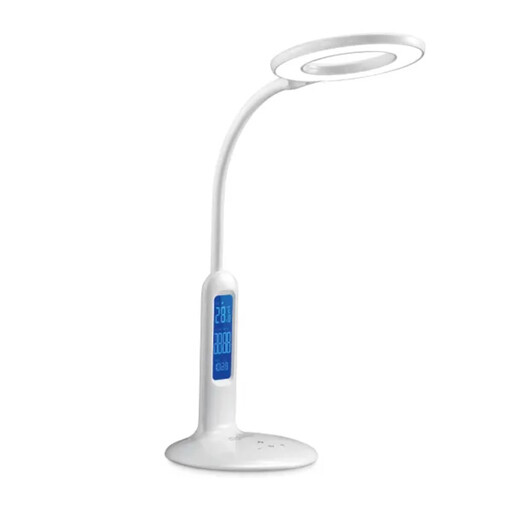
Why it suits this profile: This 7-watt LED lamp combines compact desk lighting with touch controls, a calendar display and an alarm. It brings several features together in one device, making it a good fit for students or a small home office.
Adjust the brightness continuously with the touch control. The fully adjustable arm helps you direct the beam where it’s needed, rather than relying on a high wattage alone.
2700–6500 kelvin, 360 lumens, touch controls and an integrated display showing the time, date and temperature.
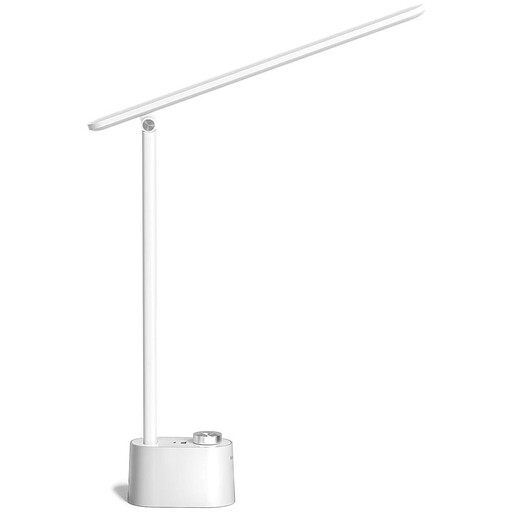
Why it suits this profile: Designed to keep your workspace tidy, this folding desk lamp has USB-A and USB-C charging ports. Its adjustable light colour lets you tailor the lighting to different tasks.
According to the product description, the reinforced lamp stem is designed to stop the lamp head from drooping. The brightness can be adjusted from 15 to 100 per cent.
500 lumens, 3000/4000/5500 kelvin, CRI 95 according to the product specifications, and two charging ports.

Why it suits this profile: This flexible, battery-powered desk lamp is suited to changing workspaces, bedside tables or reading without a nearby plug socket. Its flexible neck makes it easy to position the light just where you need it.
You’re not tied to one spot with this lamp. Three colour temperatures and touch dimming let you adjust the light without needing to buy several different lamps.
400 lumens, 3000/4000/5000 kelvin, a built-in 2 × 1800 mAh battery and a 1-metre charging cable.
We’ve put together a comprehensive, regularly updated list of products that meet these strict selection criteria and the safety regulations in force in the EU.
Position your desk reading lamp to the side of your dominant hand. Right-handed people usually place it on the left, while left-handed people usually put it on the right. This helps reduce shadows from your hand when writing. Don’t point the lamp head directly towards your face at eye level.
With clamp lamps, the desk edge needs to be clean, thick enough and sturdy. The Atmosphera Clamp Desk Lamp, for example, is designed for desk or bed edges. However, according to the product specifications, it’s supplied without a bulb and isn’t dimmable. Check the bulb and its fitting type before you buy.
Around 400 to 500 lumens may be enough for a small personal workspace. More important than any single figure are even illumination, the distance from the work surface and whether the lamp is dimmable.
The stated lifespan depends on the model. Product specifications may list figures such as 25,000, 30,000 or 50,000 hours. These are manufacturer estimates and can be affected by operating time, heat and how the lamp is used.
LED lights generally need less electrical power than traditional incandescent bulbs to produce a similar amount of light. Your running costs depend on the wattage, how long you use the lamp each day and your current electricity tariff. With occasional use, a 7- or 9-watt lamp will use less electricity than a significantly more powerful one.