
Lieferung heute & morgen

Qualitätsgarantie

Willkommens-Angebote freischalten: KOSTENLOSE Lieferung | Bis zu 80 % RABATT | Kostenlose 30-Tage-JoyPlus-Testphase
App herunterladen
A desk organiser should keep your papers, pens, books and everyday items within easy reach. In practice, however, many people end up buying a model that looks tidy in pictures but doesn't fit the available space or meet their actual storage needs. Especially in a home office, student hall of residence or small flat, just a few centimetres can make all the difference to how usable it really is.
Rustic wood finishes, open compartments and decorative wire constructions may look versatile. What really matters, though, is whether the width, depth and height suit your desk, shelf or wall. A desk organiser that's too deep will eat into your work surface, while a document tray that's too shallow won't securely hold larger envelopes or ring binders.
Before you buy, measure the available space and the dimensions of the items you need to store. Also take into account cables, monitor feet, window handles and the clearance needed for drawers or flaps to open.
A stackable desk tray can help you make better use of vertical space. However, it needs a level surface and an even weight distribution. If you store heavy folders on top and light letters underneath, the centre of gravity can shift unfavourably.
With a desk shelf, pay attention to the number of tiers, the construction and the stated load capacity. For small shelves that aren't fixed to the wall, it's best to place them well away from the edge of the desk. Children should not be allowed to climb on or pull at such furniture.
'Wood' can mean solid wood, MDF, chipboard or coated wood-based panels. These materials differ in weight, surface finish, moisture sensitivity and care requirements. A wooden organiser made from solid wood isn't automatically suitable for damp rooms. With coated panels, the edges and surfaces need to be protected from prolonged exposure to water.
For products made from MDF or chipboard, the specific material description is more important than a vague label like 'premium wood'. In an office setting, what counts most is a sturdy construction, neatly finished edges and a surface that can be wiped clean with a dry or slightly damp cloth.
First, decide what you need it for:
With wall-mounted solutions, also measure the wall area and check whether the necessary fixing materials are included. For a wall organiser made of wood or metal, the load-bearing capacity of the wall itself is just as important as that of the product.
Wood and metal often suit a professional or homely home office. Wire constructions make it easy to see magazines and letters, while closed compartments can reduce dust and visual clutter. Bamboo and steel should be protected from high humidity and not cleaned with abrasive products.
With coated wood-based materials, take care not to damage the surface with sharp objects. For everyday office storage, a soft, dry cloth is usually sufficient.
An adjustable desk shelf can be adapted to different desk widths. A folding desk, on the other hand, can be useful if you only need the work surface from time to time. With folding constructions, check in particular:
Don't confuse the load capacity with the recommended storage space. Heavy equipment or large quantities of files should only be stored within the manufacturer's specified limits.
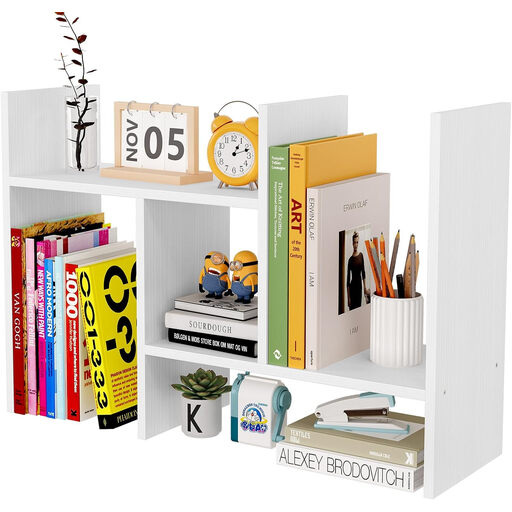
Why this product fits the profile: This compact desk shelf offers two adjustable tiers and can be used on desks, in bedrooms or in student accommodation.
The width can be adjusted from 41 to 73 cm. This means it can make better use of the available space than a desk shelf with a fixed width.
Two tiers, 19 cm depth and a construction made from coated melamine board with a variable width of 41–73 cm.
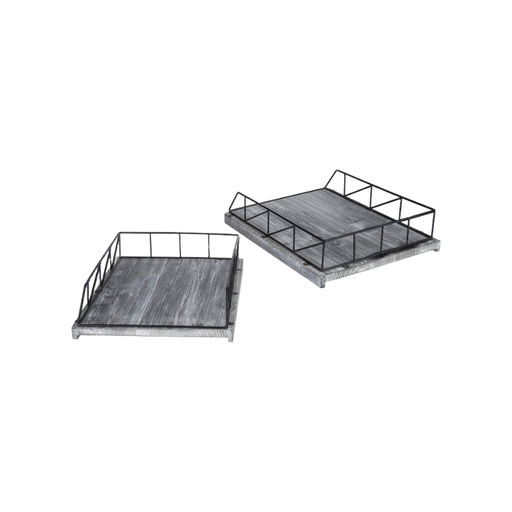
Why this product fits the profile: If you regularly sort documents and appreciate a wood-and-metal look, you'll get two separate or stackable storage trays.
The trays don't have to be stacked on top of each other. This means you can arrange them to suit the available space and the height you want to reach them at.
Set of two stackable document trays made from wood and metal for letters, magazines and standard paperwork.
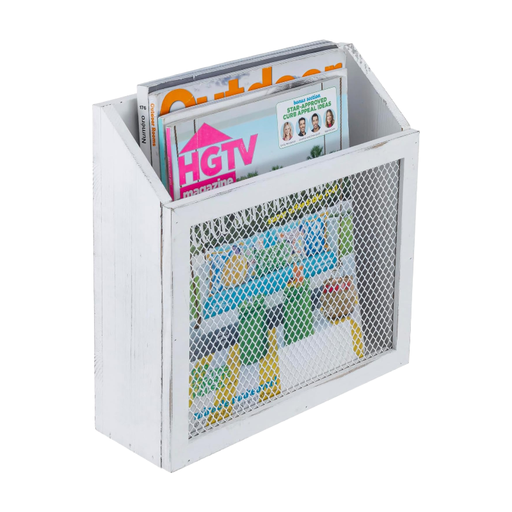
Why this product fits the profile: This holder is ideal for magazines, post and larger envelopes in the office, hallway or living area, and can be placed on a surface or mounted on the wall.
The dual-use design prevents you from committing too early to a purely wall-mounted solution. However, fixing materials are not included.
Dimensions of 29.4 × 28.9 × 9.6 cm, key hook for wall mounting and a flat base for tabletop use.
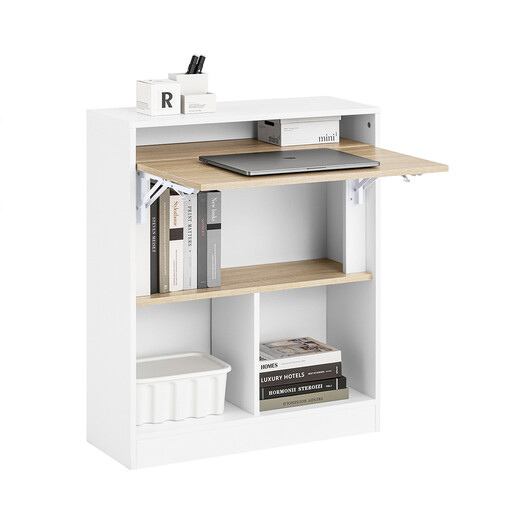
Why this product fits the profile: This folding desk combines a work surface with five storage compartments and is designed for small flats, bedrooms or home office areas.
The stated dimensions of 70 × 57 × 85 cm and the folding mechanism make the space requirements clear. The wall mounting and assembly instructions should be planned for before purchase.
Five storage compartments, desktop load capacity of up to 81 kg according to the product specification, and a folding work surface made from PB and MDF (E1).
We've put together a complete, regularly updated list of products that fully meet these strict selection criteria and the safety regulations in force in the EU.
For pens, sticky notes and small accessories, 10 to 20 cm is often sufficient. A document tray for letters and magazines usually needs more depth. Measure the documents you have and allow a few extra centimetres so that paper doesn't stick out or get jammed.
A desk tray can be used immediately without drilling and can be moved around flexibly. A wall organiser saves surface space and is ideal for post, keys or frequently used items. With wall mounting, you need to consider the wall type, wall plugs, screws and the intended load.
Divide the compartments into clear categories, such as 'to do', 'to file' and 'personal'. Use storage baskets for items you rarely need and try to keep the top shelf as clear as possible. With a file organiser, it's also a good idea to regularly sort out documents you no longer need, in line with the applicable retention periods.