
Lieferung heute & morgen

Qualitätsgarantie

Willkommens-Angebote freischalten: KOSTENLOSE Lieferung | Bis zu 80 % RABATT | Kostenlose 30-Tage-JoyPlus-Testphase
App herunterladen
By a Joybuy Product Recommendation Officer, 28 August 2026
A cluttered desk doesn't just look bad; it hurts your concentration. A good desk organiser promises a solution, but the selection is vast, and not every product delivers on its promise. Many buyers invest in solutions that quickly prove to be impractical or unstable. Before you make a decision, it's helpful to know the most common pitfalls that can lead to a purchase you'll regret.
To avoid these problems, you should base your choice on objective criteria. A well-designed desk organisation system is distinguished by three core features.
The material determines durability, stability, and aesthetics.
A good office organiser adapts to your needs, not the other way around. Before buying, consider what you need to store.
An organiser should stand firmly in its place. Models with a heavier weight or a wider base are less prone to tipping. Another important detail is non-slip feet or protective pads on the underside. They not only prevent sliding but also protect your desk surface from scratches.
Based on these criteria, we have identified several models that are suitable for different user profiles and requirements.
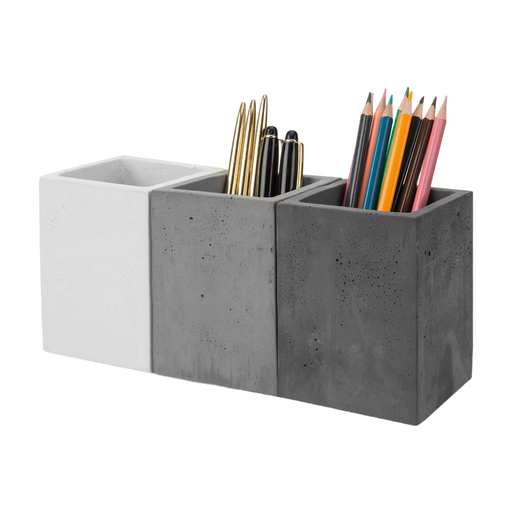
Why it's a great fit: Ideal for users who value a minimalist aesthetic and high-quality materials. The set of three separate cups allows for flexible arrangement on the desk and fits perfectly into modern office or home office environments.
The solid cement construction provides substantial weight, preventing it from tipping over. The simple, functional design without unnecessary dividers is universally practical and durable.
Material: Durable cement. Special Feature: Set of three separate holders for flexible organisation. Includes bottom protectors to shield the desk surface.
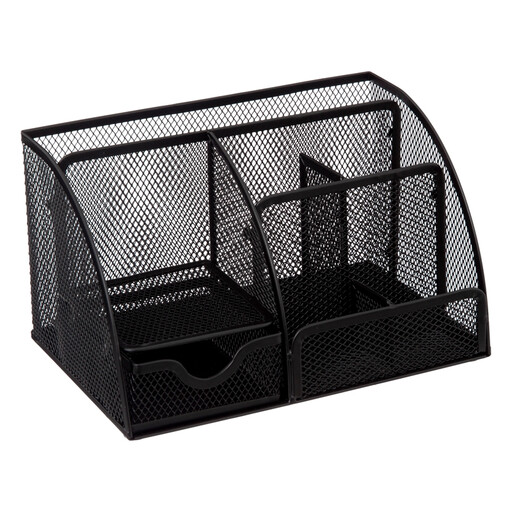
Why it's a great fit: Perfect for users with many different utensils. With multiple compartments of various sizes and an additional tray, this organiser offers a comprehensive solution for keeping pens, scissors, rulers, and notepads bundled in one place.
The robust steel construction is resilient and durable. The thoughtful compartment layout, with varying heights and widths, is specifically designed for the practical storage of diverse office supplies.
Material: Robust steel. Special Feature: Generous dimensions (22 x 14 x 13 cm) and a multi-functional compartment structure for maximum organisation.
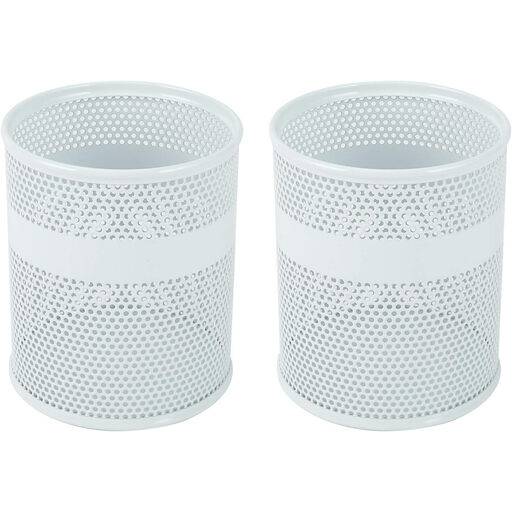
Why it's a great fit: A straightforward and cost-effective solution for creating order instantly. The set of two pots offers excellent value for money and can be used flexibly for pens or even makeup brushes.
The powder-coated metal is significantly more stable than simple plastic. The classic pen pot design is universally practical and avoids the frustration of ill-fitting compartment sizes.
Material: Powder-coated metal. Special Feature: Delivered as a practical set of 2, allowing for flexible use in different locations.
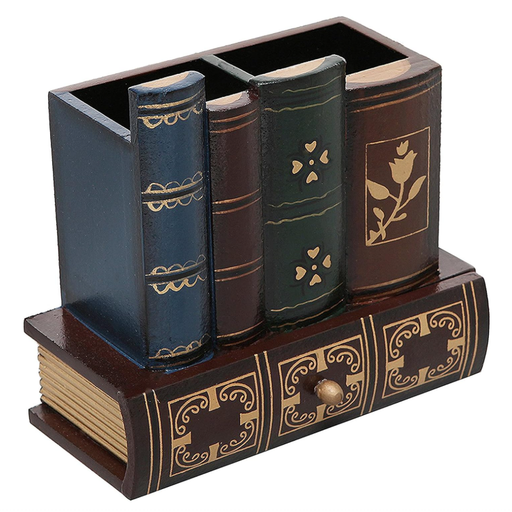
Why it's a great fit: For anyone who wants to not only organise their workspace but also decorate it. The design, shaped like antique books, is an eye-catcher and combines nostalgic charm with practical utility.
Despite the whimsical design, the function is well-thought-out: two pen compartments and a small drawer for tiny items provide a practical layout. The wood material ensures a solid feel.
Material: Painted wood. Special Feature: A unique design that doubles as a decorative object, combined with an integrated drawer for small items.
The models featured here are just a sample. If you're looking for more solutions selected based on material, function, and design, you'll find a wider selection in our main category.
Care depends on the material. You should only wipe a wooden pen holder with a dry or slightly damp cloth to prevent the material from swelling. Metal models can also be cleaned with a lightly damp cloth but should be dried immediately to prevent rust, especially on mesh structures. Avoid harsh cleaning agents for all materials.
The ideal height for a pen cup is between 10 and 12 cm. This is tall enough to securely hold longer pens, scissors, or brushes without them tipping out. For shorter items like highlighters or small notepads, shallower compartments or a desk tray are more suitable.
A heavy weight provides excellent stability, which is a clear advantage if you tend to place items down carelessly. Such organisers are virtually impossible to tip over. The downside is their lack of flexibility. If you frequently rearrange your workspace, a lighter model made of wood or metal might be more practical. The decision, therefore, depends on your personal priority between maximum stability and ease of handling.