People working at a quiet desk
If you want a breeze you can adjust while you work, compare noise and airflow at the setting you actually plan to use. IMTEST recommends looking at air speed under set conditions rather than focusing on wattage alone.


For a breeze right at your desk, a compact mini tower may be enough. If you want the airflow to reach other areas too, a freestanding tower fan with switchable oscillation could be a good choice. Compare noise and airflow at the same speed setting, and check the footprint, outlet height and cable length. A fan moves air but does not lower the room temperature, as the Verbraucherzentrale explains.
If you want a breeze you can adjust while you work, compare noise and airflow at the setting you actually plan to use. IMTEST recommends looking at air speed under set conditions rather than focusing on wattage alone.
When space is limited, the footprint is not the only thing to consider: outlet height, cable routing and where the fan can stand matter too. A mini tower and a tall freestanding tower solve different placement problems. F.A.Z. Kaufkompass describes tower fans as having a slim design, while also noting that airflow and noise may differ from those of traditional bladed fans.
If you want the airflow to reach your desk and other areas in turn, oscillation can help. IMTEST distinguishes between sweeping airflow and a fixed direction.
| What matters when buying | What to look for | Who is this especially important to? |
|---|---|---|
| Quiet, adjustable airflow | Compare noise and airflow at the same speed setting. Consider which setting you need for your seat. | If I want a pleasant breeze at my desk without the noise disrupting my work, I pay particular attention to finding the right setting. Around 33% of consumers prioritise quiet, adjustable airflow. |
| Footprint and outlet height | Check the fan and base dimensions, available space, outlet position and distance to the socket. | If there is little room next to my desk, the fan needs to fit there and reach me from where I sit. Around 27% of consumers prioritise limited space for placement or storage. |
| Air distribution around the room | Check whether oscillation can be switched off and whether the sweep suits where you plan to place the fan. | If I move between my desk and another area of the home, I want to be able to direct the airflow as needed. Around 20% of consumers prioritise distributing air across several areas. |
| Power consumption with frequent use | Take power consumption, the setting you use and daily running time into account. You will also need your electricity tariff to estimate running costs. | If the fan runs for many hours while I work, I want to be able to estimate its consumption without using the wattage to infer airflow. Around 13% of consumers prioritise ongoing electricity costs. |
| Controls and care | Check the controls, cleaning instructions and model-specific information about spare parts and warranty. | If I use the fan regularly, I want to be able to adjust it easily and care for it according to the instructions. Around 7% of consumers prioritise straightforward operation, care and support if something goes wrong. |
A fan moves air, which can make you feel cooler where you are sitting. However, it does not remove heat from your home.
Before you buy, consider whether you need airflow at your desk or a genuinely lower room temperature.
A low figure does not necessarily tell you how loud the fan will be at the setting needed to move enough air at your desk. Figures for different settings are not directly comparable.
Where possible, compare noise and usable airflow under similar conditions and at the same speed setting.
The base, cable length and outlet height all affect whether the fan will fit in the space you have in mind and reach you with its airflow.
Measure the space and check from where you sit that the airflow reaches you without blocking a walkway.
The Eole Compact VU6210F0 is an example of a mini tower designed to direct airflow to a specific spot.
The Classic 36 DC is a freestanding tower fan with several adjustable settings.
The 5000 Series includes the CX5535/11 tower fan, which has an oscillation function.
The Dreo 519S PRO and DREO 307S PRO are different tower fan models.
The TurboBlade tested in the comparison is an option if flexible airflow direction is important to you.
Here you’ll find freestanding tower fans for distributing air around the room, as well as compact desk fans for directing airflow at your workspace.
 No image available
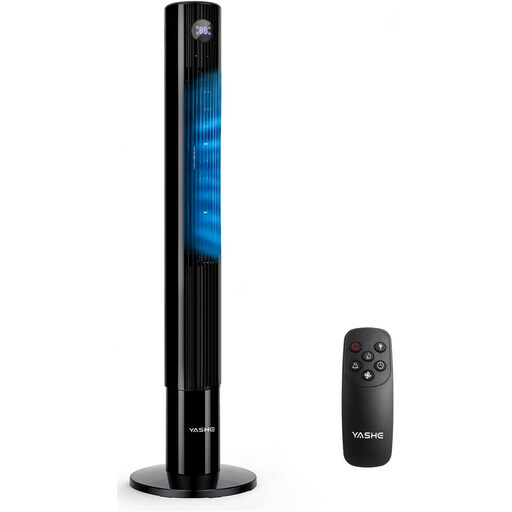
This freestanding tower fan is an option if you want to distribute air between your desk and other areas.
The product title lists 85° oscillation, three speeds and a 12-hour timer. The 28 dB figure is a product specification, not an independent measurement.
 No image available
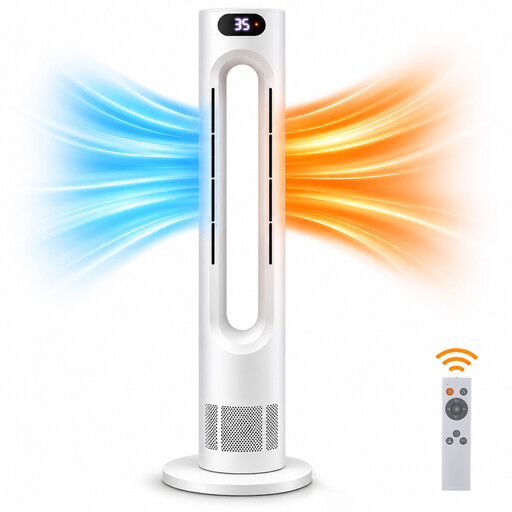
According to the product title, this model combines a fan and heater. Check whether you want to use both functions where you plan to place it.
The product title lists ten cooling settings, three heating settings, 75° oscillation and a 9-hour timer. The listed power is 25 W for the fan and 1.700 W for the heater.
 No image available
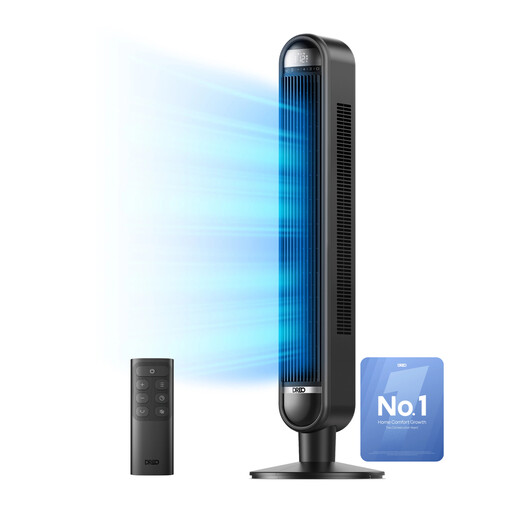
This freestanding tower fan is described as offering adjustable airflow distribution for work and living spaces.
The product title lists six speeds, four modes, 90° oscillation and a 12-hour timer. Noise figures in the product title and description are product specifications, not independently comparable measurements. The base must be correctly fitted and secured before use; keep the remote control’s button cell battery away from children.
 No image available
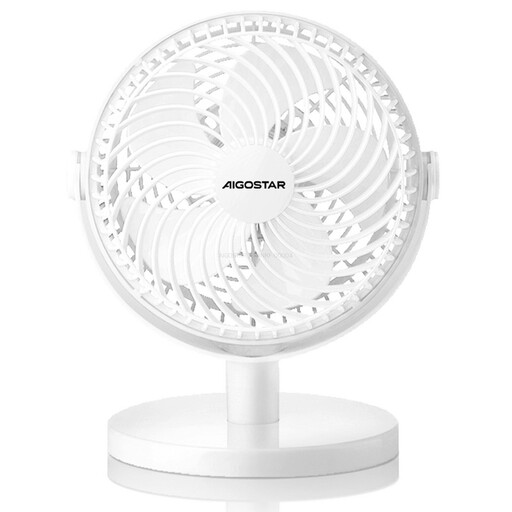
As a desk fan, this model is an alternative if you want to direct airflow at your seat. It is not a tower fan.
The product title lists two speeds and a head that adjusts through 360°. The stated dimensions are 200 × 170 × 225 mm.
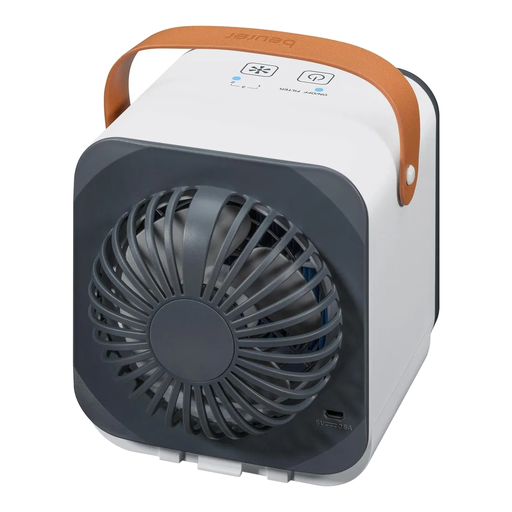 No image available
This compact desk fan provides targeted airflow at your desk, but it is not a tower fan. For the evaporative cooling function, you need to add water and fit the filter. You can also use the appliance as a fan without water.
The listed specifications include three speed settings, a 0,25-l water tank and dimensions of 14 × 14 × 11,7 cm.
No. A tower fan moves air but does not lower the room temperature like an air conditioner. The Verbraucherzentrale also recommends using sun protection and airing rooms when the air outside is cooler.
If you are the only person in the airflow, a fixed direction may suit you. If you want airflow to reach several places in turn, switchable oscillation is one option. Check that you can use the sweep effectively where you plan to place the fan.
Place the fan on a stable surface with its air inlet and outlet unobstructed, and check the cable length and cleaning instructions for the specific model. For example, Rowenta lists a cable length of 1,35 m for the VU6210F0; this figure does not apply to tower fans in general.
For consumer purchases, your statutory rights are against the seller; a manufacturer's guarantee is a separate, voluntary offer. According to the Verbraucherzentrale, the first step when there is a fault is usually to have it put right through repair or replacement. Online purchases generally also come with a 14-day right to cancel, although exceptions apply and the start of the cancellation period should be checked for each case.
Electrical equipment within the scope of the EU Low Voltage Directive must meet the relevant conformity requirements. This includes, among other things, equipment rated at 50 to 1.000 V AC. The European Union explains that CE marking is a declaration by the manufacturer, not an independent safety certificate. When considering a specific offer, check the product identity, manufacturer details and safety information in German.