Writers who already have a monitor
You want to keep your existing screen and leave as much room as possible on your small desk for your keyboard and papers. A mini PC could be a good fit, as long as its connections are compatible with your screen.


If you already have a suitable monitor, a mini PC is a practical starting point for a compact writing space. Alongside the case, consider the power supply, cables, connections and software you need. An all-in-one is worth considering if you’re buying a screen as well; a larger SFF PC is a better fit if future internal upgrades matter more to you than free desk space. Remember to budget separately for accessories and regular data backups.
You want to keep your existing screen and leave as much room as possible on your small desk for your keyboard and papers. A mini PC could be a good fit, as long as its connections are compatible with your screen.
You’re setting up a new writing space and comparing an all-in-one with a mini PC and separate monitor. The key consideration is how much room the complete setup will take up, including the stand, keyboard and mouse.
You’d like to upgrade the computer internally in future and can allow for a larger case. Check the slots on the specific SFF model, rather than relying on the form factor alone.
A good fit if: you want to keep using a suitable screen and position your computer neatly out of the way.
Bear in mind: the screen isn’t built in. Connections, configuration and what’s included can vary by offer.
A good fit if: you want to buy a screen and computer together.
Bear in mind: measure the space needed for the whole unit, including its stand. You’ll still need to allow room for a keyboard and connections.
A good fit if: a specific internal upgrade in future is important to you.
Bear in mind: HP lists M.2 and PCIe slots for its documented Pro SFF model. Still, check that your planned upgrade is compatible and that the computer will fit on your desk.
| What matters | What to check when buying | Who is this especially important to? |
|---|---|---|
| Space for your writing area | Allow for the computer, power supply, cables, monitor stand, keyboard and papers together. MSI lists case dimensions of 124 × 124 × 53,7 mm for the Cubi N ADL S form factor. | If I want to keep using my existing monitor on a small desk, there should still be enough room for my keyboard and papers. Around 28% of consumers put the space needed for a complete writing setup first. |
| Software and devices | Check that the operating system on the specific configuration meets the requirements of your writing software, and make sure it has the screen and USB connections you need. | If I want to use my usual software and existing devices, compatibility matters more than a particular computer name. Around 22% of consumers prioritise software and device compatibility. |
| Total cost of the setup | Check what’s included and, if necessary, factor in a monitor, keyboard, mouse or any adapters you need. | If I’m setting up a new writing space, I want to compare more than just the price of the computer and know what else I’ll need to make the setup usable. Around 22% of consumers put the total cost first. |
| Backing up personal writing | Set up regular data backups and check that you can restore a file from one. The Federal Office for Information Security recommends regular backups and testing that files can be restored. | If I’m working on my essay, I want to be able to recover my files if something goes wrong with my device. Around 17% of consumers prioritise protecting their writing. |
| A quiet writing space | Check the cooling system on the exact model. MSI specifies passive cooling for the Cubi N ADL S; this doesn’t automatically apply to other models. | If my computer is close to where I sit, I want it to make as little noise as possible while I’m writing. Around 11% of consumers put a quiet workspace first. |
A mini PC still needs a usable screen and compatible connections. If you measure only the computer, you may be left with too little room for the monitor stand, keyboard, power supply, cables and papers.
Before buying, sketch out the complete setup and decide where the power supply and cables will go.
Operating systems, storage and what’s included can vary within a model family. The name alone doesn’t tell you exactly which configuration you’ll receive.
Compare the full model and variant names, as well as the specific details of what’s included.
Internal slots are only useful if the upgrade you have in mind is compatible with the specific model. The larger case also takes up space, which can be in short supply on a small desk.
Choose the larger form factor if the upgrade options and the space they require suit your setup.
A replacement device can’t restore a file that hasn’t been backed up. The Federal Office for Information Security recommends regular backups and points out that you also need to be able to restore your files.
Set up a backup method that works with your operating system, then test restoring a file.
The Cubi N ADL S is a documented fanless mini PC form factor for a compact workspace.
The Pro Mini 400 G9 is a compact option, while the Pro SFF 400 G9 is worth considering if internal slots are important to you.
Lenovo describes the ThinkCentre Neo 50q Gen 5 as a 1-litre Tiny PC for a workspace with a separate screen.
The Pro Micro QCM1250 is a small desktop computer, but its configuration needs to suit your existing setup.
The Mac mini is a compact macOS option with an external screen; the iMac is the all-in-one alternative.
These mini PCs are designed for a writing space with a separate screen. Compare their case dimensions, connections and specifications with your existing monitor and the rest of your setup.
 No image available
This mini PC is designed for a writing space with a separately connected screen.
Windows 11, 8 GB DDR4, 256 GB SATA SSD; two HDMI outputs and four USB ports are listed. Case dimensions: 105 × 113 × 45 mm.
 No image available
The two HDMI outputs are useful to note if you’re connecting a separate screen.
8 GB LPDDR4, 256 GB SSD, dual HDMI, Gigabit LAN, Wi-Fi and Bluetooth 5.0; the title states up to 2,4 GHz. The product description specifies using the original adapter and keeping the ventilation openings clear.
 No image available
The listed screen connections may be useful for a setup with a separate monitor.
12 GB LPDDR5, 512 GB NVMe SSD, two HDMI outputs and two M.2 slots are listed. The product description also gives dimensions of 113 × 113 × 44,5 mm and advises ensuring adequate ventilation and using the original power adapter.
 No image available
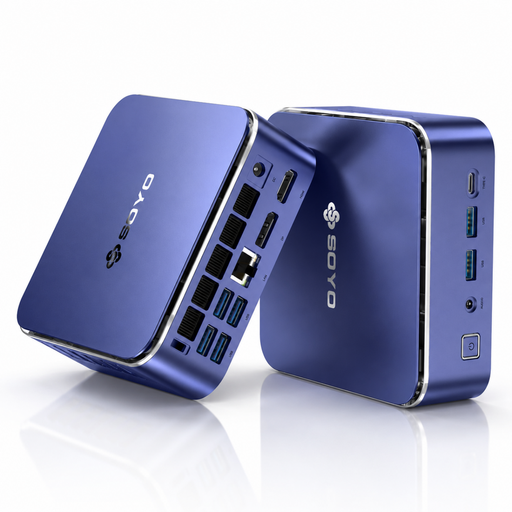
HDMI and USB4 outputs, along with the stated support for three displays, are worth considering when planning your screen setup.
16 GB RAM, 512 GB SSD, Radeon 680M, two M.2 slots and Wi-Fi 6 are listed.
 No image available
The multiple listed screen outputs let you check compatibility with an existing monitor and other devices.
Windows 11 Pro, 16 GB LPDDR5, 512 GB NVMe SSD, HDMI, DisplayPort, Type-C and six USB 3.0 ports; case dimensions: 128 × 128 × 47,6 mm.
Check the operating system, storage, screen connection and what’s included with the specific offer. Manufacturers list different configurations and details of any included input devices, so make sure they’re compatible with your monitor, keyboard and mouse.
The Federal Office for Information Security recommends regular data backups and points out that you also need to be able to restore your files. Choose a method that works with your operating system and test restoring a file.
For its market surveillance, the Federal Network Agency lists points including the CE marking, an identifiable product and manufacturer details, as well as German instructions with the required usage and safety warnings. Check these details on the specific device; a product description is no substitute for doing so.