
Lieferung heute & morgen

Qualitätsgarantie

Willkommens-Angebote freischalten: KOSTENLOSE Lieferung | Bis zu 80 % RABATT | Kostenlose 30-Tage-JoyPlus-Testphase
App herunterladen
Developmental toys for babies should encourage them to grasp, turn, press, roll and listen. However, shops stock plenty of products labelled “educational toys”, “Montessori toys for babies” or “sensory toys for babies”. These terms alone say little about how practical a toy will be in everyday life.
Three common buying pitfalls crop up particularly often:
Our selection therefore considers not only play value, but also age recommendations, material information, care, stability and intended use.
For developmental toys from 6 months, the design should suit the child’s stage of development. Large, easy-to-grasp elements are usually best for younger babies. From around one year, shape sorters, rotating parts, connecting pieces and simple musical instruments may be of interest.
Look for:
An age recommendation is no substitute for supervision. Damaged parts, loose seams or tears are good reasons to stop using a toy.
For plastic toys, details such as ABS, BPA-free and rounded edges can be useful points of reference, provided they are clearly stated in the product information. For wooden toys, details about the wood’s origin and surface treatment may be relevant. For textiles, washability and material composition are particularly important.
The CE mark indicates that the manufacturer must have taken the relevant EU requirements into account. However, it is not an independent quality mark. You should also check the product details for safety warnings, manufacturer information and, where applicable, the EN 71 standard.
Care instructions are also essential for products that go in your baby’s mouth. A teething and grasping toy that should only be cleaned with a damp cloth should not be sterilised at high temperatures or put in the dishwasher by mistake.
Musical toys for babies can provide audio feedback when a child presses a button or hits a drum surface. A volume control, a quiet mode and easily accessible battery compartments are useful features. Check whether batteries are included and how often they are likely to need replacing.
The space you have available also matters for activity cubes, play tables and foam modules. A product may suit a nursery, a small flat or travel to different degrees. Dimensions, stability and storage should all be part of your buying decision.
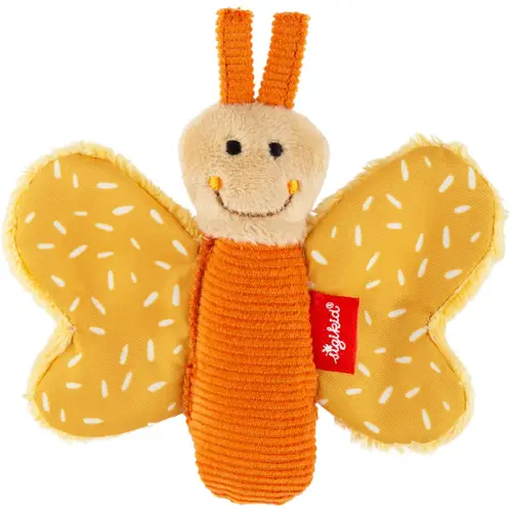
Why this product suits this profile: This soft grasping toy needs no batteries and is listed as suitable from 0 months. It’s ideal for those first attempts at grasping and exploring textures.
The features are straightforward, and the product information lists no batteries or electronic components. This helps keep potential ongoing costs down.
The product details specifically mention crinkle paper, different textures and machine washing at 30 °C.
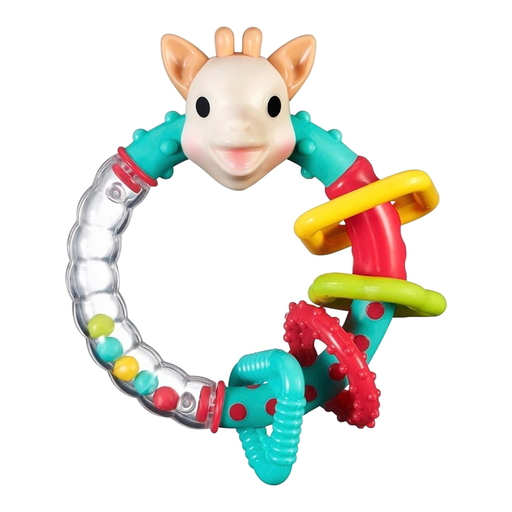
Why this product suits this profile: This compact toy combines a rattle, grasping toy and teething toy. The product information recommends it from 3 months.
The care instructions are clear: wipe with a damp cloth, do not sterilise at high temperatures and do not put in the dishwasher.
Four moving rings, colourful balls, and hard and soft surfaces offer plenty of ways to grasp and explore.
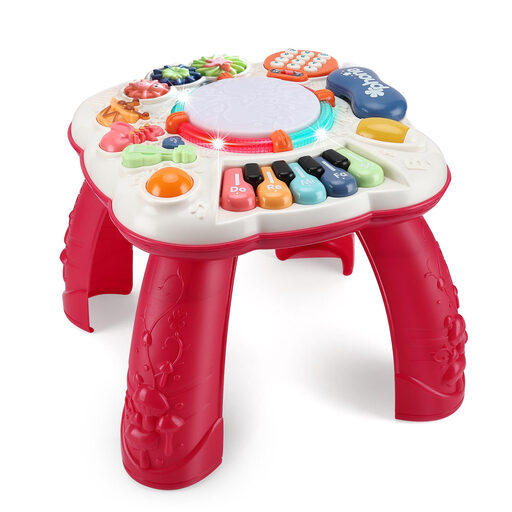
Why this product suits this profile: This baby activity table combines piano keys, a drum, gears and a phone function. Its detachable legs let you use it as a floor play panel.
It isn’t limited to just one stage of development. The product information recommends it for ages 6 to 36 months, and it has a volume control.
Six play areas, detachable legs and listed dimensions of around 30 × 30 × 31 cm.
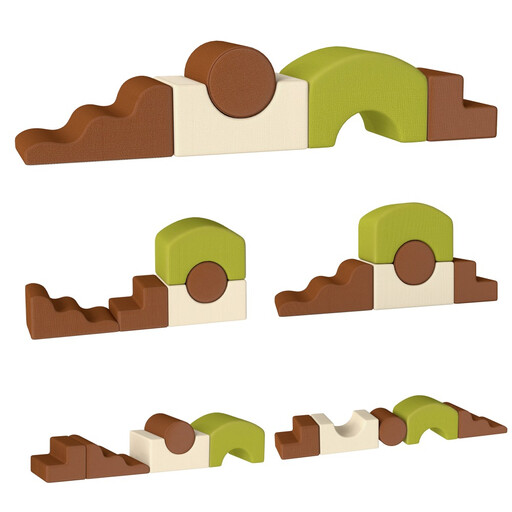
Why this product suits this profile: The five soft foam modules, covered in colourful corduroy, are designed for play areas at home or in childcare settings.
Unlike toys with lots of small connecting pieces, this set focuses on gross motor skills. Measure the available floor space before buying.
The different modules can be arranged in various ways for supervised balance and movement activities.
We’ve put together a complete, regularly updated list of products that meet these strict selection criteria and fully comply with the safety regulations in force in the EU.
It depends on the product and the child’s stage of development. Grasping toys and soft rattles are often sold as suitable from 0 or 3 months. Shape sorters, activity centres and activity cubes for toddlers are generally aimed at children from around 12 months. The specific age recommendation, warnings and need for supervision are what matter most.
How long a toy remains useful depends on its complexity and your child’s development. A simple grasping toy is mainly used during the first few months. An activity table, activity cube or foam play course may stay interesting across several stages of development if it offers different ways to play. However, it’s not possible to guarantee a longer product lifespan across the board.
Musical toys for babies usually involve the cost of batteries, unless they have a built-in rechargeable battery. Before buying, check whether batteries are included, what size you need and whether the toy has a volume control or quiet mode. Non-electronic Montessori toys for babies have no ongoing power costs.