When buying muesli or breakfast cereals in a bulk pack, the first thing to consider is whether the nutritional values and ingredients of that particular variety suit your plan – not the pack size. Compare the carbohydrates in the portion you actually eat, as well as the sugar, fibre and allergens. ‘No added sugar’ alone tells you neither how much sugar nor how many carbohydrates the product contains overall. diabetesDE points out that, for people on insulin therapy, the carbohydrate content is relevant to their individual calculations.
Who should consider their choice carefully?
People who carefully manage their carbohydrate intake
If you weigh the amount you eat, you can use the nutritional information to calculate the carbohydrates in your portion. diabetesDE explains why this information matters for people on insulin therapy.
Households keeping an eye on sugar and fibre
If you regularly eat the same variety for breakfast, compare its sugar, carbohydrates, fibre and ingredients before buying a larger pack, rather than relying on the product name alone.
Families with different tastes
Variety packs can be a good way to offer some choice. However, check the ingredients, nutritional values and serving sizes of each variety separately before deciding.
What should you look for when buying?
First, check the nutritional information for the variety you’re considering and how much you actually eat. Only then can you decide whether the pack size is right for your household.
| What to consider |
What to check when buying |
Who should pay particular attention |
| Carbohydrates per portion |
Compare the carbohydrates per 100 g with the amount you’ve weighed out. |
If I need to calculate the carbohydrates in the amount I actually eat, checking the sugar figure alone isn’t enough. For around 29% of consumers, planning portions is the top priority. |
| Sugar and ingredients |
Check ‘of which sugars’ per 100 g, as well as ingredients such as syrup, honey and dried fruit. |
I want to know what a claim such as ‘no added sugar’ means before eating a variety regularly. Around 29% of consumers prioritise checking this information. |
| Wholegrain and fibre |
Check for wholegrain ingredients in the list and fibre in the nutritional information; be aware of allergens. |
For my everyday breakfast, I’m looking for a wholegrain blend and want to know how much fibre it contains. This is a priority for around 24% of consumers. |
| Pack size |
Check the contents, storage instructions and how many portions your household can realistically use. |
A large pack only works for me if we eat that variety regularly and can finish it. This is the main reason for buying for around 18% of consumers. |
Common pitfalls when buying in bulk
-
Assuming ‘no added sugar’ means low in total sugar
The claim doesn’t tell you how much sugar or how many carbohydrates the blend contains overall. bio-familia AG lists 12 g of sugar and 65 g of carbohydrates per 100 g for Swiss Müesli No Added Sugar.
Check ‘of which sugars’ and ‘carbohydrates’ in the nutritional information, and look at the ingredients of the specific variety.
-
Buying a large pack before you know the variety suits you
A pack may be too large for your household if you don’t eat the blend often or can’t finish it as planned after opening.
Check the contents and storage instructions. If you haven’t tried a variety before, starting with a smaller pack can help you work out how much you’ll use.
Unused leftovers and storing an opened pack can also add to the day-to-day hassle.
-
Confusing a low sugar figure with low carbohydrates
Seitenbacher lists 1 g of sugar but 55 g of carbohydrates per 100 g for its Müsli zuckerarm. The sugar figure alone therefore doesn’t tell you how many carbohydrates are in the portion you eat.
Weigh your portion and include the carbohydrate information on the specific pack in your personal plan.
-
Overlooking the ingredients in wholegrain or nut muesli
Even if wholegrain and fibre are important to you, a blend may contain ingredients that don’t suit your allergies. For example, Seitenbacher Müsli zuckerarm contains oats, spelt and almonds.
Check the ingredients and allergen information on the specific pack before choosing a larger size.
Brands to consider
Seitenbacher
Müsli zuckerarm is an example of a fruit-free blend sold in a 600 g pack.
- Seitenbacher lists 1 g of sugar, 55 g of carbohydrates and 9 g of fibre per 100 g for this product.
- The blend contains oats, spelt and almonds. The carbohydrates in your own portion remain the key figure for planning.
familia
Swiss Müesli No Added Sugar is a blend with fruit and nuts from the international range by bio-familia AG.
- bio-familia AG lists 65 g of carbohydrates, 12 g of sugar and 8 g of fibre per 100 g.
- Check the ingredients, precautionary allergen statements and packaging variant of the specific product on offer.
Kellogg's
The Variety Pack may suit households looking for several types of cereal in one pack.
- The assortment offers a choice of varieties in a single pack.
- Kellogg's lists 22 g of sugar and 83 g of carbohydrates per 100 g for the assortment as declared. Check the information for the individual varieties included, too.
Cini Minis
These cinnamon-flavoured cereals are worth comparing if this is a popular choice in your household.
- Nestlé Cereals publishes nutritional information for the German product variant.
- Nestlé Cereals lists 24 g of sugar and 73.4 g of carbohydrates per 100 g. When buying, the information on the specific pack is what matters.
Muesli and oats at Joybuy
This selection includes muesli and oats in packs from 400 g to 750 g. When choosing something to stock up on, compare not only the pack size but also the nutritional information and ingredients for each variety.
 No image available
Dr. Oetker Vitalis Less Sweet Pure Crunchy Muesli, 600 g
For households looking for crunchy muesli in a 600 g pack. Compare the nutritional values for your weighed portion and check the ingredients and allergens on the pack; the ‘Less Sweet’ name doesn’t replace these checks.
View at Joybuy
 No image available
Kölln Fine Oat Flakes, 500 g
For households who prefer oats as a breakfast base rather than a ready-made muesli blend. The pack contains 500 g; for carbohydrate planning, the amount you weigh out is what counts.
View at Joybuy
 No image available
Jeden Tag Less Sweet Crunchy Oat Muesli, 750 g
For households that regularly eat crunchy muesli and are considering a 750 g pack. Before stocking up, check the sugar, carbohydrates and ingredients, as well as how to store it after opening.
View at Joybuy
 No image available
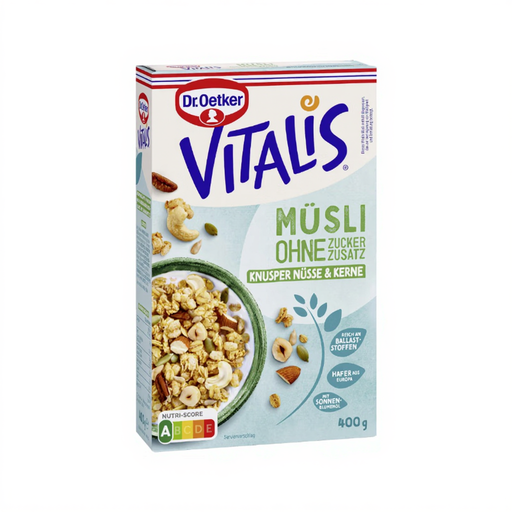
Dr. Oetker Vitalis No Added Sugar Crunchy Nut Muesli, 400 g
For households looking for crunchy nut muesli in a 400 g pack. Despite the product name, check the total sugar and carbohydrate content, as well as the allergen information on the specific pack.
View at Joybuy
Frequently asked questions
Do I have to avoid breakfast cereals altogether if I have diabetes?
There’s no blanket rule to avoid or choose all breakfast cereals. The variety and the amount you eat are what matter. diabetesDE highlights the importance of calculating carbohydrates, particularly for people on insulin therapy.
Does muesli labelled ‘no added sugar’ automatically contain little sugar?
No. The claim is no substitute for checking the sugar figure in the nutritional information. Also compare the carbohydrates per 100 g and read the ingredients list for items such as dried fruit or fruit purée.
When is a large pack of cereal a good fit for a household?
A large pack is most practical when you eat that variety regularly and can store and finish the contents appropriately. Check the portion size, pack contents and storage instructions beforehand.
Which allergens should I check in muesli?
Check the ingredients and allergen information on the specific pack of every variety. Depending on the blend, it may contain gluten-containing cereals or nuts, for example. For variety packs, check the information for each individual variety.


