Parents with a regular snack routine
If you often plan a mid-morning or afternoon snack, compare the sugar, salt and ingredients in the specific products rather than relying on child-friendly packaging.


For a toddler’s regular snack time, neither the words ‘for children’ nor the name ‘Digestive’ alone should determine your choice. Compare the specific ingredients and nutritional information, and consider how safely your child can eat crunchy foods. A children’s wafer explicitly recommended from one year old can be handy when you’re out and about; a classic Digestive biscuit is more of an occasional sweet treat. Both types of product call for a check of wheat and other allergens, and crunchy snacks should be eaten sitting down and under supervision.
If you often plan a mid-morning or afternoon snack, compare the sugar, salt and ingredients in the specific products rather than relying on child-friendly packaging.
A handy pack makes snacks easier to take with you. What matters most is whether your child can eat the biscuits sitting down and under supervision in that particular situation.
When choosing, check the ingredients and information on the actual pack you’re buying. The children’s wafer and classic Digestive biscuit discussed here both contain wheat.
When choosing crunchy biscuits, first consider the eating situation and the age guidance. Then compare the ingredients, nutritional information and allergen details for the specific products.
| Criteria | What to check | Who it matters most to |
|---|---|---|
| Age and eating situation | Check the age guidance, texture and manufacturer’s supervision advice; an age recommendation doesn’t replace your own assessment of how your child chews. | When my child eats crunchy biscuits, I want to be sure they’re sitting upright and supervised. For around 36% of consumers, safe snacking is the top priority. |
| Sugar, salt and ingredients | Compare the nutritional information per 100 g and the ingredients list; if a product says ‘no added sugar’, check for fruit concentrates too. | If a snack is part of our regular routine, I want to know what’s actually in it besides wholegrain. Around 29% of consumers put this comparison of ingredients and nutritional values first. |
| Wheat and other allergens | Read the ingredients, highlighted allergens and may-contain warnings on the specific pack. | If we need to choose carefully because of an allergy or a gluten-free diet, I don’t rely on the product name or branding. Checking allergens comes first for around 21% of consumers. |
| Portion and portability | Check the pack size, closure and storage advice for after opening. | For a day out, I want to pack an amount that suits the planned snack and is easy to take along. Around 14% of consumers check this first. |
Such a claim doesn’t tell you everything about the ingredients or nutritional values. For example, the Freche Freunde wafer listed by REWE contains 6,7 g of sugar per 100 g.
Read the ingredients list and compare sugar and salt on the same basis, rather than looking only at the front of the pack.
According to REWE, McVitie’s Digestive The Original contains 16% wholemeal wheat flour, but also 15,1 g of sugar and 1,3 g of salt per 100 g. So wholegrain content alone doesn’t answer whether it’s suitable as a regular snack for a toddler.
Take the full nutritional information, ingredients and intended portion into account when choosing.
The children’s wafer discussed here contains wheat and, according to REWE, carries may-contain warnings for egg, soya, milk and nuts. The Digestive biscuit discussed here also contains gluten-containing cereals.
Check the ingredients and allergen information on every pack you buy. If an allergy or coeliac disease has been diagnosed by a doctor, follow the individual medical advice you’ve been given.
The manufacturer’s guidance for the children’s wafer discussed here warns against eating it unsupervised or lying down. Kindergesundheit-info.de also highlights the choking risk posed by small or hard foods.
Have your child sit upright while eating and stay with them; choose biscuits and piece sizes that suit their ability to chew and swallow.
The details below relate to specific product variants, not a brand’s entire range.
The Bio Waffel-Herzchen Apfel-Erdbeere listed by REWE is positioned as a children’s snack from one year old.
Digestive The Original is a classic wheat biscuit with some wholegrain flour, not a product specifically marketed as a toddler snack.
Lotus Biscoff is a caramelised biscuit, so it’s another sweet biscuit option, rather than a children’s wafer or classic Digestive.
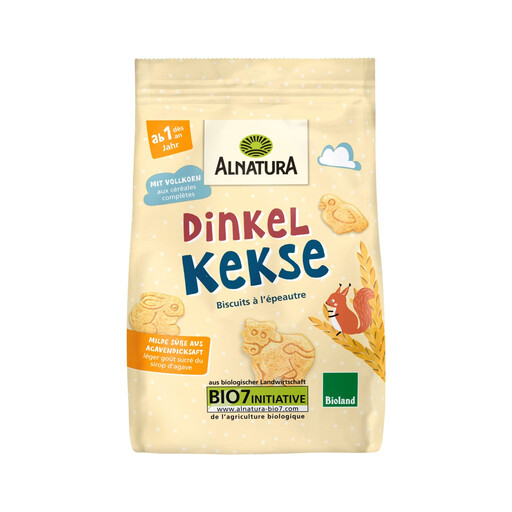
These spelt biscuits are another snack option from one year old, but they’re neither a wafer nor a classic Digestive biscuit. So if you’re choosing between those two types of biscuit, they aren’t a direct substitute for comparing their ingredients and nutritional information.
 No image available
A spelt biscuit option if you’re looking for a snack with an age recommendation from one year old. The pack contains 125 g; check the ingredients and allergens on the pack you buy, and make sure your child eats crunchy biscuits sitting down and under supervision.
Not on the basis of wholegrain content alone. According to REWE, McVitie’s Digestive The Original contains 16% wholemeal wheat flour, but also 15,1 g of sugar and 1,3 g of salt per 100 g. Compare the ingredients, allergens and planned portion too.
No, that doesn’t follow from the claim. The Freche Freunde wafers listed by REWE contain fruit juice concentrates and provide 6,7 g of sugar per 100 g. The sugar content and ingredients list tell you more than that claim alone.
Yes, if your child needs a gluten-free diet. Both the children’s wafer discussed here and McVitie’s Digestive The Original contain wheat. Check the ingredients and allergen information on the current pack, rather than assuming that other variants have the same ingredients.
Toddlers should eat crunchy snacks sitting down and with an adult nearby. The manufacturer’s guidance for the children’s wafer discussed here expressly warns against eating it unsupervised or lying down; also consider how safely your child chews and swallows.
Not necessarily. The Verbraucherzentrale generally considers special snack products for children unnecessary. A children’s wafer may be handy because of its packaging or age guidance, but the specific ingredients, nutritional information and eating situation still matter.