Don’t choose a biscuit just because it’s called a “Digestive”. If organic certification is your priority, check the packaging; if you need a gluten-free option, look for an explicit “gluten-free” claim. To choose between a classic Digestive and an oat or wholegrain biscuit, compare the ingredients, allergens and nutritional values per 100 g, as well as the texture you prefer.
Who is this choice relevant to?
People who check organic certification and provenance
When shopping in the organic and speciality food sections, what matters to them is what the packaging says—not whether the name or design looks natural. Lebensmittelklarheit identifies the EU organic logo, the control body code and the origin statement as important labelling elements.
People who need gluten-free products
They need to distinguish between an ordinary oat or wholegrain biscuit and a product explicitly labelled as gluten-free. The Bavarian State Office for Health and Food Safety explains the requirements for the “gluten-free” claim.
People comparing grain profiles and flavours
They’re looking for a heartier alternative to a classic Digestive and want to know which grains, chocolate or nuts each recipe contains. Product information from Bohlsener Mühle and EDEKA shows how these varieties differ in their ingredients.
What should you look for when buying?
When choosing Digestive biscuits and similar bakes from organic and speciality ranges, let your main requirement guide you. Organic certification, an explicitly gluten-free recipe and your preferred biscuit style each answer different questions.
Organic oat or wholegrain biscuit
A good choice if: organic certification and an oat or wholegrain profile matter more to you than a classic Digestive recipe.
Bear in mind: organic certification alone tells you nothing about whether a product is gluten-free or how much sugar it contains.
Explicitly gluten-free Digestive
A good choice if: gluten-free is your priority and you’re looking for a Digestive-style biscuit.
Bear in mind: “gluten-free” doesn’t prove that a product is organic or free from other allergens.
Classic Digestive
A good choice if: you mainly want a familiar Digestive-style biscuit and don’t have a specific organic or gluten-free requirement.
Bear in mind: the product name alone doesn’t tell you about organic certification, allergens or nutritional values.
| Criteria | What to check when buying | Who it matters most to |
|---|
| Organic certification |
For prepacked organic food from the EU, look for the EU organic logo, control body code and origin statement. The Federal Ministry of Agriculture, Food and Regional Identity and Lebensmittelklarheit explain this labelling. |
Anyone specifically looking for an organic product in the speciality food aisle won’t want to rely on the look of the packaging. For around 40% of consumers, this proof comes first when choosing. |
| Gluten and allergens |
If needed, look for an explicit “gluten-free” claim and read the ingredients list and highlighted allergens for the specific variety. |
If gluten or another allergen determines your choice, “oat biscuit” or “wholegrain biscuit” isn’t enough. Around 30% of consumers give this requirement priority. |
| Grains and nutritional values |
Compare the types and proportions of grain in the ingredients list, along with sugar, fat, fibre and salt per 100 g. |
If I’m looking for a particular oat or wholegrain profile, I want to know what’s actually in the biscuit and how its nutritional values compare. This is the main consideration for around 20% of consumers. |
| Flavour and texture |
Choose between a Digestive style and a heartier biscuit. If it contains chocolate, spelt or nuts, check the ingredients too. |
People mainly looking for a particular flavour or bite will choose differently from those whose priority is a specific label. Around 10% of consumers focus first on this taste experience. |
Common mistakes when choosing
-
Assuming “Digestive” tells you about nutritional values
The name describes a style of biscuit, not a particular recipe or suitability for people with allergies. Oat varieties and organically certified options can also differ significantly in their ingredients and nutritional values.
Read the ingredients list and compare the nutritional information on the specific packs, rather than assuming the product name tells you what they contain.
-
Assuming organic means gluten-free
The labels answer different questions: an organic oat cookie may contain wheat, while an explicitly gluten-free Digestive isn’t automatically an organic product.
Check the claim that matters most to you directly on the packaging, and read the ingredients and allergen information too.
-
Comparing portion sizes only
If manufacturers give different portion sizes, the figures aren’t directly comparable. Nutritional values per 100 g provide a common basis for comparison.
Compare the figures per 100 g first, then relate the stated portion to the amount you usually eat.
Brands to consider
Gullón
According to its own product pages, Gullón offers Digestive biscuits and Bio-Organic varieties, including recipes with chia or oats and chocolate.
- The brand can help guide your search for both classic and organic Digestive varieties.
- Check which specific variety is available from your chosen retailer and what information appears on its packaging.
Bohlsener Mühle
Bohlsener Mühle describes its organic cookies and Haferlinge as having a range of grain and chocolate recipes.
- These products may suit people mainly looking for an oat or spelt profile.
- Cookies and Haferlinge aren’t verified classic Digestive products; ingredients and allergens vary by variety.
Alnavit
Alnavit describes its oat biscuit as organic, gluten-free and vegan; according to the manufacturer, it contains over 50% oats.
- This explicitly labelled variety is an option if you’re looking for a gluten-free oat biscuit rather than a classic Digestive.
- It isn’t called a Digestive. Check the ingredients and allergen information on the pack you choose.
Schär
REWE stocks Schär Landtaler Digestive as an explicitly gluten-free product.
- The product name combines Digestive style with a stated gluten-free claim.
- Gluten-free doesn’t mean organic or free from other allergens. Read the ingredients and information on the specific pack.
EDEKA Bio
EDEKA describes an organic oat cookie with milk chocolate as an alternative for anyone looking for an oat profile.
- For this variety, EDEKA lists 32% oat flakes, 25% milk chocolate and 11% wholemeal wheat flour.
- It’s an oat cookie, not a Digestive. EDEKA notes that the product may not be available in every store.
Suitable products at Joybuy
This product selection features a spelt biscuit as an alternative for shopping in the organic and speciality food range, rather than a classic or explicitly gluten-free Digestive. Check the labelling on the pack to make sure it suits you.
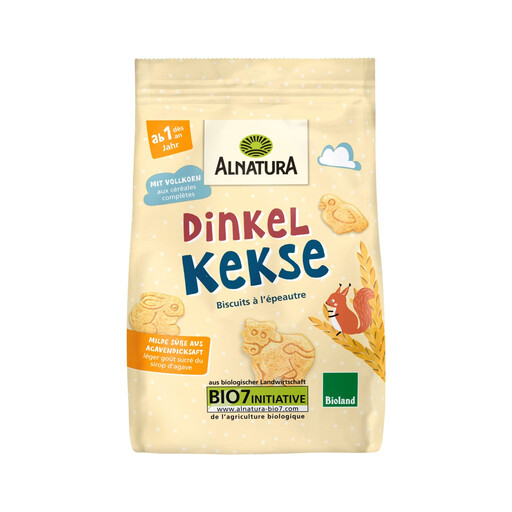 Image unavailable
Alnatura organic spelt biscuits from 1 year, 125 g
Spelt biscuits as an alternative for anyone who isn’t looking for a classic Digestive. The product name states that they’re organic, suitable from 1 year and come in a 125 g pack. Check the organic labelling, ingredients and allergens on the specific pack.
View at Joybuy
Frequently asked questions
How can I identify a prepacked organic biscuit?
For prepacked organic food from the EU, look for the EU organic logo, control body code and origin statement. The Federal Ministry of Agriculture, Food and Regional Identity explains that these products must carry the EU organic logo; Lebensmittelklarheit describes the related labelling information.
Is an oat Digestive automatically gluten-free?
No. The oat content or the name “Digestive” doesn’t prove that a product is gluten-free. If you need a gluten-free option, look for an explicit “gluten-free” claim. The Bavarian State Office for Health and Food Safety sets the maximum gluten content at 20 ppm.
How do I compare the sugar and fibre in different biscuits?
Compare the nutritional values per 100 g so that different portion sizes don’t skew the results. Consider sugar and fibre alongside the other nutritional values and the ingredients list, rather than judging the whole recipe on a single figure.
Are the highlighted ingredients enough if I have an allergy?
Read the full ingredients list and any precautionary allergen information on the specific pack. Lebensmittelklarheit explains that intentionally added major allergens must be highlighted; a warning about possible traces provides a different kind of information.


