
Lieferung heute & morgen

Qualitätsgarantie

Willkommens-Angebote freischalten: KOSTENLOSE Lieferung | Bis zu 80 % RABATT | Kostenlose 30-Tage-JoyPlus-Testphase
App herunterladen
A digital coffee scale helps you get the proportions of coffee grounds and water, as well as the brewing time, right every time. This matters just as much for espresso as it does for pour-over recipes. However, models vary considerably in their weighing range, controls, power supply and extra features.
Many buying decisions come down to three common pitfalls:
Resolution refers to the smallest weight increment shown on the display. A 0.1 g resolution is useful for coffee when weighing small doses, for example. For larger quantities, a resolution of 1 g may be fine for kitchen recipes.
The minimum load matters too. Some models only give a stable reading above a certain weight. If you weigh beans, ground coffee and water one after another, you should also consider the maximum capacity. An espresso scale needs to support the cup, portafilter or jug without overloading the platform.
The tare function resets the weight of a container to zero. This saves you from doing the maths and is handy when pouring directly into a cup or carafe. A coffee scale with a coffee-to-water ratio can also display the ratio of ground coffee to water. This feature is particularly useful for repeatable recipes, but it doesn’t replace choosing suitable beans and grinding them consistently.
A built-in timer helps you monitor brewing time and weight together. Some espresso scales offer automatic timing or sensor functions. Check the product description and user manual to see whether the automatic function suits your routine.
A pour-over scale should have enough room for your brewing vessel and a display that remains visible while you pour. A flat surface with non-slip feet can make it easier to use. Even if a model has a silicone mat or water-resistant surface, electronic scales should never be submerged in water.
A rechargeable coffee scale with a USB Type-C port reduces the need for disposable batteries. Battery-powered models, on the other hand, are ready to use straight away and don’t depend on a charging cable. For digital kitchen scales, capacity, unit conversion and ease of cleaning are also worth considering.
The models below cater to different needs. The details are based on the product information provided for each one. Before buying, check the product page for what’s included, current availability and instructions for use.

Why it suits this profile: Designed for everyday kitchen tasks, this scale supports loads of up to 5 kg and offers several units of measurement and a tare function.
The product details clearly state the 1 g increments, 5 kg maximum capacity and stainless steel platform. This makes it easier to judge whether it’s suitable for your kitchen and larger containers.
Stainless steel platform, LCD display, automatic shut-off and conversion between four units of measurement.

Why it suits this profile: For pour-over brewing, this model combines a stated resolution of 0.1 g with timer and flow-rate functions.
The description gives specific details about the weighing range, resolution, timer and power supply. This makes it easier to compare with scales that simply claim to be “precise”.
2000 g capacity, USB Type-C lithium-polymer battery and heat-resistant silicone mat, according to the product details.
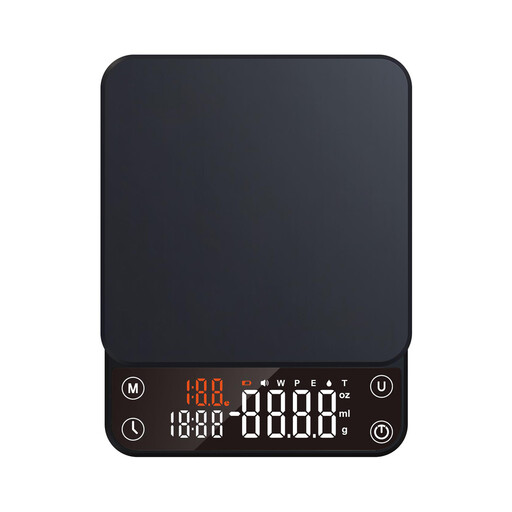
Why it suits this profile: This model is for anyone who wants to switch between weighing, pour-over and several espresso modes.
The four brewing modes and automatic tare function are clearly listed. This lets you check whether the extra features really suit your routine.
0.1 g increments below 1 kg, 3 kg capacity, LED display and integrated 800 mAh battery with Type-C charging.

Why it suits this profile: The product name lists a coffee-to-water ratio, water flow rate, timer, and espresso and pour-over modes.
You can compare the listed functions with your own brewing method. That way, you can avoid paying for app or automatic features you don’t need.
According to the product name, it supports espresso and pour-over modes, as well as switching between ounces and kilograms.
We’ve put together a complete, regularly updated list of products that meet these strict selection criteria and fully comply with the safety regulations in force in the EU.
For espresso, the scale should fit beneath your cup or portafilter, have an easy-to-read display and include a tare function. An espresso scale with a timer can also track the extraction time. Before buying, check the platform size, maximum capacity and water-resistance information.
No. A separate timer does the same basic job. However, a coffee scale with a built-in timer can make the process easier to follow, as you can monitor weight and time at the same time. If you want to control the water flow, look for a coffee scale with a flow-rate display.
Its lifespan depends on the battery, charging cycles, time in use and care. Without specific information from the manufacturer, it’s not possible to give a reliable estimate. To help your scale last longer, store it in a dry place, don’t overload it and only charge it with the supplied cable. A flat, stable surface will also help you get consistent readings.