Time individual espresso shots
If you make espresso shots one after another, you’ll want to track how long each one takes and be able to set a frequently used time again when needed.


For measuring how long an espresso shot takes to pour, choose a timer with a clearly specified stopwatch function. If you need to set a fixed end time while getting on with other tasks, a countdown timer with a suitable alarm is more practical. When several kitchen jobs are happening at once, you’ll need separate timer channels. A coffee scale with a timer is a good choice if you also want to keep track of the amount of water when pouring manually.
If you make espresso shots one after another, you’ll want to track how long each one takes and be able to set a frequently used time again when needed.
When other jobs alongside making coffee have their own end times while family are visiting, timers that can run simultaneously are useful.
If you want to keep an eye on both the time and the amount of water when pouring by hand, consider a coffee scale with a timer.
First, decide whether you want to track elapsed time or set a fixed end time. Then consider whether you need several timers to run at once, or whether you also need scales for pouring.
| What you need | What to check | Who it matters to |
|---|---|---|
| Elapsed extraction time or a fixed end time | Check the stopwatch and countdown functions separately; use a consistent start point when timing an espresso shot. | If I want to track how long an espresso shot takes, I need an upwards count and a suitable start point. Around 36% of consumers put elapsed extraction time first. |
| Several timers running at once | Check how many timers can genuinely run simultaneously; don’t count the stopwatch or memory function as an extra countdown timer. | If coffee and other preparations have their own end times, I want to be able to track them separately. Around 29% of consumers prioritise simultaneous timers. |
| Keeping track of time and the amount poured | Check the weighing and timing functions separately, and allow for the space needed for your brewing vessel. | When making filter coffee by hand, I want to keep an eye on the time and the amount poured at the same time. Around 21% of consumers prioritise seeing both together. |
| Display, alarm, placement and power supply | Check that the display is easy to read where you plan to use it, along with the alarm type, mounting options and whether batteries are included for the specific model. | If I want to see the timer clearly while guests are visiting or hear its signal at the right moment, the display, placement and alarm type all matter. Around 14% of consumers prioritise ease of use. |
A stopwatch measures elapsed time; it doesn’t automatically give you another countdown that can run at the same time. For tasks that overlap, TFA Dostmann says its TRIPLE TIME 38.2020 can run three timers simultaneously.
If several end times overlap, check how many timer channels the product explicitly says can run in parallel.
The HARIO V60 Drip Scale tracks time and volume while you pour. However, that doesn’t mean it can also replace a countdown with an end-of-timer alarm or several kitchen timers.
If you’ll be doing other tasks while pouring, check before buying whether the model has the alarm you need.
Battery contents and signal options vary by model. Westmark says the Round requires three AAA batteries, which are not included; batteries are included with the Big, according to the manufacturer.
For the exact model, check the battery type, what’s included and the alarm type you want.
You’ll need to have three AAA batteries ready separately for the Westmark Round.
Digital timers with a range of functions for individual timings, simultaneous timers and different signals.
The CONTARE 12330 is a digital kitchen timer for a single timing.
Digital timers with different features for display, count direction and alarms.
The V60 Drip Scale combines a coffee scale with time tracking for manual pouring.
The Basic 2.0 is a coffee scale with a timer for buyers who want to track time and weight together.
This selection includes a digital countdown timer for set timings and a coffee scale with a timer for manual pour-over.
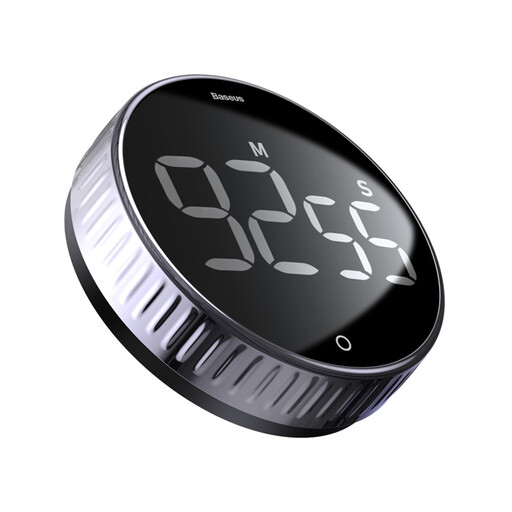 No image available
A good fit if you want to set a specific brewing time; the product name indicates a countdown function.
If you want to count upwards to track how long an espresso takes, check that the timer’s controls suit your preferred start point.
 No image available
A good fit for manual pour-over if you want to track time and the amount poured together.
The product description lists an automatic timer, a flow rate function, 0.1 g precision and a 2000 g capacity.
If you want to measure contact time, start when the hot water meets the coffee grounds. Kaffeemacher explains that on many machines you can use the button press as the start signal, but some machines delay the flow of water. The first drop in the cup doesn’t mark the start of contact with the water.
Not necessarily. GEFU explicitly says the CONTARE is not dishwasher-safe. For other devices, follow the care instructions for the specific model.
What’s included depends on the model: TFA Dostmann lists an LR44 battery included with the 38.2022.01, but says the 38.2053.02 requires two AAA batteries, which are not included. In Germany, the retailer is generally responsible for statutory warranty claims if a product is faulty; this is separate from any voluntary manufacturer’s guarantee. Verbraucherzentrale explains the retailer’s responsibility for putting faults right.
Electrical waste must be collected separately from unsorted household waste. The Umweltbundesamt recommends removing any removable batteries where possible and disposing of them separately at a battery collection point.