Espresso time-tracker
If you want to compare the elapsed seconds of each shot, look for a stopwatch that’s easy to operate. For consistent results, always use the same starting point.


To compare extraction times, use a dedicated digital timer with a stopwatch or count-up function. Count-down is useful when you want to time a set duration. In a shared kitchen, choose a display, fixing method and alarm that suit the location and the people using it. A coffee scale with a timer is worth considering if you also want to track the amount of water you pour.
If you want to compare the elapsed seconds of each shot, look for a stopwatch that’s easy to operate. For consistent results, always use the same starting point.
If you share the kitchen with others, a visible signal may be more suitable than a loud alarm. Bear in mind that a light signal is only useful if the timer is in your line of sight.
If you want to track both time and water as you pour, you can compare a standalone timer with a scale that has a built-in timer.
| What you need | What to check when buying | Who is it important to? |
|---|---|---|
| Elapsed extraction time | Check that the specific model has a stopwatch or count-up function, with start and stop buttons that are easy to reach. | If I want to compare espresso times from a consistent starting point, I need a display that shows the elapsed time. This is the top priority for around 36% of consumers. |
| An alarm that won’t disturb others | Check whether it has an audible signal, adjustable volume or a genuinely silent mode. If you want a light signal, choose a visible spot for the timer. | If I share the kitchen with others, I want to notice the signal without disturbing them unnecessarily. A suitable alarm is the top priority for around 29% of consumers. |
| Positioning and timing multiple tasks | Check that the stand, hanging option or magnet suits the spot you have in mind. Only choose multiple timer channels if you need them. | If I want to keep the timer within easy reach or track several tasks at once, the fixing method and, where needed, independent timers matter. This is the top priority for around 21% of consumers. |
| Time and water quantity | Check whether you really need a scale and whether its dimensions will fit your brewing area. | If I want to monitor both the time and the amount of water poured when making coffee by hand, a scale with a timer may be a good option. This combination is the main consideration for around 14% of consumers. |
A countdown shows how long it is until a set time is reached. It doesn’t automatically record how much time has passed since the shot began.
If you want to compare extraction times, check that the exact model number has a count-up function or a stopwatch.
A silent light signal is easy to miss if the timer isn’t in your line of sight.
Position the timer so you can see its display. If you turn away while brewing, check whether the model also has a suitable audible alarm setting.
The TFA models reviewed differ in battery type and what’s included. HENDI’s battery information for the 582046 is contradictory.
Before ordering, check the exact model number to find out which type and number of batteries it needs, and whether they’re included.
The 38.2051.02 and 38.2047.05 models reviewed combine a digital timer with a stopwatch.
HENDI describes the 582046 as a dual timer for two independent timings.
The Triple Timer is an option if you need to time several tasks at once and also want a stopwatch.
The V60 Drip Scale is a scale with a built-in timer. It’s an alternative for pour-over brewing when you also want to track the amount of water used.
This selection includes standalone digital timers with a stopwatch or countdown, as well as coffee scales with built-in timer functions for espresso and pour-over brewing.
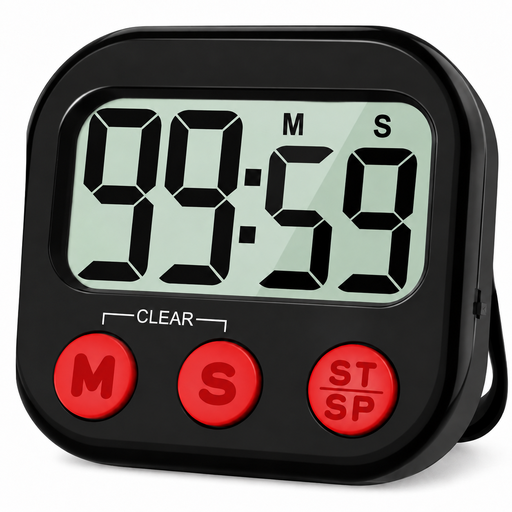 No image available
For anyone who wants to measure elapsed shot time: the product description lists count-up and count-down functions, as well as a stopwatch.
The description also mentions adjustable alarm volume, a stand, a magnet and a hanging option.
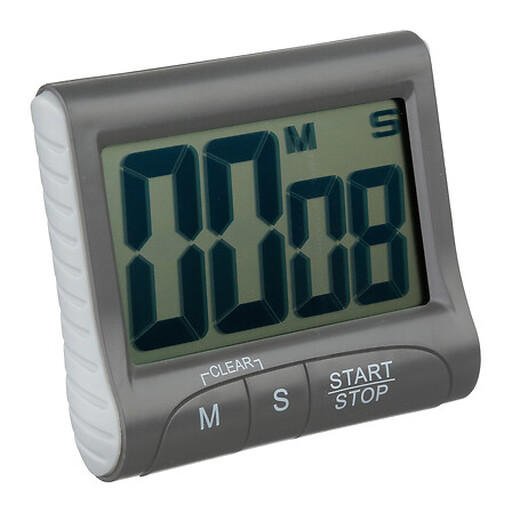 No image available
For anyone who wants to set a specific time: the product description lists a countdown and an audible signal.
A hanging option is also described.
 No image available
For anyone who wants to track time and weight on a scale while brewing: the product description lists pour-over and espresso modes, plus an automatically starting timer.
A flow-rate display is also described. This is a scale, not a standalone kitchen timer.
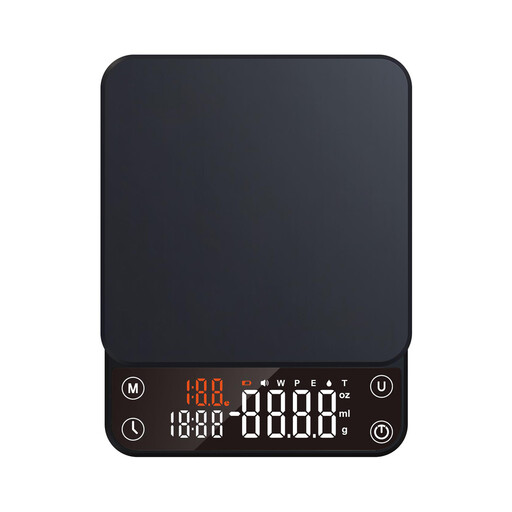 No image available
For anyone looking for a coffee scale with timer functions for espresso and pour-over: the product description lists four modes and an automatic espresso timer.
It also describes an LED display and a capacity of up to 3000 g. It needs a flat, stable surface.
 No image available
For anyone who wants to track weight and time while making pour-over coffee: the product description lists a built-in automatic timer and a flow-rate function.
The description lists 0.1 g precision, a capacity of 2000 g and a rechargeable battery. This is a scale, not a standalone kitchen timer.
If you want to compare the actual shot time, a count-up stopwatch is a natural choice. Set a consistent starting point: Barista Hustle describes espresso times as running from switching on the machine to the end of the shot, and notes that the first drop may not appear until later. A countdown can complement the stopwatch if you want a reminder when a preset time is reached.
Choose a dry, easy-to-see spot where you can reach the start and stop buttons. Check whether the built-in stand works for the location, or whether the magnet on the specific model will hold on the surface you have in mind. TFA Dostmann lists both options for model 38.2051.02.
It depends on the model. TFA Dostmann says the 38.2051.02 needs two AAA batteries, which aren’t included; according to the manufacturer, a CR2032 is included with the 38.2047.05. Don’t assume the same applies to other models, and check what’s included with the specific version.
Take the electrical item to a suitable collection or take-back point, separately from your household rubbish. If the batteries can be removed, take them out first and return them separately to a battery collection point. The Federal Environment Agency outlines local return options, while the Federal Ministry for the Environment explains how to return used device batteries free of charge.