
Lieferung heute & morgen

Qualitätsgarantie

Willkommens-Angebote freischalten: KOSTENLOSE Lieferung | Bis zu 80 % RABATT | Kostenlose 30-Tage-JoyPlus-Testphase
App herunterladen
A digital kitchen scale can give you much greater control when baking, cooking, portioning and making coffee. However, models vary considerably in their weighing range, controls, power supply and specialist features. A high number on the packaging or terms such as ‘High Precision’ alone tell you little about whether a scale will suit your everyday needs.
A kitchen scale with a capacity of up to 5 kg is handy for weighing flour, vegetables and liquids, as well as larger bowls. However, maximum capacity doesn’t automatically indicate the scale’s resolution. For a coffee or espresso scale, a display in 0.1 g increments may be more important than a particularly high capacity.
So check for these two separate specifications:
For everyday kitchen tasks, a resolution of 1 g is often enough. A finer display can be more useful for coffee, spices or small portions.
A kitchen scale with a tare function sets the weight of a container to zero, so you can weigh ingredients one after another. However, not every reset or zero button works in the same way. With some models, the container needs to be sitting steadily on the platform before you press the button.
Check that the product description explicitly mentions a tare function. When making bread or cake dough, it means less transferring between containers and makes it easier to weigh several ingredients into the same bowl.
Depending on the model, a digital coffee scale may simply display weight and time, or it may also calculate ratios and flow-rate data. So it’s worth checking exactly what terms such as water flow rate, ‘ratio’ and ‘auto timer’ mean:
These features are mainly useful for pour-over and espresso brewing. You don’t need them for weighing flour or fruit.
For home cooks and bakers, 1 g increments, a capacity of at least 5 kg and an easy-to-read display are usually a good choice. If you use international recipes, check whether you can switch between g, ml, oz and lb. The ml display is a conversion, so it won’t necessarily be equally accurate for every liquid, as different ingredients have different densities.
Coffee lovers often need a more compact platform and a finer resolution. For pour-over brewing, a timer and water flow rate feature are also useful if you want to get consistent results.
An LCD display with high-contrast digits is usually easy to read in a kitchen. LED displays can be clear on a coffee scale, but make sure they won’t be obscured by a coffee pot or tall container.
Touch controls are easy to clean, but may respond differently to wet fingers than mechanical buttons. Also look for:
Glass and stainless steel platforms are smooth and can be wiped clean with a slightly damp cloth. Electronic scales must not be immersed in water. Only place hot saucepans or frying pans on the scale if the manufacturer explicitly says it’s safe to do so.
A rechargeable kitchen scale or coffee scale with a USB-C connection means you’ll need fewer disposable batteries. Battery-powered models, on the other hand, are convenient and ready to use without needing to charge them. A kitchen scale with Bluetooth may also offer app features for units, portions or nutritional data. Before buying, check that the app is compatible with your mobile phone and that you’ll actually use the features it offers.

Why it suits this type of user: Designed for everyday weighing, this model features a stainless steel platform, a 5 kg capacity and several units of measurement.
The clearly stated 5 kg capacity, four units and tare function make it easy to compare with other models, without vague claims.
Stainless steel platform, LCD display, automatic switch-off and non-slip feet.

Why it suits this type of user: This coffee scale combines 0.1 g resolution with a timer and water flow rate feature, plus a rechargeable USB-C battery.
The specifications clearly distinguish between capacity, resolution and specialist features.
2,000 g capacity, 0.1 g resolution, LED display and up to 24 hours of stated use with auto switch-off.
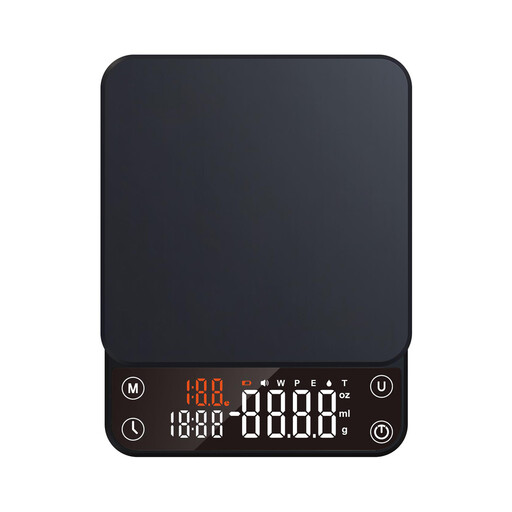
Why it suits this type of user: Espresso and pour-over enthusiasts get four brewing modes, timer functions and a rechargeable power supply.
The modes are clearly named: weighing, pour-over timer, espresso auto timer and espresso sensor timer.
3 kg capacity, 0.1 g increments below 1 kg, LED display and 800 mAh battery with USB-C connection.

Why it suits this type of user: This model is designed for people who want to record ingredients, portions and units using a Bluetooth app.
Capacity, resolution, minimum weight, units and Bluetooth connection are listed separately.
10 kg capacity, 1 g increments, five switchable units and a 3 mm glass platform.
We’ve put together a complete, regularly updated list of products that meet these strict selection criteria and fully comply with the safety regulations in force in the EU.
Place every scale on a level, dry and stable surface. An uneven surface can affect the reading. Use the tare function before each weighing if there’s a container on the platform. Never exceed the stated maximum capacity.
For the models mentioned, a soft, slightly damp cloth is all you need for cleaning. Keep liquid away from the casing, buttons and charging port. Avoid placing hot items on glass platforms or subjecting them to hard knocks. Dispose of batteries and electronic components separately, in accordance with local requirements.
For baking and cooking, a capacity of around 5 kg, 1 g resolution, an easy-to-read LCD display and a tare function are useful. Multiple units are handy if you use recipes from different countries.
A timer isn’t essential, but it makes it easier to get consistent results when making espresso and pour-over coffee. A water flow rate or ratio display is most useful if you want to keep track of your brew volume and flow rate.
A scale’s lifespan depends on how it’s used and cleaned, the batteries and how well it’s protected from overloading or moisture. Keeping it dry, handling it carefully and staying within its maximum capacity can help keep it in good working order. Check its durability and the manufacturer’s warranty separately before buying.