Bread bakers following recipes in grams
You want to use the specified amount of flour rather than an inconsistent volume measurement, and tare the bowl beforehand. King Arthur Baking explains how to weigh flour and tare the container.


For recipes that give flour quantities in grams, a digital kitchen scale with a clear display and a tare function is a sensible choice. King Arthur Baking explains how to place an empty bowl on the scale and tare it before adding flour. Make sure the bowl and ingredients together stay within the maximum capacity. With larger bowls, the platform and a clear view of the display matter too. A 1 g increment alone does not prove accuracy when weighing very small quantities.
You want to use the specified amount of flour rather than an inconsistent volume measurement, and tare the bowl beforehand. King Arthur Baking explains how to weigh flour and tare the container.
You add ingredients to a heavy or large container, so you need to consider maximum capacity, the platform and how clearly you can see the display. The manufacturers' specifications for Beurer, ZWILLING and WMF show different maximum capacities and platform features.
You want to add ingredients one after another, so convenient taring and a display that's easy to use while you work are important. King Arthur Baking explains how to tare again when adding ingredients by weight.
Start by checking the amount of flour and your recipe, then consider the total weight and how easy the scale is to use with the bowl you actually use.
| What matters | What to look for | Who it's especially important for |
|---|---|---|
| Weighing flour to match a recipe | Check that it displays grams, is easy to read and has a tare function. | When I weigh flour for a recipe in grams, I want to measure it by weight and deduct the weight of the bowl first. Around 36% of consumers say weighing the amount of flour specified in a recipe is their top priority. |
| Weighing several ingredients | Check the tare button and how the scale behaves if you pause between adding ingredients. | When I weigh several ingredients in the same bowl, I want to tare easily between steps rather than change containers. Around 29% of consumers particularly value being able to add ingredients by weight in stages. |
| Using a heavy bowl | Compare the maximum capacity with the combined weight of the bowl and ingredients, and check the platform and visibility of the display. | With a large mixing bowl, I want to be able to read the display despite the container and keep the total weight within the maximum capacity. Around 21% of consumers pay particular attention to heavy containers and larger quantities. |
| Cleaning and power supply | Check the care instructions, power supply and what's included with the specific model. | When I use the scale regularly, I want to know how to remove flour dust and whether I need to replace batteries or charge a battery. Around 14% of consumers pay particular attention to care and power supply. |
The bowl and ingredients are on the scale at the same time. The model-specific maximum capacity applies to their combined weight.
Compare the maximum capacity with the heaviest total weight you expect to weigh, and check whether the bowl obscures the display.
The displayed increment tells you how the reading changes, not necessarily how far the measurement may deviate. Very small recipe quantities may call for a different level of precision.
Distinguish the manufacturer's stated increments from independent accuracy tests, and consider the quantities your recipe calls for.
Care instructions vary by model. Joybuy's description of the ZWILLING Enfinigy warns against immersing the scale in water.
Follow the care instructions for the model you choose rather than assuming the surface material makes it waterproof.
The KS 34 Stainless Steel may be worth considering if you need a high maximum capacity for the container and ingredients.
The black Enfinigy 53011-053-0 combines a larger weighing surface with rechargeable power.
The digital kitchen scale 3201000339 is an option if the combined weight of your bowl and ingredients stays within 5 kg.
The EKS-L221 is an option if you're considering a rechargeable kitchen scale.
This selection at Joybuy includes digital kitchen scales for weighing flour to recipes in grams, as well as models with a tare function for adding several ingredients to one bowl.
 No image available
For recipes in grams and adding ingredients by weight in stages, the product title lists 1 g increments and a tare function.
Maximum capacity: 5 kg. LCD display; stainless steel body.
 No image available
For weighing ingredients in a bowl, the product title lists 1 g increments and a tare function.
Maximum capacity: 5 kg. LCD display; automatic switch-off.
 No image available
For weighing several ingredients in one bowl, the product title lists a tare function and 1 g increments.
Maximum capacity: 10 kg. Dimensions: 21 × 15,5 × 2,9 cm. Made from stainless steel and plastic.
 No image available
The product title specifies a removable bowl for weighing ingredients.
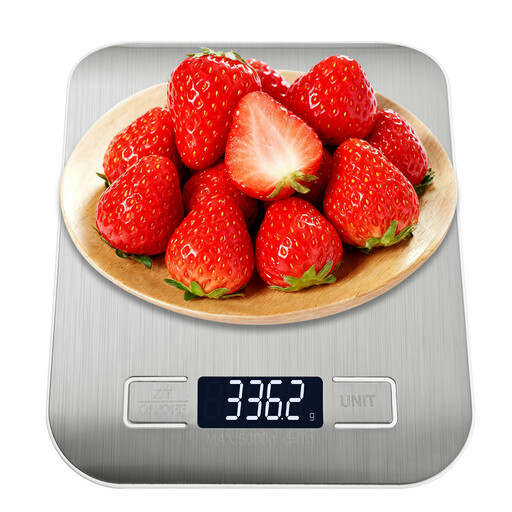 No image available
For recipes in grams, the product title lists 1 g increments and switchable units of measurement.
Maximum capacity: 5 kg. Stainless steel surface; colour: white.
Place the scale on a level surface, put the empty bowl on it and tare the scale to 0 g. Then add flour until you reach the amount in grams specified by your recipe. You can tare the scale again before adding more ingredients.
Not necessarily. If your recipe calls for much smaller quantities, consider using a supplementary precision scale or another measuring method suited to the recipe. Display increments alone do not prove actual measuring accuracy.
Follow the instructions for the specific model. Joybuy's description of the ZWILLING Enfinigy recommends using a damp cloth and warns against immersing the scale in water; this is not general care advice for all models.
Statutory rights for faulty goods are separate from a voluntary guarantee. The Verbraucherzentrale explains that statutory rights are governed by law, while a guarantee is subject to the terms set by the individual provider.
In Germany, electrical equipment must not be put in household rubbish. The Umweltbundesamt lists recycling centres and suitable retailer take-back points; removable batteries should be handed in separately.