
Lieferung heute & morgen

Qualitätsgarantie

Willkommens-Angebote freischalten: KOSTENLOSE Lieferung | Bis zu 80 % RABATT | Kostenlose 30-Tage-JoyPlus-Testphase
App herunterladen
A digital kitchen scale is part of the basic equipment in many households. When baking, cooking, portioning or preparing coffee, however, the price alone does not determine how practical a scale is for everyday use. Unclear information about weighing accuracy, delicate surfaces or unnecessary extra features can often lead to disappointing purchases.
The Joybuy Product Recommendation Officer selection is therefore based on clear, easy-to-understand product data: weighing range, increments, tare function, display, power supply, cleaning and intended use.
A 5-kg kitchen scale is useful for bowls, dough and larger quantities of ingredients. However, the maximum capacity says little about how accurately small quantities can be measured. For spices, yeast or coffee beans, specifications such as 1-g or 0.1-g increments are more relevant.
A scale with 0.1-g increments can be particularly useful for coffee. Before buying, check whether this resolution applies across the entire weighing range. With some models, the increments change once a certain weight is reached.
Many kitchen scales have a smooth stainless steel, glass or plastic surface that is easy to wipe clean. This does not automatically mean that the appliance can be submerged in water or cleaned under running water. Doing so may damage the electronic components.
Pay close attention to the care instructions. Product details usually distinguish between wiping with a damp cloth, a splash-resistant surface and do not immerse.
A kitchen scale with an app or a scale with nutritional analysis can help you track calories and nutrients. However, these features require a smartphone, a Bluetooth connection and a compatible app. Databases may also represent products, brands or serving sizes differently.
If you simply want to weigh flour, sugar or vegetables, these features are not essential. A straightforward scale with an easy-to-read display and tare button may be more useful in everyday life.
For typical kitchen tasks, a weighing range of up to 5,000 g with 1-g increments is often sufficient. This covers the classic use of a scale for baking and cooking. For pour-over coffee or espresso, smaller increments and a fast, stable display are more important.
A precision coffee scale should also have a sufficiently low minimum load and a stable weighing platform. With tall containers, the display may be obscured, so a slim design or a display that remains easy to read offers advantages.
A kitchen scale with a tare function resets the weight of a container to zero. This allows you to weigh several ingredients one after another in the same bowl. Check that the tare button is easy to reach and that the scale reliably returns to zero when switched on.
Depending on the recipe, g, ml, oz or lb:oz can be useful. However, an ml display is not a universal volume measurement: different densities may be taken into account for milk and water, but for oil, flour or syrup, weight is generally more reliable.
An LCD display should remain visible even when using larger bowls. Touch buttons are easy to clean, but may respond less reliably with wet fingers or when splashed. Physical buttons, on the other hand, provide a more direct feel when operating the scale.
For regular use, batteries or an integrated rechargeable battery are important considerations. A USB-C rechargeable battery reduces the need for disposable batteries, but must be charged regularly. Battery-powered models can be used independently of power sockets. The surface should only be cleaned in accordance with the manufacturer's instructions.

Why this product suits this profile: With a weighing range of up to 5 kg, four units and an LCD display, this model is well suited to everyday cooking and baking.
The specifications clearly state the maximum capacity and explain that the scale should be used on a dry, level surface, with the stainless steel surface wiped clean.
5 kg capacity, stainless steel platform, LCD display and non-slip feet.

Why this product suits this profile: As a digital coffee scale, this model combines 0.1-g resolution, a timer and a water-flow display for pour-over brewing.
The technical specifications state the weighing range, resolution, charging method and recommended cleaning method, including that the scale must not be immersed.
Up to 2,000 g, 0.1-g precision, USB-C rechargeable battery and silicone weighing mat.
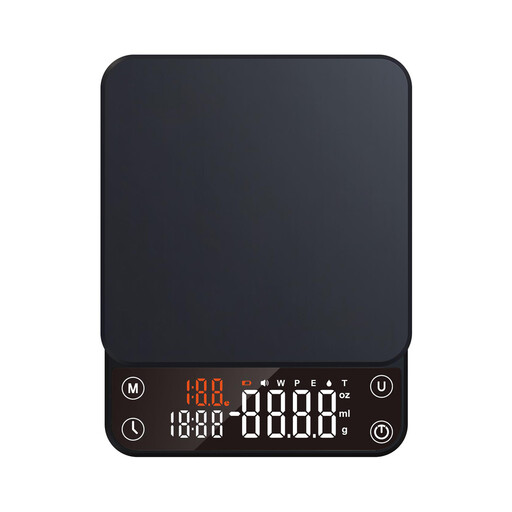
Why this product suits this profile: This espresso scale offers separate modes for weighing, a pour-over timer and an espresso timer.
The features are broken down into four specific brewing modes rather than being marketed simply as “smart”.
Up to 3,000 g, 0.1-g increments below 1,000 g, LED display and integrated 800-mAh rechargeable battery.
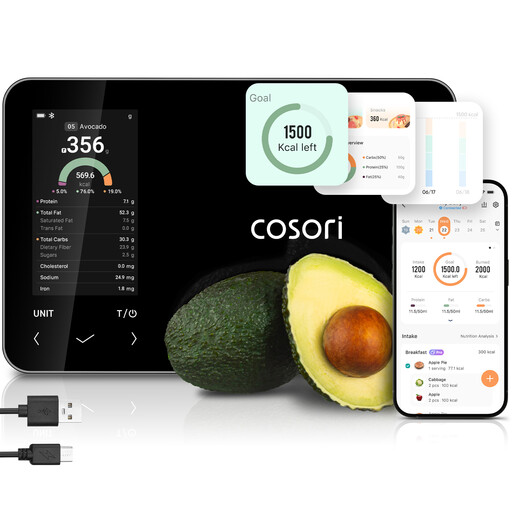
Why this product suits this profile: This scale is designed for portion tracking and nutrition monitoring via a compatible app.
The requirements for use are clearly stated: a Bluetooth connection, a compatible app and a stable, dry surface.
3 to 5,000 g in 1-g increments, 19 listed nutritional values, USB-C charging and several input options.
We have put together a complete, regularly updated list of products that fully meet these strict selection criteria and the safety regulations applicable in the EU.
For everyday cooking and baking, 1-g increments are sufficient in many cases. If you prepare espresso or pour-over coffee, you may benefit from a digital coffee scale with 0.1-g increments. The key consideration is the weighing range for which this resolution applies.
Its lifespan depends on the build quality, power supply and care. Using the scale on a level, dry surface, observing the maximum capacity and cleaning it with a soft cloth can help maintain its everyday performance. Electronic scales should not be dropped or immersed in water.
Battery-powered models generally only use energy while weighing and often switch off automatically. Rechargeable models are charged via USB-C and avoid the need for regular battery replacement. The actual amount of power used depends on how often the scale is used, the battery capacity and the automatic switch-off function.