
Lieferung heute & morgen

Qualitätsgarantie

Willkommens-Angebote freischalten: KOSTENLOSE Lieferung | Bis zu 80 % RABATT | Kostenlose 30-Tage-JoyPlus-Testphase
App herunterladen
A precise digital kitchen scale is an indispensable tool in any modern kitchen. Whether you're accurately measuring baking ingredients, controlling portion sizes for a diet, or dosing coffee beans with precision, the requirements for a scale can vary widely. However, with a multitude of models featuring different functions, capacities, and designs, making a choice can quickly become overwhelming.
This article serves as your guide. We'll introduce different types of digital kitchen scales and explain the key criteria to help you choose the perfect model for your specific needs.
To make the right choice, it's helpful to understand your own needs and the technical features of the scales.
Precision is a crucial criterion. For most baking and cooking applications, like measuring flour or sugar, a baking scale with an accuracy of 1 gram is sufficient.
However, more specialised tasks require higher accuracy. A precision kitchen scale with increments of 0.1 g or even 0.01 g is ideal for weighing spices, yeast, coffee grounds, or for preparing baby food.
At the same time, consider the maximum weight capacity. Standard models typically weigh up to 5 kg, which is usually enough for everyday use. However, if you process larger quantities, such as when making jam or baking large loaves of bread, you should consider a 10 kg kitchen scale.
The material of the weighing surface affects both durability and hygiene. A stainless steel kitchen scale is robust, easy to clean, and blends well visually with many kitchen designs. Tempered glass surfaces are also easy to maintain, while plastic models are often lighter and more affordable.
Some models come as a kitchen scale with a bowl. This is particularly convenient as the bowl is perfectly matched to the scale, making it easier to weigh loose ingredients like flour or liquids. A detachable bowl, ideally made of stainless steel and dishwasher-safe, adds to the convenience.
The tare function (add-and-weigh feature) is a standard on modern digital scales. It allows you to zero out the weight of a container, so only the ingredient's weight is measured. This also lets you weigh multiple ingredients consecutively in the same bowl, saving time and washing up.
For tech-savvy and health-conscious users, the smart kitchen scale is gaining prominence. A kitchen scale with app connectivity via Bluetooth transmits weight data directly to a smartphone. The companion app analyses the nutritional values of the weighed foods, calculates calories, and helps track daily food intake.
Based on the criteria mentioned, we have compiled a selection of models that cover different areas of application.
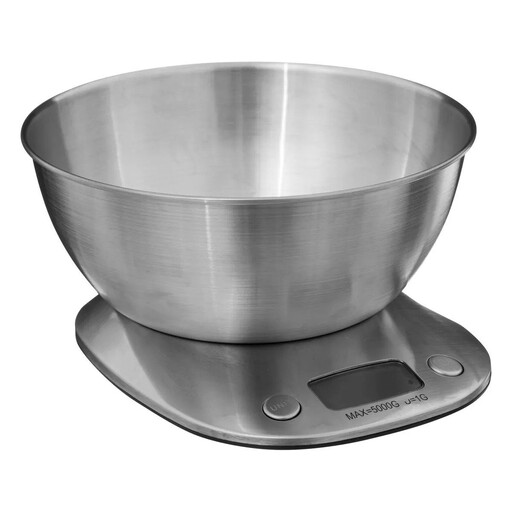
5five Digital Kitchen Scale with Stainless Steel Bowl - Silver, 21 x 21.3 cm
Why it stands out: This model combines functionality with a classic design. The included stainless steel bowl makes it a practical everyday helper that's ready to use right out of the box.
Pros:
Who it's for: Home cooks and bakers looking for a reliable, straightforward scale for daily use who appreciate the convenience of an included bowl.
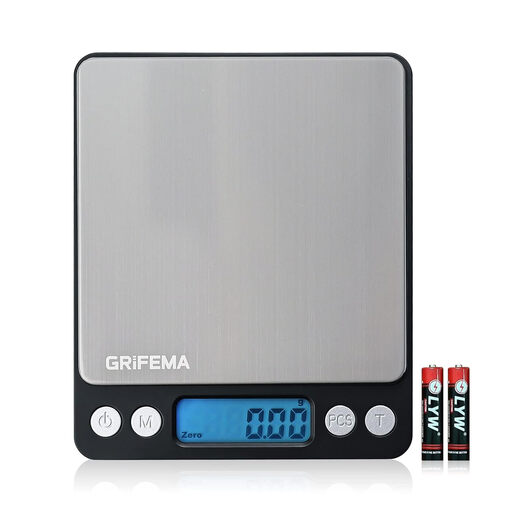
Why it stands out: This scale specialises in maximum precision. Its compact size and fine 0.01 g increments make it a tool for specific requirements.
Pros:
Who it's for: Coffee enthusiasts for precisely weighing beans, individuals on special diets requiring micro-quantities, or for hobbies where every milligram counts.

Why it stands out: This smart kitchen scale combines a high weight capacity with modern technology for nutritional analysis.
Pros:
Who it's for: Health-conscious users who want to precisely monitor and document their nutrition, as well as for families or ambitious cooks who regularly prepare large portions.
The products featured here already cover a wide spectrum. If you still haven't found the right fit for your specific needs, you might find a suitable alternative in our comprehensive selection of scales and measuring tools.
Discover more models in our Restaurant Kitchen Tools category.
The tare function, also known as the add-and-weigh feature, allows you to reset the scale to zero after placing a container on it. This ensures that only the net weight of the ingredient is measured. This function is also useful for weighing multiple ingredients consecutively in the same bowl without having to empty it in between.
The required accuracy depends on its intended use. For general cooking and baking recipes, an increment of 1 gram is usually sufficient. For tasks that demand higher precision, such as weighing spices, yeast, or preparing coffee, a precision scale with an accuracy of 0.1 g or 0.01 g is recommended.
Yes, most digital kitchen scales offer a function for measuring liquids. You can often switch between units of grams (g) and millilitres (ml). Since the density of liquids like oil or milk differs slightly from that of water, the ml measurement is a useful approximation that is accurate enough for most recipes. Alternatively, you can also weigh liquids in grams, which is the most precise method.