
Lieferung heute & morgen

Qualitätsgarantie

Willkommens-Angebote freischalten: KOSTENLOSE Lieferung | Bis zu 80 % RABATT | Kostenlose 30-Tage-JoyPlus-Testphase
App herunterladen
A digital kitchen scale can provide valuable support when baking, cooking, portioning or preparing coffee. However, not every product specification automatically leads to the right purchase. Terms such as “precise”, “smart” or “multifunctional” often describe only part of the actual user experience.
If you are looking for an electronic kitchen scale, you should therefore first clarify how you intend to use it, then compare the technical specifications, operation and cleaning requirements.
A 5 kg kitchen scale with 1-g increments is suitable for flour, sugar, vegetables and everyday portions. However, this does not mean it can reliably measure small quantities under one gram. A finer resolution is useful for spices, yeast or coffee.
When choosing a precision scale, you should therefore pay attention to three specifications:
A scale with a 10 kg capacity and 1-g increments is practical for larger bowls, but is not automatically suitable for very small quantities.
Bluetooth kitchen scales and nutritional scales can transfer measurements to an app. Before buying, check whether the app is actually compatible with your smartphone, which database is included and whether certain functions require registration.
Nutritional information from an app also depends on the foods, branded products and portion definitions stored in it. The scale measures weight; any calorie or nutritional values calculated from this are digital associations, not a medical assessment.
A glass surface is generally smooth and can be cleaned with a soft, slightly damp cloth. However, it must not be submerged and should be protected from hot pans. Stainless steel is also easy to care for, although fingerprints may show depending on the finish.
Make sure you use a dry, level and stable surface. Water, harsh cleaning products, impacts and overloading beyond the stated capacity can affect the scale’s use.
For a kitchen scale used for baking and cooking, a maximum weight of 5 kg and 1-g increments are sufficient for many households. If you weigh large bowls or several ingredients one after another, you should also consider the platform size and maximum load.
For coffee or very small ingredients, models offering 0.1-g increments in the lower weighing range are more appealing. The key question is whether this fine resolution applies only up to a specific load.
A kitchen scale with a tare function resets the display to zero while the bowl remains on the platform. This allows you to weigh several ingredients one after another without having to transfer each ingredient to a separate container.
Switchable units are also useful, including:
On many models, the millilitre display is based on stored density assumptions. For oil, syrup and other liquids, the gram measurement is therefore often the more transparent option.
An easy-to-read LCD display is just as important in a bright kitchen as it is beneath a large mixing bowl. Touch buttons make cleaning easier, while mechanical buttons may offer more direct operation with frequent use.
The power supply also affects everyday use:
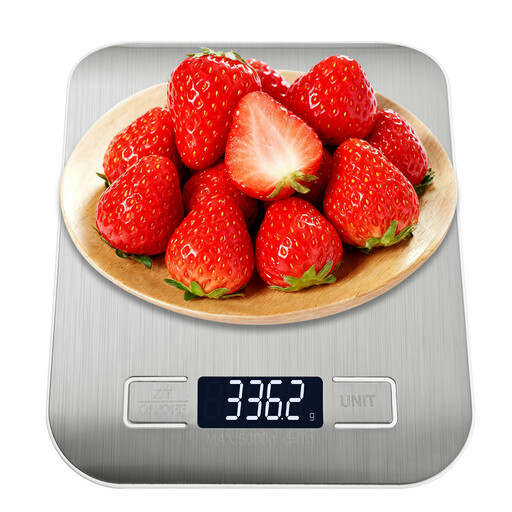
Why this product suits the profile: This compact food scale is designed for everyday cooking, baking and portioning, and requires no installation.
The specifications clearly state a 5 kg capacity, 1-g increments, several units, as well as tare, overload and low-voltage indicators.
Stainless-steel surface, LCD display and automatic shut-off; two AAA batteries are required and not included.
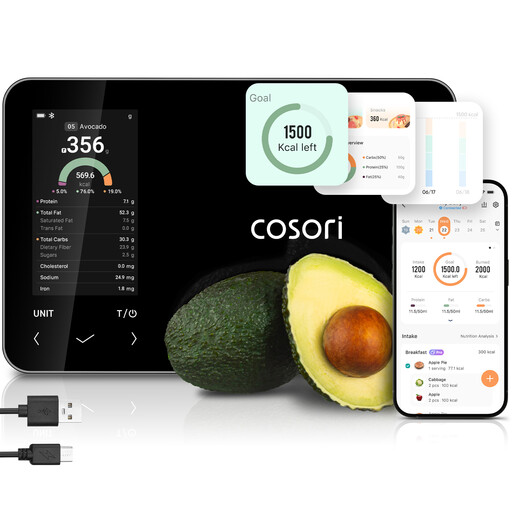
Why this product suits the profile: For people who want to manage food information digitally as well as track weight.
The product data explicitly states a weighing range of 3 to 5,000 g in 1-g increments, along with the supported units.
VeSync app, Bluetooth connectivity, a database with over 1 million foods according to the manufacturer, and USB-C charging with an 800-mAh battery.

Why this product suits the profile: This coffee scale with timer is designed for people who want to monitor weight and time together when making pour-over coffee or espresso.
The timer and flow-rate functions are clearly specified; grams, kilograms and ounces are also listed as switchable units.
A combination of electronic weight display, timer and water flow rate; suitable for coffee and general kitchen tasks.
If you bake particularly often, a kitchen machine with an integrated scale may also be worth considering. According to the product description, the Kenwood Titanium Chef Baker XL features an integrated EasyWeigh scale, a 7-litre mixing bowl and a 1,200-watt motor. It does not replace a compact standalone scale for every situation, but it can make it easier to weigh ingredients directly into the mixing bowl during certain workflows.
We have put together a complete, regularly updated list of products that fully meet these strict selection criteria and the safety regulations applicable in the EU.
For typical ingredient quantities, 1-g increments are generally sufficient. If you weigh coffee, spices or very small portions, you should choose a model with 0.1-g resolution in the lower weighing range. The manufacturer’s stated minimum load remains crucial.
Its lifespan depends on factors including the batteries, sensors, cleaning and load. Place the scale on a level surface, do not exceed its maximum capacity and avoid allowing moisture into the housing. Automatic shut-off reduces battery consumption, but it does not replace careful handling.
Compact models with AAA batteries use comparatively little energy during normal operation and often switch off automatically. Rechargeable USB-C models avoid regular battery replacement, but they do need to be charged. For running costs, it is therefore important to consider not only the purchase price, but also the power supply and how frequently the scale is used.